Mansfield Water vs. Your Anode Rod
Mansfield splits into two heater eras. Downtown and the older streets near the commuter rail run Victorians and early colonials with tanks that have been in service for decades — many on their original anode rod, which is to say, on no rod at all anymore. The postwar subdivisions run mid-life tanks now entering the classic rod-depletion window on the town's treated water supply. Chlorinated municipal water is steady and predictable in what it does to magnesium: about five years, then the rod is a wire, then the tank starts rusting from the inside. In Mansfield's older homes we pull rods that disintegrate in our hands — and then we have an honest conversation, because a fresh rod in a tank that's already rusting through buys months, not years. Where the tank is sound, though, a new rod is transformative: it halts internal corrosion cold and routinely adds five-plus years of service. We inspect first and recommend second.
The Warning Signs Most Homeowners Miss
Here's the honest diagnostic we run on every 02048 service call: we read the tank's serial number for its age, check the water type feeding it, and pull the anode rod for direct inspection. A healthy rod looks like a solid metal core, maybe pitted. A dying one is thin, deeply pitted, or coated in calcium. A dead one is a bare steel wire with the sacrificial metal completely gone — and in Mansfield, on Mansfield's town water, we find dead ones in tanks as young as four years when well water is aggressive. The inspection also tells us about the tank: heavy rust staining around the rod port or the top fittings suggests the corrosion has spread beyond what a new rod can reverse. That's the fork in the road — a sound tank gets a fresh rod and five more years; a tank that's already rusting through gets an honest recommendation instead of a part it can't use. Either way, you get the truth, not a sales pitch.
Rusty or metallic-tasting hot water in Mansfield's older homes is the classic dead-rod signal. Also: sulfur smell at the hot tap, tanks past year six (or year fifteen downtown) with no service record, and visible rust flaking around the tank's top fittings.
From Inspection to Hot Water: The Process
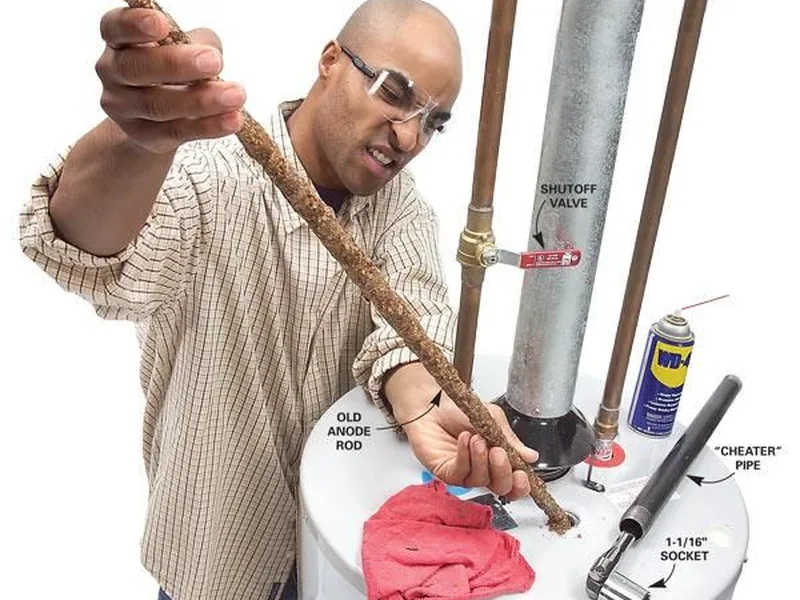
A professional anode rod replacement in a Mansfield home follows a careful sequence, and skipping steps is how DIY attempts go wrong. First we shut off the cold-water inlet and kill power at the breaker — or turn a gas control to pilot — because you never open a live, pressurized tank. Then we relieve pressure through a hot tap and drain a few gallons so the water level drops below the rod port. The old rod unthreads from its hex head at the tank top; on older 02048 tanks this fitting is often seized, which is where an impact wrench and experience matter — brute force in the wrong direction can twist the tank itself. We extract the rod fully, inspect it with you, and thread in the new one with proper sealant. Then the tank refills, air purges from the lines, power or gas comes back on, and we verify clear, odor-free hot water at the tap. Start to finish, most Mansfield jobs run sixty to ninety minutes.
Downtown Mansfield tanks often live in tight old basements with limited headroom — we carry segmented flex rods for those, plus standard rods for the subdivision utility rooms. Water and power off, pressure relieved, old rod extracted and shown to you, correct replacement installed, system refilled and leak-checked.
Which Rod Your Tank Actually Wants
The decision framework we use on 02048 service calls is straightforward. Start with the water: municipal supply without odor gets magnesium or aluminum/zinc on a five-year check rhythm. Well water with sulfur smell gets aluminum/zinc or powered — never magnesium, which feeds the odor. Aggressive low-pH well water that has eaten rods in under three years gets powered, full stop. Then consider the tank: a young tank deserves the rod that maximizes its full lifespan; a ten-year-old tank gets the rod that protects its remaining years most economically. And consider access: low-clearance installs in downtown Victorians and postwar subdivisions may dictate segmented flex rods regardless of alloy. We walk every Mansfield homeowner through this in plain language, with the old rod in hand as evidence — because the right rod is the one matched to your water, your tank, and your house.
Magnesium rods are the factory default in most tanks, and on kind water they're perfectly fine — magnesium is the most electrochemically active common anode material, which means it protects aggressively. The tradeoff is lifespan: on Mansfield's town water, a magnesium rod typically gives four to six years, and on aggressive well supplies sometimes half that. The other magnesium quirk matters in Mansfield's well-water neighborhoods: as magnesium degrades, sulfur-reducing bacteria feed on it, producing the rotten-egg hot-water smell. So magnesium is the right call for municipal-water tanks without odor issues — strong protection, standard lifespan, lowest part cost — and the wrong call where well water brings sulfur bacteria or very low pH. We stock magnesium for the tanks it suits and steer the rest toward better options.
The Maintenance Rhythm That Actually Works
The anode rod doesn't work alone — it's half of a two-part protection system, and the other half is flushing. Mansfield's town water lays down sediment in every tank: mineral particulate that settles to the bottom, buries the lower heating element or insulates the burner, and creates the popping and rumbling Mansfield homeowners hear from neglected units. Sediment also matters for the rod's world: a tank choked with sediment runs hotter at the bottom, accelerating the corrosion chemistry the rod is fighting. That's why our 02048 rod visits include a drain-valve check and usually a flush — the fresh rod protects the steel while the flush removes the sediment working against it. Going forward, annual flushing plus the rod-check rhythm above is the complete maintenance program, and it's the difference between tanks that die at ten years and tanks that serve at twenty.
The replacement is only half the job — the other half is the inspection rhythm that keeps the tank protected from here on. On Mansfield's town water, the honest intervals are: municipal water, check every four to five years; mixed or moderately aggressive well water, every three; the truly aggressive well supplies around 02048, every two. 'Check' means pulling the rod and looking, not guessing from the calendar — water chemistry varies street by street, and the rod's actual condition is the only reliable gauge. In downtown Victorians and postwar subdivisions, we leave every homeowner with the tank's birthdate from the serial number and a recommended next-check date written down, because the number-one reason rods die unnoticed is that nobody writes anything down. A two-minute inspection every few years is what stands between a twenty-year tank and a ten-year tank.
One Call, Protected Tank
Calling (833) 713-2101 takes about two minutes, and here's exactly what happens. First, we ask four quick questions: gas or electric, how old the tank is (the serial number works if you're not sure), whether the hot water smells or runs rusty, and whether you're on town water or a well. Second, we schedule the visit — most Mansfield rod replacements happen within a day or two, and the job itself runs sixty to ninety minutes. Third, the tech arrives with standard, segmented flex, and powered rods on the truck, inspects your old rod with you, installs the right replacement, flushes the tank, and verifies clear hot water at the tap before leaving. No guesswork, no upsell theater — just the protection your tank should have had all along. Call (833) 713-2101 or ask for us by name: Water Heater Leak Repair Crew.