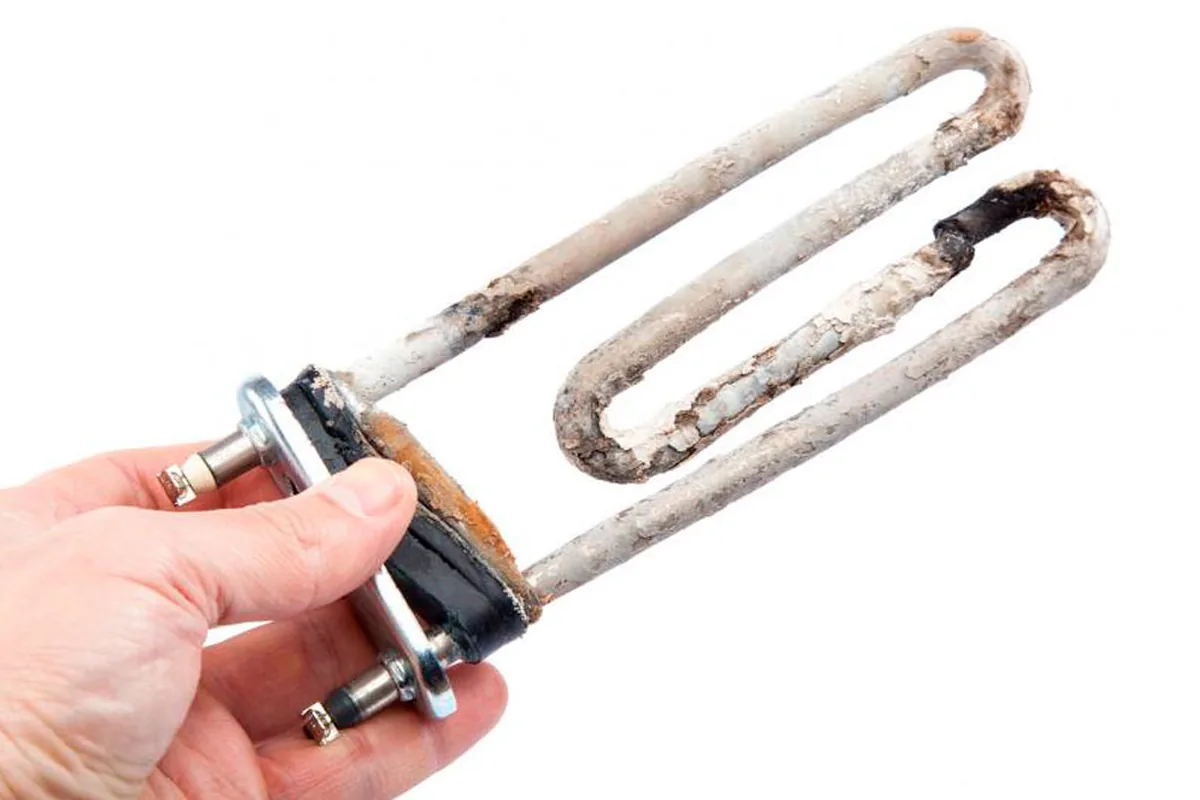
How Electric Elements Fail
A heating element is a resistive coil sealed in a metal sheath, threaded into the side of the tank — one near the top, one near the bottom. Electricity flows through the coil, the coil gets hot, and the sheath transfers that heat to the surrounding water. Two things kill elements: scale and exposure. When sediment buries the lower element, the sheath cannot shed heat into the water efficiently; it overheats, the internal coil breaks down, and the element burns out. When a tank is drained and power is restored before it is completely refilled — the classic dry-fire — an element exposed to air instead of water destroys itself in seconds.
Elements also simply age. Years of thermal cycling stress the sheath and the internal insulation, and eventually the coil opens or shorts to ground. A shorted element trips the breaker or the high-limit reset; an open element just quietly stops heating, leaving the other element to carry the whole load badly.
Attleboro's soft water is a mixed blessing here. Low mineral content means less scale caking on elements than in hard-water regions — but sediment still accumulates from pipe debris, rust particles, and dissolving anode rods, and it still buries lower elements over time. And soft water does nothing to prevent dry-fire damage, which remains the fastest way to kill a brand-new element. The failure pattern here leans more toward sediment burial and age than toward scale, but the result is the same: cold showers and a heater that needs attention.
Reading the Symptoms: Which Element Failed
Your heater's behavior tells a trained technician a great deal before a meter ever comes out. No hot water at all — the tap runs cold from the start — usually means the upper element or upper thermostat has failed, because the upper element heats the water that exits the tank first. Plenty of hot water that runs out unusually fast points to the lower element: the top of the tank heats, but the bottom never catches up, so the reserve is small. Lukewarm water that never gets truly hot can mean either element is weak, or a thermostat is misbehaving.
A tripped breaker or a tripped high-limit reset button (the red button behind the upper access panel) suggests an element shorting to ground — electricity finding a path through the water to the tank shell. That is worth taking seriously: it means the element's sheath has breached, and the heater should not simply be reset and ignored.
We verify all of this with testing. Each element gets an ohmmeter check — a good element shows the resistance its wattage rating predicts; a failed one shows infinite resistance (open) or continuity to ground (shorted). Each thermostat gets tested too, because a failed thermostat mimics a failed element perfectly, and replacing the wrong part helps nobody. Diagnosis first, parts second — always.
Why Matching the Element Exactly Matters
Not all heating elements are interchangeable, and this is where do-it-yourself element swaps most often go wrong. Three specifications must match: voltage, wattage, and physical fit. A 240-volt heater needs 240-volt elements; installing a lower-voltage element in a 240-volt circuit will burn it out almost immediately, sometimes dramatically. Wattage must match the original design — typically 4500 watts in modern residential units — because the wiring, breaker, and thermostats are sized for that load. An oversized element draws more current than the circuit was built for.
Physical fit matters too. Elements come in screw-in and flange (bolt-on) styles, in different lengths, and in standard versus low-watt-density designs. Low-watt-density elements spread the same wattage over more surface area, running cooler and lasting longer — a genuine upgrade for heaters prone to sediment burial, and one we often recommend for the lower position.
When we arrive, we read your heater's rating plate and bring elements matched to its exact specifications. The fifteen minutes spent verifying the rating plate is what separates a repair that lasts years from one that fails in weeks. If you are comparing our service to a quick swap, this is the difference you are paying for: the right part, verified, not the closest part on the truck.
Our Element Replacement Procedure
We start with the power off — breaker switched off and verified dead with a meter, because 240 volts deserves no assumptions. Then we shut the cold-water inlet and drain the tank below the element being replaced. Access panels come off, insulation is folded back, and the wiring is disconnected and labeled so it goes back exactly as it came off.
The old element unscrews with a dedicated element wrench. We inspect the tank tapping for corrosion and sediment packing — a heavily sedimented tank gets our recommendation for a flush while we are in there, since fresh sediment will simply bury the new element the same way. The new element goes in with a fresh gasket, torqued to seal without cracking the tank fitting, and the wiring is reconnected to the correct terminals.
Here is the step that matters most: the tank is refilled completely and air is purged through a hot tap until water runs solid before the breaker is ever touched. Dry-firing a new element — powering it while exposed to air — destroys it in seconds, and it is the single most common cause of 'the new element failed immediately' stories. We verify full tank, verify no leaks at the element gasket, restore power, and confirm both elements cycle correctly under thermostat control. Then we test your hot water at the tap.
Thermostats: The Other Half of the Electric System
Every element has a partner thermostat, and the two fail in overlapping ways. The upper thermostat contains the high-limit safety switch — the red reset button — which trips when water temperature exceeds safe limits, cutting power to both elements. A tripped high-limit that keeps tripping after reset usually means a thermostat is stuck closed, letting its element heat unchecked, or an element has shorted.
Because a failed thermostat produces exactly the same cold-water symptoms as a failed element, we test both during every element call. Replacing an element when the thermostat was the problem leaves you with the same cold shower and a second service call; replacing both when only one failed wastes your money. Metered diagnosis takes minutes and gets it right the first time.
We also check calibration while we are in there. Thermostats drift with age, and a thermostat reading twenty degrees off means lukewarm water no matter how healthy the elements are. We set both thermostats to 120 degrees — the recommended balance of comfort, safety, and efficiency — unless your household has a specific reason for a different setting.
Extending the Life of Your Electric Heater
An element replacement is also an opportunity to address why the element failed. If sediment burial was the cause, a flush during the same visit removes the debris that killed the old element and protects the new one. If the anode rod has never been checked, we can inspect it — a depleted rod lets the tank corrode, and corrosion particles become the sediment that buries elements. These services compound: each one makes the others last longer.
For Attleboro's many older homes with electric heaters in basements, we also look at the installation environment. Damp basements corrode electrical connections at the element terminals; we clean and secure those connections during the repair. And we confirm the breaker and wiring are correctly sized for the heater — in houses with decades of electrical modifications, mismatches happen more often than you would think.
Call (833) 713-2101 when your electric water heater stops delivering hot water. We will meter-test the elements and thermostats, replace exactly what failed with correctly matched parts, and leave you with a heater that runs like it should — usually all in a single visit.