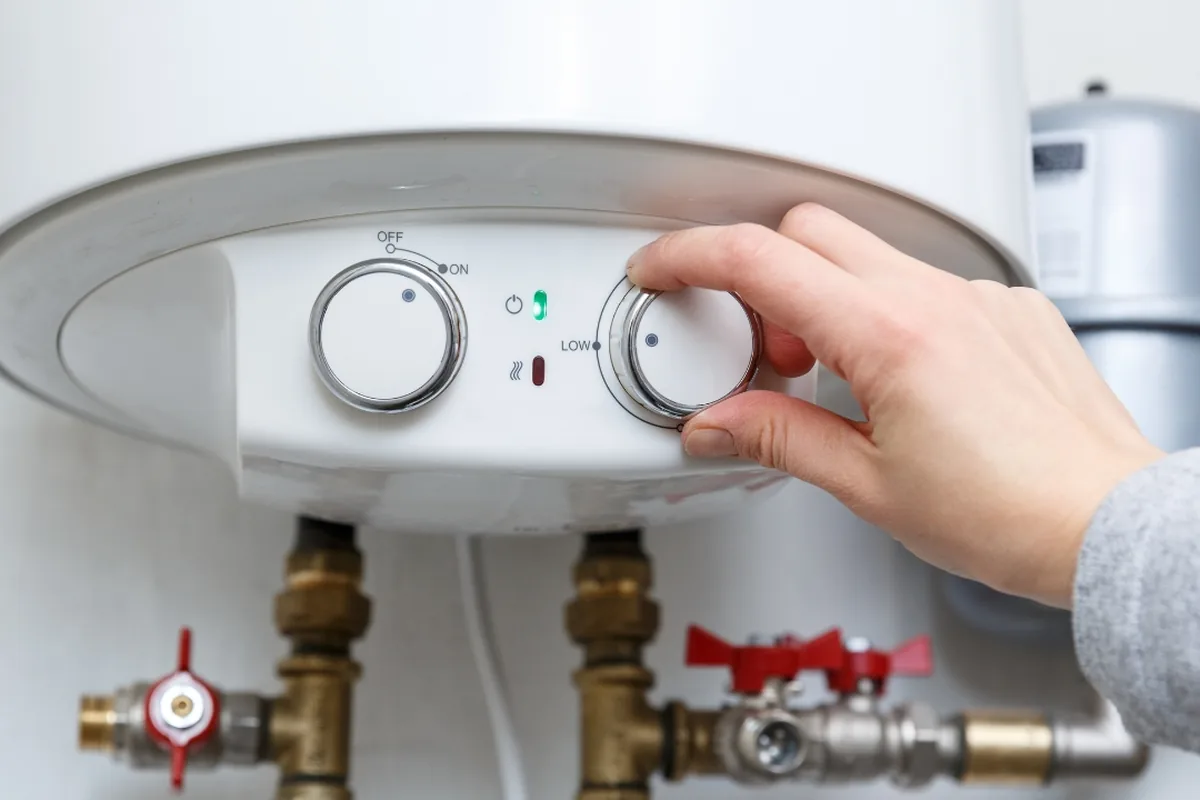
What Thermostats Do in Electric and Gas Heaters
An electric water heater has two thermostats, and understanding their division of labor explains most temperature complaints. The upper thermostat is the boss: it contains the high-limit safety switch and controls the upper element, which heats the water at the top of the tank — the water that reaches your tap first. Once the upper zone reaches temperature, the upper thermostat hands off to the lower thermostat, which runs the lower element to heat the bulk of the tank. They never run simultaneously; the upper always takes priority.
A gas heater consolidates this logic into the gas control valve, where a temperature probe in the tank feeds a mechanical thermostat that opens and closes the gas supply to the burner. Same job, different hardware — and when it fails, the whole heater's temperature regulation goes with it.
Thermostats fail in two directions. Stuck open means the element or burner never fires: cold or lukewarm water no matter the setting. Stuck closed means it never stops firing: water that keeps climbing past the set point toward scalding. The second failure is the dangerous one, which is why the high-limit safety switch exists as a backup — and why a tripped high-limit that keeps tripping is a signal to stop resetting it and call for service.
Symptoms That Point to a Thermostat
Water that is consistently too hot — uncomfortably, skin-reddening hot — with the dial set at a normal temperature is the hallmark of a thermostat stuck closed. This is not a setting issue; if the dial says 120 and the water scalds, the thermostat is not regulating. Treat it as urgent, particularly in homes with children or older adults, and call (833) 713-2101 promptly.
Lukewarm water that never reaches a satisfying temperature, despite the elements testing good, suggests a thermostat stuck open or badly out of calibration — it is satisfied at a temperature far below the dial setting. Wild temperature swings between uses can indicate a thermostat with intermittent contacts, firing and cutting out unpredictably.
The red high-limit reset button behind the upper access panel tells its own story. If you have reset it once and it trips again, something is overheating the tank — usually a stuck-closed thermostat or a shorted element. Repeatedly resetting a tripping high-limit is like repeatedly resetting a breaker without finding the short: it masks a problem that needs diagnosis. One reset to get through the day is understandable; a pattern of trips is a service call.
Why We Test Everything Before Replacing Anything
Here is the uncomfortable truth about thermostat diagnosis: the symptoms overlap almost perfectly with element failures, and even experienced technicians cannot separate them by symptoms alone. Cold water can mean a failed upper element or a failed upper thermostat. Fast-depleting hot water can mean a failed lower element or a failed lower thermostat. Replacing parts on symptoms is gambling with your money.
Our procedure is metered and methodical. Each element gets a resistance test — open or shorted to ground means the element failed. Each thermostat gets continuity testing across its contacts and a calibration check against actual water temperature. Only the failed component gets replaced, and when we replace a thermostat we verify the elements it controls are healthy so the new part is not inheriting a hidden problem.
This discipline also catches the compound failures that symptom-guessing misses: a shorted lower element that has been tripping the high-limit, or a thermostat whose calibration drifted while its element aged. The few extra minutes of testing are what make the repair right the first time, and they are non-negotiable in our process.
Our Thermostat Replacement Procedure
Power comes off first — breaker off and verified dead, because thermostat terminals carry line voltage. The access panels and insulation come off to expose the thermostat, which we photograph or label before disconnecting so every wire returns to its exact terminal. Thermostat wiring is not complicated, but it is exact, and exactness matters at 240 volts.
The old thermostat unclips from its bracket against the tank wall. We clean the mounting surface — the thermostat reads tank temperature through direct contact, and corrosion or debris between the sensor and the tank wall causes misreading — then clip the new unit in place, pressing it firmly against the steel. Wires go back to their labeled terminals, insulation is replaced carefully (it is part of the temperature sensing environment, not just padding), and the access panel goes back on.
We set both thermostats to 120 degrees as standard. That temperature is the widely recommended balance: hot enough for comfortable showers and effective dishwashing, cool enough to prevent scalding injuries and to avoid wasting energy overheating water. If your household needs a different setting for a specific reason — a dishwasher without a booster heater, for example — we discuss it and set what you decide. Then we restore power and verify through a full heating cycle that the thermostats stage the elements correctly and the water temperature matches the setting.
The 120-Degree Standard: Safety, Comfort, and Efficiency
The 120-degree setting deserves a moment because it is one of the simplest safety improvements a household can make. Water at 140 degrees scalds in seconds; at 120 degrees, the same exposure takes minutes — the difference between a startlingly hot shower and a trip to urgent care, especially for children and elderly family members whose skin is more vulnerable. Many heaters we service in Attleboro are set far hotter than necessary, sometimes because a failing thermostat drifted upward and the household adapted without realizing it.
There is an efficiency dividend too. Every ten degrees of unnecessary water temperature is energy spent heating water hotter than anyone uses, plus increased standby loss from the tank around the clock. Dropping an overheated heater to 120 degrees is one of the rare changes that simultaneously improves safety and reduces operating cost.
The one legitimate exception involves dishwashers: some older dishwashers without internal heaters clean better with 140-degree supply water. If that applies to your home, we discuss the tradeoff openly — including anti-scald mixing valves as a way to keep the tank hotter while delivering safe temperatures at the tap — and set what you choose with full information.
When Thermostat Trouble Signals a Bigger Problem
Sometimes the thermostat is the messenger, not the culprit. A high-limit that trips repeatedly because sediment has buried the lower element and it is overheating locally means the real problem is sediment — the thermostat is doing its safety job correctly. A thermostat that reads wildly wrong because its tank contact is corroded points to the damp basement environment attacking the installation. We look for these underlying causes during every thermostat call rather than just swapping the part.
Age context matters as well. A failed thermostat on a four-year-old heater is a simple part failure; the same failure on a thirteen-year-old heater with a depleted anode rod and visible base rust is a data point in a bigger story about a tank nearing the end. We give you that context honestly — not to upsell a replacement, but because you deserve to make the repair-or-replace decision with the full picture.
And when the 'thermostat' is actually the gas control valve's internal thermostat on a gas unit, we say so and treat it as the valve job it is, with the gas-safety procedures that work requires. Accurate naming of the failed part is the foundation of accurate repair. Call (833) 713-2101 when your water temperature cannot be trusted — we will find out why, fix exactly that, and verify the result at your tap.