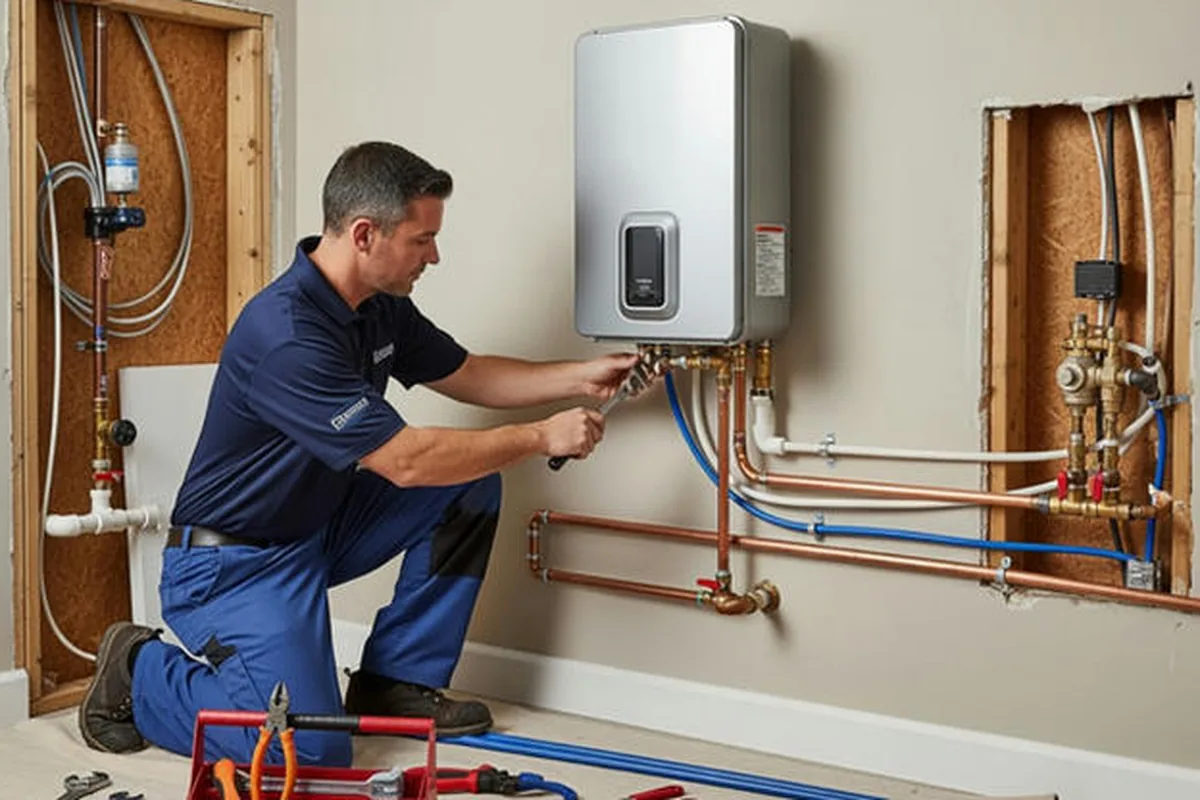
Where Tankless Units Leak (It's Rarely Obvious)
The most serious tankless leak point is the heat exchanger — the copper or stainless assembly where the burner transfers heat to the water. Exchangers fail from scale buildup creating hot spots, from freeze damage cracking the waterways, or from years of thermal cycling fatiguing the metal. An exchanger leak often shows as water dripping from inside the cabinet or from the bottom of the unit, and it is the one failure that can approach the cost of replacement — we diagnose it honestly and give you the real math.
More commonly, the leak is in the supporting cast. The condensate drain — present on high-efficiency condensing units — carries acidic condensate away, and a clogged or frozen condensate line backs water up until it overflows inside or beneath the unit. The pressure relief valve and its discharge piping weep under the same thermal-expansion pressures that affect tank heaters. Water connections at the isolation valves corrode or loosen. And the internal waterways' O-rings and gaskets age, weeping at joints deep inside the cabinet where you cannot see them.
Diagnosis means opening the cabinet and tracing with the unit running. We check the condensate system first — it is the most common and most fixable culprit — then the relief valve, then connections, then the exchanger itself. Each has a distinct signature, and a technician who works on tankless units weekly reads those signatures fast.
The Descaling Problem Nobody Warned You About
Here is what the brochure did not emphasize: tankless heat exchangers need periodic descaling, and in a unit that has never been serviced, scale is often implicated in the leak. Even Attleboro's soft water carries enough dissolved minerals over years of high-volume flow to coat the narrow waterways of a heat exchanger. That coating insulates unevenly, creating hot spots where the metal overheats, weakens, and eventually weeps or cracks. Scale also chokes flow sensors and restricts the waterways, making the unit work harder for less hot water.
Descaling is a straightforward service when done on schedule: we isolate the unit with its service valves, circulate a descaling solution through the exchanger with a pump for the better part of an hour, flush it clean, and verify flow rates and temperature rise afterward. Done every year or two — more often for large households — it keeps the exchanger efficient and dramatically extends its life.
But descaling cannot resurrect an exchanger that has already cracked from scale-induced hot spots. This is why we are blunt with owners of older, never-serviced units: if the exchanger is already leaking from thermal damage, the honest fix is exchanger replacement or unit replacement, not a flush. We will show you what we find inside and explain which situation you are in before you spend anything.
Freeze Damage: The New England Tankless Killer
If there is one failure mode that separates Massachusetts tankless ownership from tankless ownership in milder climates, it is freezing. Tankless units hold only a small volume of water in their exchanger at any moment, which means they freeze fast when exposed to sub-freezing air — and water expanding inside the narrow copper waterways cracks them with ruthless efficiency. Most units have built-in freeze protection heaters, but those only work when the unit has electrical power; a winter power outage in an unheated space defeats them completely.
The vulnerable installations are the ones we see across the Attleboro area: units mounted in unheated garages, in crawl spaces, on exterior walls with inadequate insulation, or with water and condensate lines running through cold zones. A single hard January night — the teens are routine here — can crack an exchanger in an unprotected installation. The leak often does not appear until the thaw, when ice blocking the crack melts and water starts flowing.
Freeze-cracked exchangers are generally not repairable — the waterways are too intricate to patch reliably. Prevention is everything: keeping the installation space above freezing, ensuring the unit's freeze protection has power (a small backup supply for outage-prone areas), insulating exposed pipe runs, and draining the unit if an extended cold outage is expected. If your tankless unit is in a cold space and has never been evaluated for freeze risk, call (833) 713-2101 before January does it for you.
Error Codes, Cold Bursts, and Performance Complaints
Tankless leaks do not always announce themselves with puddles. Sometimes the first symptom is behavioral: error codes on the display, hot water that surges hot and cold, longer waits for hot water, or reduced flow at the tap. These deserve attention because they often precede or accompany leaks — a failing flow sensor, a scaled exchanger, or a struggling burner all show up as performance problems first.
We read the unit's diagnostic system as part of every service call. Modern tankless units log fault histories that point directly at the failing subsystem — ignition failures, flame loss, overheating, flow anomalies — and combining those codes with a physical inspection usually identifies the problem quickly. We also measure actual performance: temperature rise at a known flow rate, which tells us whether the exchanger is transferring heat like it should or is compromised by scale or damage.
Cold-water sandwiches and temperature fluctuation often trace to minimum-flow issues or a scaled exchanger rather than leaks, but they share the same root causes and the same solution path: service the unit properly. Whether your complaint is water on the floor or water that will not stay hot, the diagnostic approach is the same — understand the machine, find the fault, fix it correctly.
Our Tankless Leak Repair Visit
We start with the unit's history: how old it is, whether it has ever been descaled, where it is installed, and what symptoms you have noticed. Then we open the cabinet and inspect systematically — condensate system, relief valve and discharge, water connections and isolation valves, internal gaskets and O-rings, and finally the heat exchanger itself, looking for the white mineral trails or green copper corrosion that mark a weeping joint or cracked waterway.
Repairable problems get repaired on the spot when parts allow: condensate lines cleared and rerouted, relief valves replaced, connections resealed, failed gaskets and sensors swapped. If descaling is overdue, we perform it as part of the visit — there is no point fixing a leak while leaving the scale that stresses the system. Every repair is followed by a full operational test: the unit fires, holds temperature at flow, shows no new weeps, and the condensate drains freely.
When the exchanger itself has failed, we give you the straight comparison: exchanger replacement versus unit replacement, with the age of the unit and the condition of everything else factored in. A ten-year-old unit with a cracked exchanger and original everything else is usually better replaced whole; a five-year-old unit with an isolated exchanger failure may justify the part. We have no incentive to steer you wrong — we do both jobs — so you get the math as it actually is.
Keeping a Tankless Unit Healthy in Attleboro
The maintenance schedule that keeps a tankless unit out of trouble is simple: descaling every one to two years depending on household size and water use, annual inspection of the condensate system before heating season, verification that freeze protection is powered and the installation space stays above freezing, and periodic checks of the relief valve and water connections. None of it is complicated; all of it gets skipped in practice, which is why we see so many preventable failures.
For Attleboro-area homes, two items deserve emphasis. First, pre-winter freeze-risk assessment for any unit in a garage, crawl space, or exterior installation — October is the time, not January. Second, honest descaling intervals: a family of five runs far more water through the exchanger than a couple does, and the service interval should reflect that.
Call (833) 713-2101 for tankless leak diagnosis, descaling, freeze-damage assessment, or performance troubleshooting anywhere in the Attleboro area. These are sophisticated machines, and they reward specialist care — which is exactly what we provide.