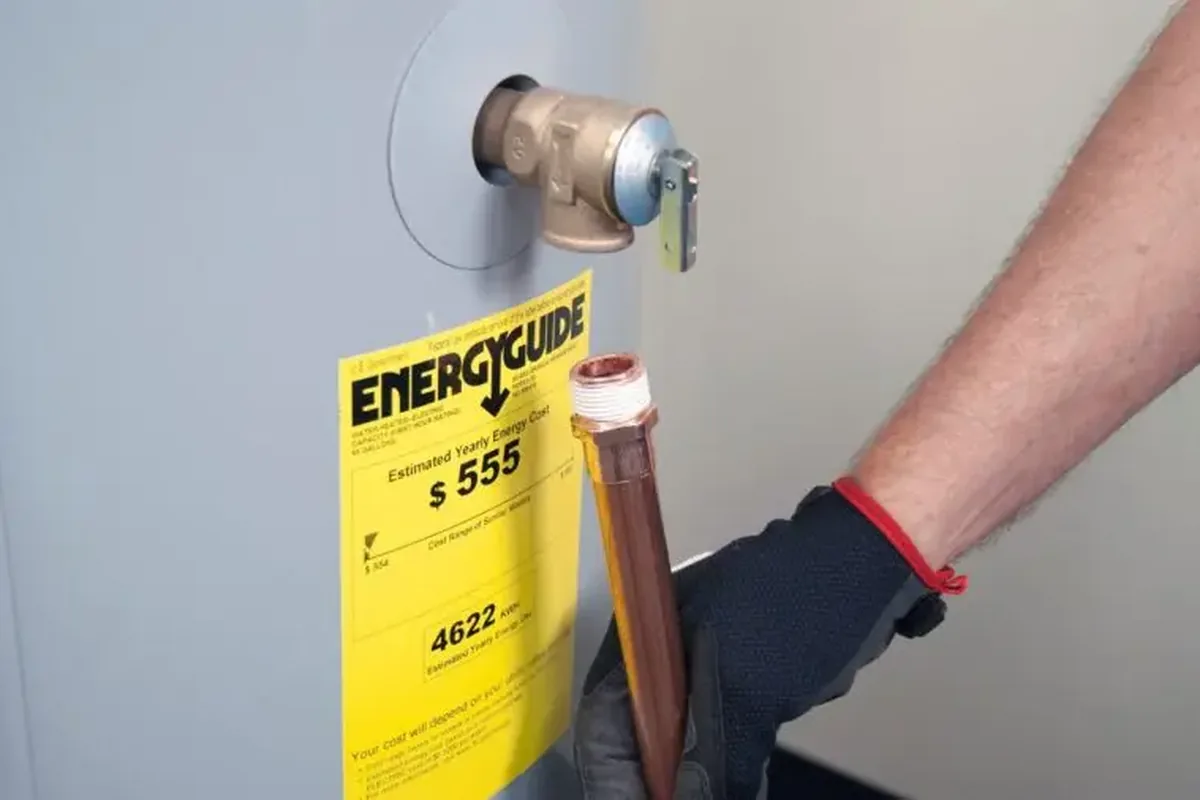
What the TPR Valve Protects You From
A water heater tank is a pressure vessel, and pressure vessels demand respect. Under normal operation, the tank holds water at household pressure — typically 40 to 80 psi — heated to around 120 degrees. Two failure modes can drive those numbers dangerous: a thermostat stuck closed can keep heating water past safe temperatures, and thermal expansion in a closed plumbing system can drive pressure far above normal with every heating cycle. Uncontrolled, either can rupture a tank with explosive force — a rare but genuinely catastrophic failure that the TPR valve exists to prevent.
The valve is elegantly simple: a spring-loaded mechanism set to open at 150 psi or 210 degrees Fahrenheit, venting water through the discharge pipe until conditions normalize. It has no electronics, no dependencies, no maintenance schedule in most homes — which is exactly why it gets neglected. A valve that has sat untested for a decade may be corroded shut, its spring weakened, or its seat fouled with mineral deposits, and you would never know until the day you needed it.
This is why we treat every TPR valve call as a safety matter first and a leak matter second. A dripping valve is usually good news in disguise — it means the valve can still open. A valve that has never dripped, never been tested, and sits on a fifteen-year-old tank is the one that worries us, because its ability to open when needed is unverified.
Why TPR Valves Drip: The Causes Behind the Symptom
A dripping or discharging TPR valve is almost always a symptom, not the disease. The most common underlying cause in modern Attleboro homes is thermal expansion in a closed plumbing system. Many homes now have check valves, pressure-reducing valves, or backflow preventers on their water service — all of which create a 'closed' system where heated water has nowhere to expand. Each heating cycle raises the system pressure, and the TPR valve, doing exactly what it was designed to do, opens to relieve it. Replacing the valve without addressing the expansion just gives you a new valve that drips identically.
The correct fix for expansion-driven discharge is an expansion tank: a small tank installed on the cold-water line with an internal bladder that absorbs the pressure rise. If your home has a closed system and no expansion tank — or an expansion tank whose bladder has failed — TPR discharge is essentially guaranteed. We check for this on every TPR call, because it is the cause more often than not.
Other causes include municipal water pressure running too high (we measure it — anything consistently above 80 psi needs a pressure-reducing valve), a thermostat stuck closed overheating the water (a scalding hazard that needs immediate attention), and the valve itself simply wearing out — springs weaken, seats foul, and a valve that drips at normal temperature and pressure has reached the end of its service life. Diagnosis distinguishes these; assumption does not.
How We Replace a TPR Valve — and Verify the System
The replacement itself is straightforward: power or gas off, water inlet closed, tank pressure relieved, the old valve unthreaded from its tapping, the new valve threaded in with proper sealant and oriented so its discharge pipe runs correctly. But the replacement is the easy half of the visit. The valuable half is the system verification that surrounds it.
Before the new valve goes in, we measure your household water pressure with a gauge — ideally left on overnight to catch the expansion spikes that occur during heating cycles. We check whether your plumbing system is closed (pressure-reducing valve, check valve, or backflow preventer present) and whether an expansion tank exists and is functional — a waterlogged expansion tank with a ruptured bladder is as useless as no tank at all. We verify the thermostat is regulating temperature correctly, because an overheating tank will defeat any relief valve eventually.
If we find expansion issues, we say so plainly and recommend the expansion tank or pressure correction the system actually needs. Installing a new TPR valve onto a system with unaddressed expansion is a repair we will not perform without telling you it will not hold — because it will not, and you deserve to know that before spending money. After installation, we test the new valve's manual lever to verify it opens and reseats, restoring full safety function.
The Discharge Pipe: A Detail That Matters
Every TPR valve needs a discharge pipe running from the valve outlet down toward the floor, and the details of that pipe are specified for good reason. It must terminate within a few inches of the floor — so discharging scalding water does not spray across the room — yet not be capped, plugged, or threaded at the end, because any restriction defeats the relief function. It should be observable: if the valve discharges, you should be able to see it happening.
In Attleboro's older homes we routinely find discharge pipes that violate these principles: pipes reduced to smaller diameters, pipes terminating into hidden locations, valves with no discharge pipe at all, and — most alarmingly — valves whose outlets have been capped to stop an annoying drip. Capping a TPR valve to stop a drip is like removing the batteries from a smoke detector to stop the beeping: it silences the symptom by disabling the safety device. If a previous owner or handyman capped your relief valve, that is an urgent correction.
During our visit we inspect the full discharge arrangement and bring it into compliance. It is a small part of the job with outsized safety importance, and it is frequently the most valuable thing we do on a TPR call.
Testing: The Maintenance Nobody Performs
TPR valves are designed to be tested periodically — lifting the manual test lever briefly to verify water flows and the valve reseats. Almost nobody does this, for understandable reasons: on an old valve, testing can disturb a seat that then refuses to reseal, turning a test into a drip. That risk is real, and it is why we recommend the first test of a long-untested valve happen during a professional visit, where a valve that fails to reseat can be replaced immediately.
Our position is straightforward: a valve that cannot be tested without failing needs replacement, not avoidance. If your TPR valve has not been tested in years, have us evaluate it. We will test it, and if it operates correctly, you gain verified safety function. If it weeps afterward or was already compromised, we replace it on the spot and verify the system pressures that determine whether the new valve will hold.
Going forward, periodic testing — or simply having us check it during other service visits — keeps the safety function verified rather than assumed. A relief valve is only a safety device if it works; an untested one is a decoration. In a home with a water heater older than ten years, TPR verification belongs on the same maintenance list as the anode rod and the sediment flush.
Attleboro Homes and TPR Issues We See Repeatedly
The local pattern has clear themes. Closed plumbing systems are increasingly common as municipal backflow requirements and pressure-reducing valves proliferate, which means expansion-driven TPR discharge is one of our most frequent calls — often misdiagnosed by homeowners as a 'bad valve' when the valve is the only part working correctly. We see failed expansion tanks regularly: the bladder ruptures silently, the tank waterlogs, and the TPR valve starts discharging months later with no obvious trigger.
High municipal pressure pockets exist in parts of the service area, particularly where elevation changes put some homes at the low end of the distribution system. Pressure above 80 psi stresses every component in the plumbing system, not just the relief valve — we have traced chronic TPR discharge, premature washing-machine hose failures, and dripping faucets in the same home back to a single pressure problem.
And in the oldest Attleboro housing stock, we find the legacy issues: capped or missing discharge pipes, valves old enough to have corroded shut, and heaters installed before expansion tanks were standard practice. If your home predates the 1980s and the water heater area has never been professionally evaluated, a TPR and expansion assessment is genuinely worthwhile. Call (833) 713-2101 — it is a short visit that verifies the most important safety device in your home.