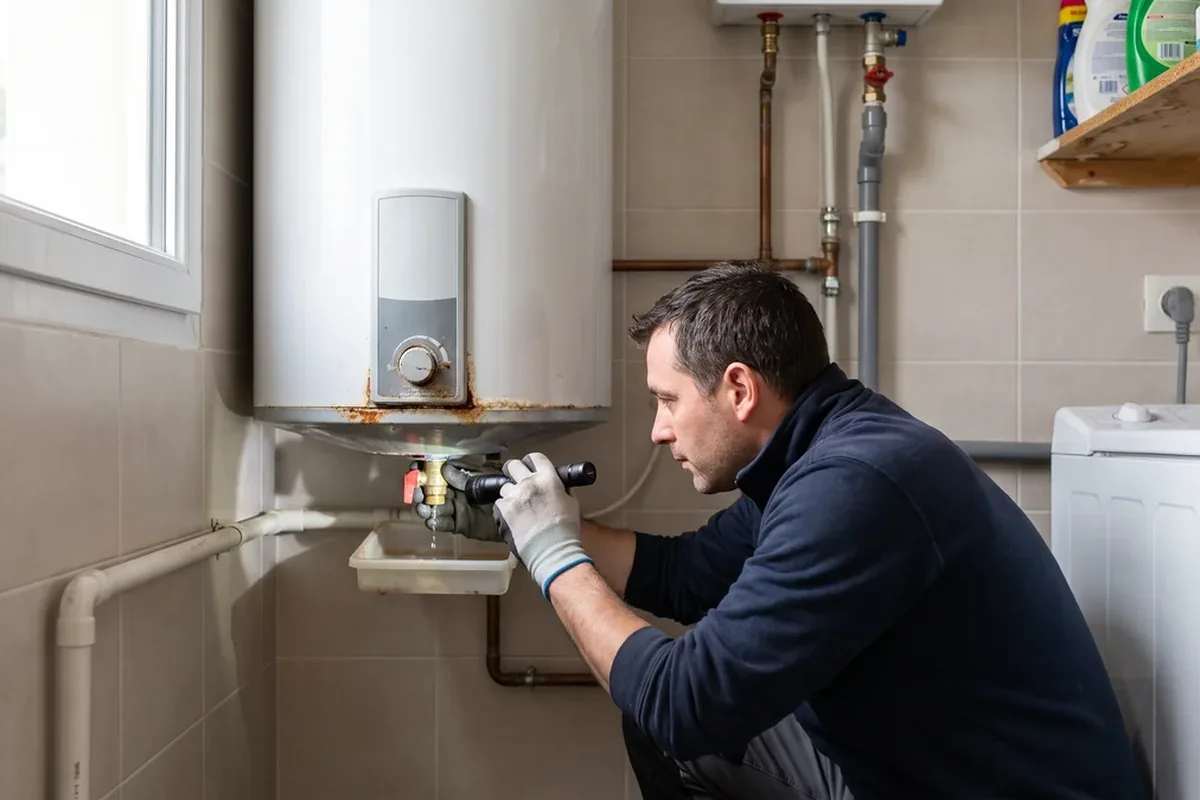
Where Tank Water Heaters Actually Leak
A tank water heater has a short list of leak points, and learning them is the key to honest diagnosis. At the top: the hot and cold water connections, the dielectric unions that join dissimilar metals, and the anode rod port. In the middle: the temperature-pressure relief valve and its discharge pipe, the tank's welded side seam, and on electric units the element gaskets. At the bottom: the drain valve, the gas control valve's temperature probe tapping on gas units, and the base seam where the tank meets its bottom pan.
Leaks from the top fittings, the TPR valve, the drain valve, and the element gaskets are component failures — repairable, usually in a single visit, with parts we carry. Leaks from the tank shell itself — the side seam, pinholes in the wall, the base seam — are structural failures. Steel that has rusted through cannot be patched, welded, or sealed back into service; the tank is done.
Water is also a traveler, which complicates diagnosis. A leak at a top fitting runs down the jacket and pools at the base, looking exactly like a base leak. Condensation on a cold tank does the same. Our diagnostic process accounts for this: we dry the area, watch where water reappears, and trace upward from the puddle to the origin before recommending anything. The most expensive mistake in this business is replacing a heater whose only problem was a fitting — the second most expensive is repairing fittings on a tank that is rusting through.
The Rust Question: Reading What the Tank Is Telling You
Rust is the language of a dying tank, and it speaks in stages. Surface rust on fittings and connections is normal aging — unsightly, worth watching, but not a death sentence. Rust streaks running down the tank jacket from a seam or fitting indicate water has been escaping at that point, and the stain pattern often points straight at the source. Rust in the hot water itself, especially after the heater sits unused overnight, means the tank's interior is corroding — the anode rod is long gone and the steel is next.
The critical distinction is between rust on the tank and rust through the tank. A rust-stained fitting can be replaced; a rust-perforated tank wall cannot. We look for the signs that separate them: blistering or flaking on the jacket near the base, a base that stays damp no matter how dry the fittings are, pinhole weeps that reappear after drying, and the telltale orange-brown crust around the bottom seam.
Attleboro's soft water shapes this story. Without heavy scale to mask it, corrosion shows itself more directly here — but soft water does not prevent it. The tanks we condemn in this area most often died from internal rust after years without anode rod service, in basements damp enough to corrode the exterior too. A tank that has been maintained — flushed periodically, anode rod replaced — can look remarkably sound at twelve years; a neglected tank can be terminal at eight. The label date and the service history tell us which story we are in.
Our Leak Diagnosis, Step by Step
Every tank leak call follows the same disciplined sequence. First, we make the scene safe and stop active water: inlet valve off, power or gas off, area contained. Then we dry the tank exterior and the surrounding floor completely — diagnosis on a wet tank is guesswork, and we do not guess.
With the area dry, we inspect from top to bottom. The supply connections and dielectric unions get checked for weeping and corrosion. The anode port and TPR valve are examined — a discharging TPR valve leaves a distinctive trail down its discharge pipe. Element gaskets on electric units get a close look. The drain valve is tested. Then the tank shell itself: seams, base, and jacket, feeling for dampness that should not be there and looking for the rust signatures described above.
If the source is still ambiguous, we pressurize and watch. With the tank full and the system at normal pressure, a true leak reappears at its origin within minutes; condensation does not. We also check system pressure behavior, because excessive pressure from thermal expansion in a closed system can force water past fittings and relief valves in ways that mimic tank failure. Only when we have identified the true source do we recommend a course of action — repair the component, or replace the tank.
Repairs We Complete on the Spot
When the diagnosis points to components, most repairs happen in the same visit. Dielectric unions and supply connections get resealed or replaced. Drain valves get upgraded to brass ball valves. TPR valves that are weeping or failed get replaced — and if thermal expansion is the underlying cause, we address that too rather than letting the new valve inherit the same stress. Element gaskets on electric units get replaced with the tank drained below the element level. Gas control valves, thermocouples, and thermostats get the full diagnostic-and-replacement treatment.
Each repair follows the same discipline: the failed part is shown to you when possible, the replacement is matched to the unit's specifications, the tank is refilled and purged of air, and the system is tested under normal operating pressure before we leave. We check our work the way we would want it checked — running the heater through a full heating cycle and reinspecting every connection we touched.
While we are there, we assess the tank's overall health and tell you what we find. A successful fitting repair on a nine-year-old tank with a depleted anode rod is a good time to discuss preventive service — not as an upsell, but as information you deserve before the next failure decides your schedule for you.
When Replacement Is the Honest Answer
Some tanks cannot be saved, and you deserve to hear that directly. A tank leaking from its shell — seam weeps, pinholes in the wall, base-seam failure with rust present — is structurally finished. No sealant, epoxy, or patch restores a rusted-through steel vessel to safe service, and anyone offering one is selling delay, not repair. We will show you the failure point and explain why replacement is the only sound option.
Age plus condition can also point to replacement even when the current leak is technically repairable. A fourteen-year-old tank with a failed drain valve, visible base rust, and a depleted anode rod is telling you its story: the valve is today's problem, but the tank is tomorrow's. In that situation we lay out both paths — repair now with eyes open, or replace now and be done — with our honest recommendation and the reasoning behind it. The decision is always yours.
Replacement through us means a correctly sized unit for your household and fuel type, installed to current Massachusetts plumbing standards with proper venting, expansion control, and seismic strapping where applicable, with the failed tank drained, removed, and hauled away. Most residential replacements are completed in a single day, and you will have hot water back that evening.
Why Attleboro Tanks Fail the Way They Do
The local pattern is consistent enough that we can practically predict it. Attleboro's housing stock skews old — roughly seven in ten homes predate 1980 — which means a huge installed base of tanks sitting in basements with original-era plumbing, old shutoff valves, and connections that have been corroding quietly for decades. Many of these heaters have never had an anode rod inspection or a sediment flush; they run until something gives.
Soft water changes the failure mode without preventing it. Without mineral scale armoring the interior, corrosion attacks the steel more directly once the anode rod is spent — and Attleboro's rods deplete on the normal three-to-six-year schedule regardless of hardness. The result is tanks that look fine externally while rusting from the inside, then fail suddenly at a seam or the base with little external warning.
Winter adds the final stress. Cold incoming water, longer burner cycles, thermal shock during cold snaps, and the occasional frozen pipe run in a half-heated basement — January through March is our busiest season for terminal tank failures. A pre-winter inspection catching a depleted anode rod or a weeping fitting in October is worth more than any emergency response in February. Call (833) 713-2101 before the cold finds your tank's weak point.