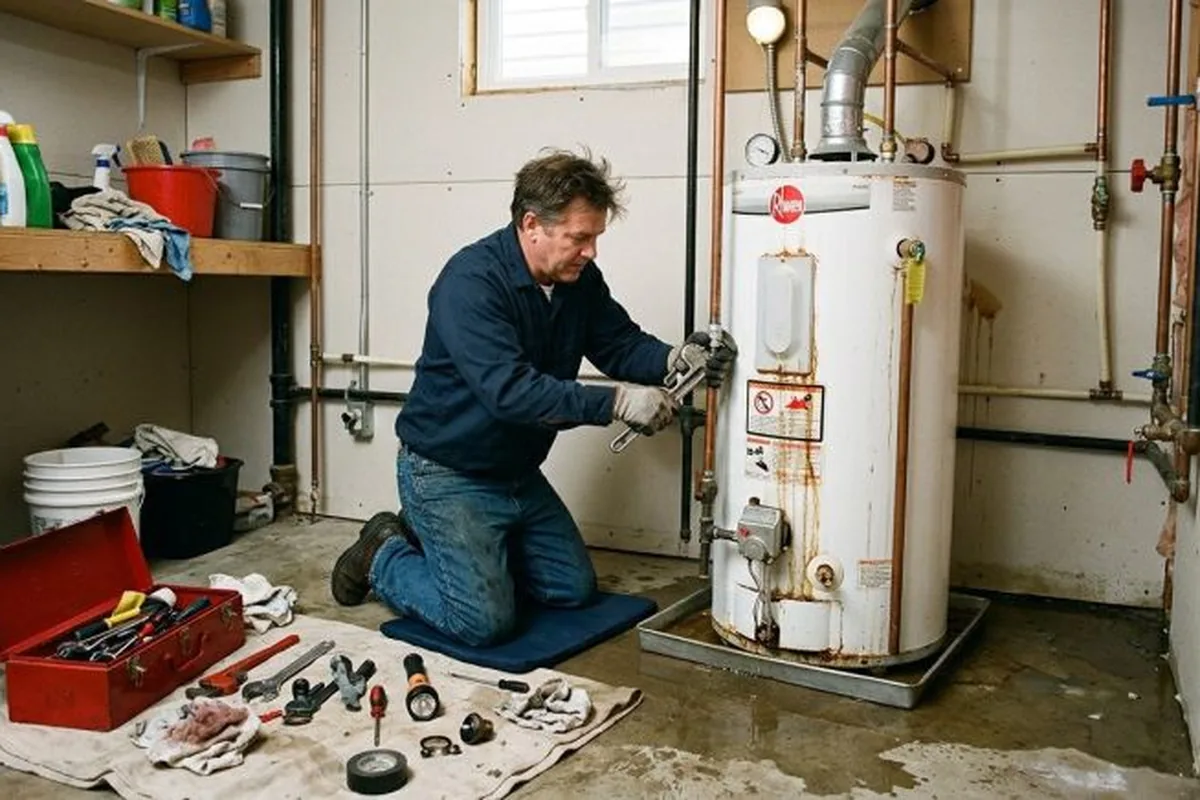
What Counts as a Water Heater Emergency
Not every water heater problem needs a middle-of-the-night response, so here is how to judge yours. It is an emergency when water is actively flowing or spreading — a burst tank, a split fitting gushing water, a relief valve discharging continuously. It is an emergency when water is pooling near a gas burner or electrical components, because water and energy sources are a dangerous combination. And it is an emergency when the leak is reaching finished space: carpet, drywall, hardwood, or stored valuables that are being damaged by the minute.
A slow drip from a fitting, a damp spot you just noticed, or a heater that has simply stopped making hot water without leaking can generally wait for a scheduled visit — though we still encourage calling promptly, because slow drips have a way of becoming emergencies at the worst moment. When you call (833) 713-2101, describe what you see as precisely as you can: where the water is, how fast it is coming, whether the unit is gas or electric, and whether water is near anything electrical. We will tell you honestly whether you need us right now or can safely schedule ahead.
One special case: if you smell gas — the distinctive rotten-egg odor of natural gas, not the hot-water sulfur smell — leave the area and call your gas utility's emergency line first, then call us. Gas leaks are the utility's domain; water heater leaks are ours.
What to Do in the First Five Minutes
While we are on our way, there are three things you can do that dramatically limit the damage. First, stop the water: find the cold-water shutoff valve on the pipe entering the top of the heater and turn it clockwise until it stops. This cuts the supply feeding the leak. If that valve is seized — common in older Attleboro homes where it has not been turned in twenty years — shut off the home's main water valve instead. It is usually near where the water line enters the house.
Second, cut the energy: for an electric heater, switch off its dedicated breaker in the electrical panel. For a gas heater, turn the gas control knob on the unit to the off position. A heater that keeps firing with a falling water level can overheat dangerously, and an electric element exposed to air will burn out in seconds.
Third, contain what you can: towels around the base, valuables and cardboard boxes lifted off the floor, and if water is heading toward a floor drain, clear a path for it. Do not wade into standing water that may be in contact with electrical equipment. Then call (833) 713-2101 if you have not already — we can talk you through any of these steps while the technician is en route.
How Our Emergency Visit Unfolds
Our technician arrives with a vehicle stocked for the scenarios water heaters actually present: replacement valves, fittings, thermostats, elements, anode rods, gas control components, pan supplies, wet-vacuum equipment, and the tools to drain a tank quickly and safely. The first priority is always the same: make sure the water is stopped and the unit is safe. If you have not been able to shut things off, we do it immediately.
Next comes rapid diagnosis. We determine where the water originated — tank shell, fitting, valve, relief discharge, or supply connection — because everything that follows depends on that answer. A failed fitting or valve gets repaired on the spot in most cases; we carry the parts and the repair is usually completed within the same visit. A ruptured tank cannot be repaired, so we shift to stabilization: the tank gets fully drained and secured, the area gets dried as much as possible, and we lay out your replacement options with a clear path to getting hot water back.
For burst tanks, we can often schedule the replacement immediately — many residential swaps are completed the next day, and in some cases the same day if the unit size and fuel type allow. We will give you a realistic timeline before we leave, not a vague promise. And we haul the failed tank away; you will not be left with a dead fifty-gallon steel carcass in your basement.
Why Attleboro Winters Produce the Worst Emergencies
A disproportionate share of our emergency calls arrive between January and March, and the pattern is unmistakable. Southeastern Massachusetts winters routinely bring overnight lows in the teens and twenties, and Attleboro's older homes have plenty of half-heated spaces — unfinished basements, crawl spaces, mudrooms, and garages where a water heater or its pipe runs sit in near-freezing air. Water expands when it freezes with enough force to split copper, crack fittings, and rupture pipe runs, and the resulting leak is not a drip but a flow.
Tanks suffer too. Ice-cold incoming water slamming into a hot tank during a cold snap creates thermal stress that finds the weakest point in aging steel — often a seam that has been quietly corroding for years. We also see freeze-related failures in the pressure relief discharge piping and in condensate lines on high-efficiency units, where a frozen blockage forces water to go somewhere it should not.
If your heater lives in a space that gets cold, the single best emergency prevention is a pre-winter check: we verify the space will not freeze, test the TPR valve, check the anode rod, and make sure the thermostat is set correctly. It is far cheaper than the 2 a.m. call — but if the 2 a.m. call is what you are facing right now, call (833) 713-2101 and we will come.
After the Water Stops: What Comes Next
Stopping the leak is only the first half of an emergency. Once the water is controlled, we assess the damage footprint with you: how far the water spread, what it reached, and whether drying equipment or further remediation is needed. We are water-heater specialists, not a restoration company, and we will tell you straight when a situation needs professional drying beyond what we provide — particularly with finished basements, where water trapped behind drywall or under flooring becomes a mold problem if it is not addressed quickly.
Then we resolve the heater itself. Repairable failures get repaired on the spot. Failed tanks get a replacement plan: we confirm the right size and fuel type for your household, check venting and space requirements, and schedule the installation. If the failed unit was old enough that its connections are outdated, we update what needs updating so the new heater is not inheriting the old one's weaknesses.
Before we leave, we walk you through what happened and why, show you the failed component when possible, and make sure you know how to shut the system down yourself if anything ever happens again. An emergency you understand is less frightening the second time — though with the heater fixed properly, there should not be a second time.
The Real Cost of Waiting
It is tempting to put a bucket under a drip and deal with it on the weekend. We understand the impulse — and we strongly advise against it. Water heater leaks escalate; they do not stabilize. A weeping fitting corrodes further under constant moisture. A pinhole in a tank wall grows as rust expands the opening. Pressure cycles from normal household use work every weakness a little further open with each heating cycle.
Meanwhile the water is doing quiet damage beyond the heater. It wicks into drywall, swells the base of finished walls, saturates carpet padding, rusts the legs of nearby appliances, and creates exactly the damp, warm environment mold needs. What would have been a single-visit valve replacement becomes a valve replacement plus flooring plus drywall — and the difference is usually measured in days of delay, not months.
The call is free to make and the advice is honest. If what you are seeing can wait, we will tell you so. But if you are watching water spread across your basement floor right now, every minute matters. Call (833) 713-2101 — the Water Heater Leak Repair Crew answers, and we come to you.