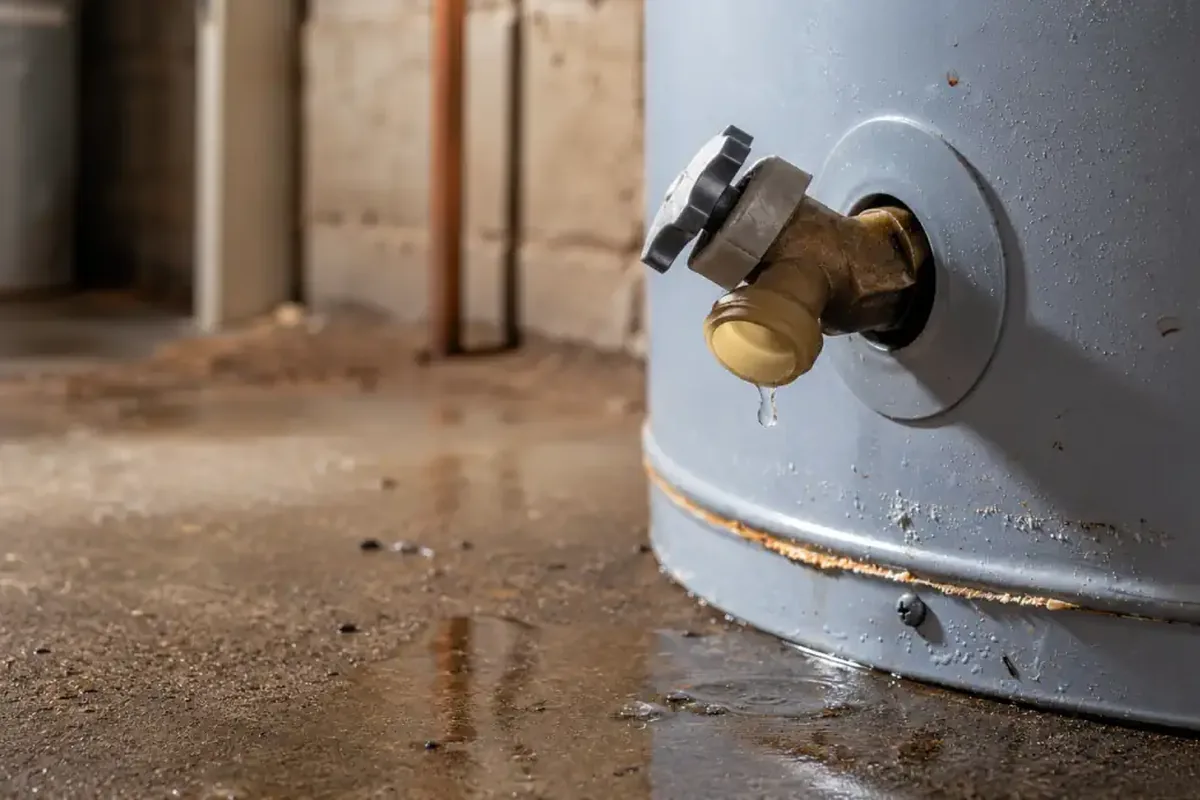
Why Factory Drain Valves Fail So Predictably
Most tank water heaters ship with a plastic drain valve — a cost-saving choice by the manufacturer, not an engineering one. Plastic and hot water are a poor long-term combination: years of heat cycling make the plastic brittle, the internal washer hardens and loses its seal, and the valve body itself can develop hairline cracks. The failure often announces itself right after someone finally opens the valve for a flush — the washer that sealed adequately while undisturbed for eight years cannot reseal once disturbed, and the drip begins.
In Attleboro's older housing stock this plays out constantly. A homeowner with a fifteen-year-old tank decides to be responsible and flush the sediment, opens the plastic drain valve for the first time in a decade, and either the handle snaps off in their hand or the valve weeps from that day forward. We also see valves that fail without ever being touched — the plastic simply ages out, and a slow drip appears at the bottom of the tank that gets misdiagnosed as a tank leak.
The telltale sign of a drain valve leak is water appearing specifically at the bottom front of the heater, at the little spigot near the base, while the rest of the tank stays dry. If that matches what you are seeing, the tank itself is probably fine — you need a valve, not a heater.
Brass Ball Valves: The Upgrade Your Heater Should Have Had
When we replace a drain valve, we do not install another plastic one. We fit a full-port brass ball valve — a quarter-turn valve with a solid brass body and a lever handle that opens and closes positively every time. Brass does not go brittle with heat cycling. The ball mechanism does not rely on a compression washer that hardens with age. And the full-port design means the opening is the full diameter of the pipe, so sediment-laden water actually flows out during a flush instead of clogging in a restricted plastic passage.
That last point matters more than it sounds. The entire purpose of the drain valve is to let you flush sediment from the tank, and a clogged or restricted valve makes flushing nearly impossible. Many of the sediment-choked tanks we see in Attleboro basements got that way partly because the factory valve could not pass the debris. A brass ball valve turns flushing from a frustrating trickle into a genuinely effective maintenance task.
The lever handle is a practical upgrade too. In an emergency — a tank that needs draining fast — a quarter-turn lever is far easier to operate than a stiff plastic gate that may snap. It is a small part that makes the heater meaningfully more serviceable for the rest of its life.
How We Replace a Drain Valve Without the Drama
The procedure is methodical. We shut off power or gas to the heater and close the cold-water inlet, then attach a hose to the old valve and drain the tank down below the valve level — there is no need to empty the entire tank for this job, which keeps the visit efficient. Once the water level is below the valve, we unscrew the old valve from the tank tapping. On older heaters this fitting can be stubborn, and we take care not to damage the tank threads.
We inspect the tank tapping for corrosion before the new valve goes in. If the threads are sound, we wrap them with quality thread sealant tape, thread in the brass ball valve, and tighten it to a proper seal. Then we close the valve, refill the tank completely — purging air through a hot tap until the water runs solid — restore power or gas, and verify the burner or elements fire correctly.
Finally, we test the new valve under pressure: open it briefly to confirm full flow, close it, and check for any weep at the connection. We also take the opportunity to check the tank's overall condition while we are there — the anode port, the TPR valve, the general state of the fittings — and report anything worth knowing. Most drain valve replacements are done within a couple of hours, start to finish.
The Flush Connection: Why This Valve Matters for Tank Health
A drain valve that works is the gateway to the most important maintenance a tank heater receives: sediment flushing. Attleboro's soft water means mineral scale is less of an issue here than in hard-water regions, but sediment still accumulates — rust particles, fine debris from aging pipes, and the remnants of the anode rod as it dissolves all settle to the bottom of the tank over the years. In gas heaters, that sediment layer insulates the burner from the water, forcing longer, hotter burn cycles that stress the tank. In electric heaters, sediment buries the lower element and burns it out prematurely.
A functioning drain valve lets us — or you — flush that sediment out periodically and keep the tank efficient. A failed valve makes it impossible, and the sediment keeps building. We frequently find that the same visit which replaces a broken drain valve is the first time the tank has been properly flushed in a decade, and the amount of debris that comes out explains a lot about the heater's recent performance.
After we install your brass valve, ask us about flushing intervals for your household. Heavy hot-water use means more sediment turnover; a simple annual or biennial flush keeps the tank at its best, and with a proper valve it is a quick job rather than an ordeal.
When a Dripping Valve Is Hiding a Bigger Problem
We are honest about this: sometimes the drain valve is not the real problem. A valve that drips only when the tank is overheating, or a discharge that seems to come from the valve area but is actually running down from above, can point to a failing TPR valve, excessive system pressure, or a tank that is weeping from a seam just above the valve. Part of our diagnostic visit is ruling those out before we replace anything.
We check the TPR valve's operation, look at the tank seams and base for rust, and verify system pressure behavior. If the drain valve is genuinely the culprit — and it usually is when the drip is localized to the spigot — we replace it and you are done. If we find something bigger, we tell you plainly and lay out the real options. Replacing a valve on a tank that is rusting through would be a disservice, and we will not do it without telling you what we see.
This diagnostic honesty is especially important in Attleboro's older homes, where a fifteen-year-old tank with original plumbing can have several things going marginal at once. Our job is to fix what is actually broken, in the right order, without selling you parts you do not need.