What Makes 02780 Tough on Anode Rods
Taunton's Silver City housing stock runs some of the hardest-working water heaters in the region — triple-deckers with high hot-water demand, tanks cycling constantly, and anodes depleting faster under the workload. The city's reservoir-fed municipal water is treated and consistent, good for about five to six years per magnesium rod under normal use — but a triple-decker tank serving three households isn't normal use, and heavy demand shortens rod life measurably. The Whittenton mill-era homes add age to the equation: tanks installed decades ago, rods depleted a decade ago, interiors rusting with every cycle. What we see in Taunton, over and over, is the deferred-maintenance tank — a unit that's been 'working fine' for fifteen years while its protection died in year six. The rusty-morning-water complaint is endemic here, and it's almost always the dead rod. A fresh rod in a sound Taunton tank is transformative: corrosion halts, water clears, and the replacement conversation moves five years into the future.
Is Your Tank Running Without Protection?
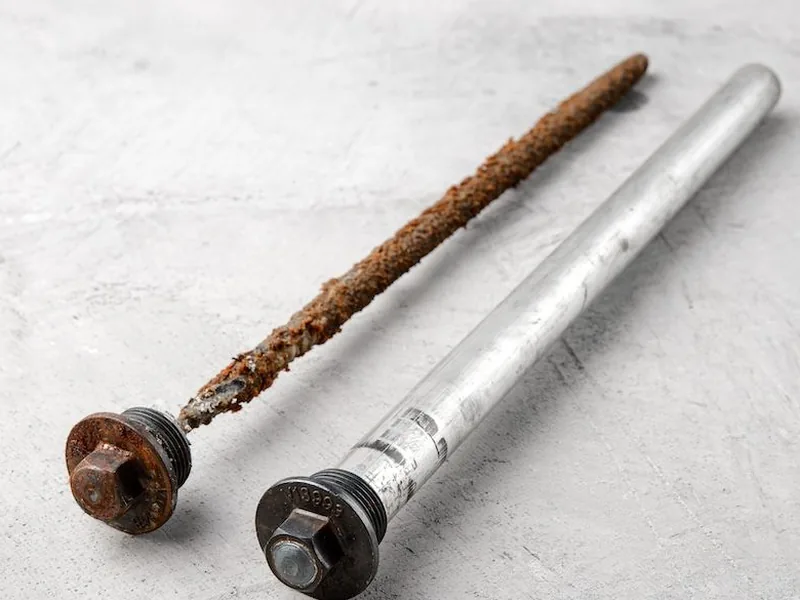
Here's the honest diagnostic we run on every 02780 service call: we read the tank's serial number for its age, check the water type feeding it, and pull the anode rod for direct inspection. A healthy rod looks like a solid metal core, maybe pitted. A dying one is thin, deeply pitted, or coated in calcium. A dead one is a bare steel wire with the sacrificial metal completely gone — and in Taunton, on Taunton's reservoir-fed municipal water, we find dead ones in tanks as young as four years when well water is aggressive. The inspection also tells us about the tank: heavy rust staining around the rod port or the top fittings suggests the corrosion has spread beyond what a new rod can reverse. That's the fork in the road — a sound tank gets a fresh rod and five more years; a tank that's already rusting through gets an honest recommendation instead of a part it can't use. Either way, you get the truth, not a sales pitch.
Rusty morning hot water in Taunton's triple-deckers is the dead-rod anthem. Also: metallic taste, high-demand tanks past year five with no service record, sulfur notes at the hot tap, and visible rust at the tank's top fittings in the mill-era homes.
Ninety Minutes That Add Years to Your Tank
What separates a proper rod replacement from a quick swap is everything we check while the tank is open in front of us. On every Taunton visit we read the serial number and date the tank, assess the bottom seam and welds for rust-through risk, check the drain valve's condition (a seized valve gets flagged before it becomes an emergency), test the T&P relief valve, and look at the inlet and outlet connections for the slow weeps that precede bigger leaks. Taunton's reservoir-fed municipal water leaves readable signatures — the rod's condition tells us about pH and mineral load, sediment volume tells us about flushing history — and we translate all of it into plain guidance: how much life the tank likely has, what maintenance interval fits your water, and whether any companion work is worth doing now. You get a protected tank and a clear picture of its future, not just a part swapped in silence.
Triple-decker basements in Taunton are working basements — tanks often accessible but surrounded by a century of piping. We navigate it cleanly: water and power off, pressure relieved, old rod extracted and shown to you, matched new rod installed, system refilled and hot water tested. High-demand buildings get a note on the maintenance interval their usage actually needs.
The Rod Decision, Explained Plainly
Powered anode rods — also called impressed-current anodes — are the definitive answer for Taunton's most aggressive water. Instead of dissolving sacrificial metal, a powered rod uses a tiny electrical current from a wall outlet to halt corrosion electrochemically. It never depletes, never needs replacement, and it eliminates sulfur odor because there's no degrading magnesium for bacteria to feed on. For well supplies around 02780 that eat a magnesium rod in two to three years, the economics are compelling: one powered rod instead of three or four sacrificial swaps over the tank's life, with continuous protection throughout. Installation is the same ninety-minute visit plus plugging in a small power supply. The upfront part cost is higher than a sacrificial rod, but for aggressive-water homes in Silver City triple-deckers and Whittenton mill-era homes, it's the last anode decision the tank will ever need.
Magnesium rods are the factory default in most tanks, and on kind water they're perfectly fine — magnesium is the most electrochemically active common anode material, which means it protects aggressively. The tradeoff is lifespan: on Taunton's reservoir-fed municipal water, a magnesium rod typically gives four to six years, and on aggressive well supplies sometimes half that. The other magnesium quirk matters in Taunton's well-water neighborhoods: as magnesium degrades, sulfur-reducing bacteria feed on it, producing the rotten-egg hot-water smell. So magnesium is the right call for municipal-water tanks without odor issues — strong protection, standard lifespan, lowest part cost — and the wrong call where well water brings sulfur bacteria or very low pH. We stock magnesium for the tanks it suits and steer the rest toward better options.
What to Do Differently From Here On
The replacement is only half the job — the other half is the inspection rhythm that keeps the tank protected from here on. On Taunton's reservoir-fed municipal water, the honest intervals are: municipal water, check every four to five years; mixed or moderately aggressive well water, every three; the truly aggressive well supplies around 02780, every two. 'Check' means pulling the rod and looking, not guessing from the calendar — water chemistry varies street by street, and the rod's actual condition is the only reliable gauge. In Silver City triple-deckers and Whittenton mill-era homes, we leave every homeowner with the tank's birthdate from the serial number and a recommended next-check date written down, because the number-one reason rods die unnoticed is that nobody writes anything down. A two-minute inspection every few years is what stands between a twenty-year tank and a ten-year tank.
Here's the candid part: sometimes a new rod isn't the right answer, and we'd rather tell you than sell you. If the tank's bottom seam is already rusting through, if the jacket shows deep exterior corrosion, if the serial number says the unit is past fifteen years on aggressive water — a fresh rod buys months, not years, and the honest recommendation is planning a replacement on your schedule instead of the tank's. In Taunton's older housing, Silver City triple-deckers and Whittenton mill-era homes included, we have this conversation regularly, and homeowners consistently prefer hearing it before the basement floods. The rod inspection is what makes the call possible: with the old rod out and the tank's condition in front of us, we can distinguish the sound ten-year-old tank that deserves five more years from the terminal fifteen-year-old that doesn't. Either way, the (833) 713-2101 visit ends with a clear plan, not a guess.
What Happens When You Call (833) 713-2101
Calling (833) 713-2101 takes about two minutes, and here's exactly what happens. First, we ask four quick questions: gas or electric, how old the tank is (the serial number works if you're not sure), whether the hot water smells or runs rusty, and whether you're on town water or a well. Second, we schedule the visit — most Taunton rod replacements happen within a day or two, and the job itself runs sixty to ninety minutes. Third, the tech arrives with standard, segmented flex, and powered rods on the truck, inspects your old rod with you, installs the right replacement, flushes the tank, and verifies clear hot water at the tap before leaving. No guesswork, no upsell theater — just the protection your tank should have had all along. Call (833) 713-2101 or ask for us by name: Water Heater Leak Repair Crew.