Wrentham Water vs. Your Anode Rod
Wrentham's two eras of housing deplete anode rods on two schedules. The colonials around the town common — some dating back centuries — run tanks in old basements on a mix of town and well water; where wells serve, the softer, sometimes acidic groundwater shortens magnesium-rod life to three or four years, and sulfur odor is a recurring complaint. The subdivision homes run mid-life tanks on town water with the standard five-to-six-year rod timeline, now entering the depletion window as a group. Across both, the maintenance gap is the same: rods never checked, tanks running unprotected. Wrentham's well-water streets deserve particular attention — we pull rods there that look a decade old after three years, and the rotten-egg hot water that plagues those homes is almost always the magnesium rod feeding sulfur bacteria, not a well problem. The fix is the matched rod: aluminum/zinc for odor-prone wells, magnesium where town water is kind. We read the old rod, match the water, and reset the tank's protection for years.
Is Your Tank Running Without Protection?
Here's the honest diagnostic we run on every 02093 service call: we read the tank's serial number for its age, check the water type feeding it, and pull the anode rod for direct inspection. A healthy rod looks like a solid metal core, maybe pitted. A dying one is thin, deeply pitted, or coated in calcium. A dead one is a bare steel wire with the sacrificial metal completely gone — and in Wrentham, on Wrentham's town and well water, we find dead ones in tanks as young as four years when well water is aggressive. The inspection also tells us about the tank: heavy rust staining around the rod port or the top fittings suggests the corrosion has spread beyond what a new rod can reverse. That's the fork in the road — a sound tank gets a fresh rod and five more years; a tank that's already rusting through gets an honest recommendation instead of a part it can't use. Either way, you get the truth, not a sales pitch.
Sulfur odor at the hot tap on Wrentham's well-water streets is the signature symptom. Elsewhere: rusty first-draw water, metallic taste, tanks past year six (town) or year four (well) with no service history, and crust blooming on the hex head.
The Replacement, Step by Step
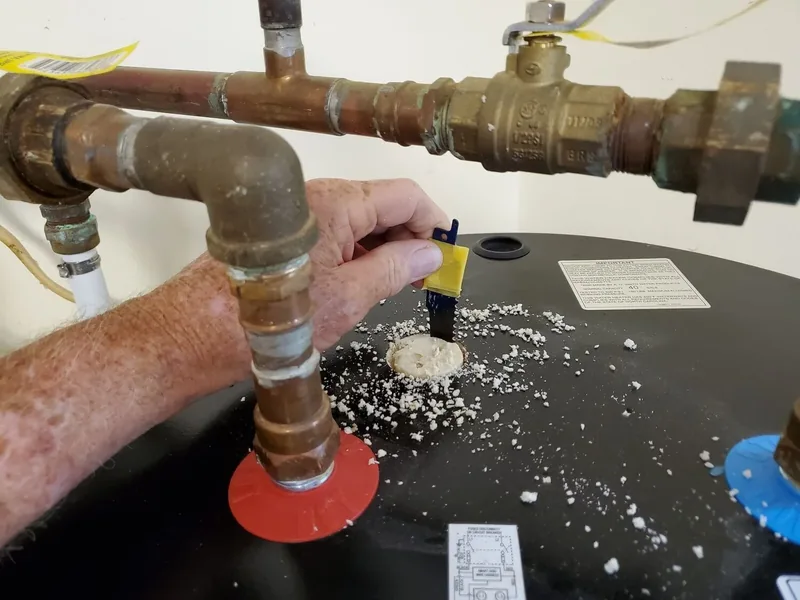
A professional anode rod replacement in a Wrentham home follows a careful sequence, and skipping steps is how DIY attempts go wrong. First we shut off the cold-water inlet and kill power at the breaker — or turn a gas control to pilot — because you never open a live, pressurized tank. Then we relieve pressure through a hot tap and drain a few gallons so the water level drops below the rod port. The old rod unthreads from its hex head at the tank top; on older 02093 tanks this fitting is often seized, which is where an impact wrench and experience matter — brute force in the wrong direction can twist the tank itself. We extract the rod fully, inspect it with you, and thread in the new one with proper sealant. Then the tank refills, air purges from the lines, power or gas comes back on, and we verify clear, odor-free hot water at the tap. Start to finish, most Wrentham jobs run sixty to ninety minutes.
Town-common colonials can mean tight old basements — segmented flex rods handle the low headroom — while subdivision utility rooms take standard rods. Water and power off, pressure relieved, old rod extracted for your inspection, matched replacement installed, system refilled and hot water verified at the tap.
The Rod Decision, Explained Plainly
Magnesium rods are the factory default in most tanks, and on kind water they're perfectly fine — magnesium is the most electrochemically active common anode material, which means it protects aggressively. The tradeoff is lifespan: on Wrentham's town and well water, a magnesium rod typically gives four to six years, and on aggressive well supplies sometimes half that. The other magnesium quirk matters in Wrentham's well-water neighborhoods: as magnesium degrades, sulfur-reducing bacteria feed on it, producing the rotten-egg hot-water smell. So magnesium is the right call for municipal-water tanks without odor issues — strong protection, standard lifespan, lowest part cost — and the wrong call where well water brings sulfur bacteria or very low pH. We stock magnesium for the tanks it suits and steer the rest toward better options.
Aluminum/zinc alloy rods are the workhorse upgrade for Wrentham's problem-water homes. The alloy sacrifices more slowly than pure magnesium, so it lasts longer — often seven-plus years on the same water that eats magnesium in four — and crucially, it doesn't feed sulfur bacteria the way magnesium does. For the rotten-egg hot water complaints we see across 02093's well-water pockets, swapping magnesium for aluminum/zinc frequently ends the odor within days while restoring full corrosion protection. The tradeoff is slightly less aggressive protection than magnesium, which is irrelevant in practice for residential tanks — the alloy still vastly out-protects a depleted rod, which is the actual alternative. When a Wrentham homeowner reports sulfur smell plus an aging tank, aluminum/zinc is usually our first recommendation, and the results speak at the tap.
Keeping the Tank Protected Year After Year
Here's the candid part: sometimes a new rod isn't the right answer, and we'd rather tell you than sell you. If the tank's bottom seam is already rusting through, if the jacket shows deep exterior corrosion, if the serial number says the unit is past fifteen years on aggressive water — a fresh rod buys months, not years, and the honest recommendation is planning a replacement on your schedule instead of the tank's. In Wrentham's older housing, town-common colonials and subdivision homes included, we have this conversation regularly, and homeowners consistently prefer hearing it before the basement floods. The rod inspection is what makes the call possible: with the old rod out and the tank's condition in front of us, we can distinguish the sound ten-year-old tank that deserves five more years from the terminal fifteen-year-old that doesn't. Either way, the (833) 713-2101 visit ends with a clear plan, not a guess.
The anode rod doesn't work alone — it's half of a two-part protection system, and the other half is flushing. Wrentham's town and well water lays down sediment in every tank: mineral particulate that settles to the bottom, buries the lower heating element or insulates the burner, and creates the popping and rumbling Wrentham homeowners hear from neglected units. Sediment also matters for the rod's world: a tank choked with sediment runs hotter at the bottom, accelerating the corrosion chemistry the rod is fighting. That's why our 02093 rod visits include a drain-valve check and usually a flush — the fresh rod protects the steel while the flush removes the sediment working against it. Going forward, annual flushing plus the rod-check rhythm above is the complete maintenance program, and it's the difference between tanks that die at ten years and tanks that serve at twenty.
What Happens When You Call (833) 713-2101
We serve all of Wrentham and the surrounding towns from our 02093-area base — town-common colonials and subdivision homes, downtown streets, and everything in between — with rod replacements, full water-heater service, and 24/7 emergency leak response on the same trucks. Calls to (833) 713-2101 are answered by people who know water heaters, not a phone tree; describe the rusty water or the sulfur smell and you'll get a straight answer about what it likely is and what it takes to fix. Evenings and weekends included. If your tank is past year five and the rod has never been checked, today's the day to find out what's left in there — before the tank starts telling you with rust. Water Heater Leak Repair Crew: call (833) 713-2101, ask a pro, get it handled.