Tankless Water Heater Error Codes: What They Mean and What to Do
Cryptic code on your tankless display? Those codes are the unit diagnosing itself. Learn the common fault families, safe
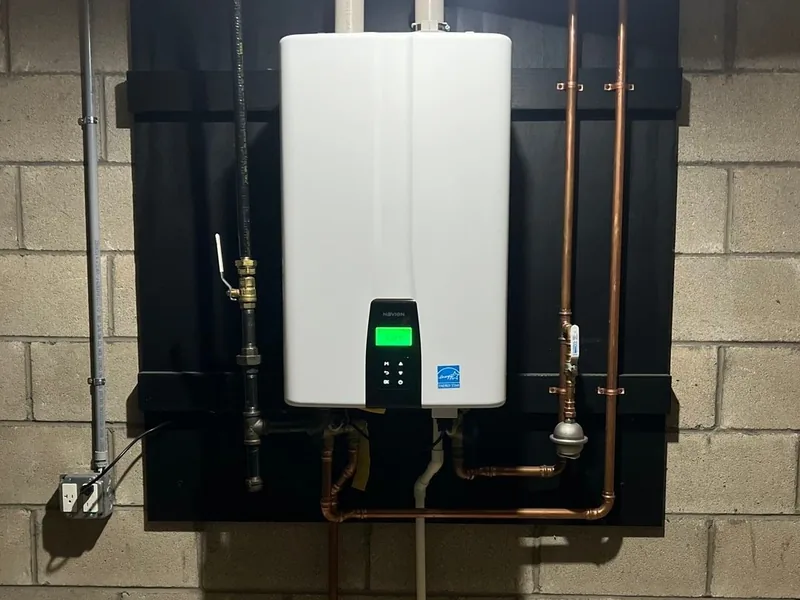
Your tankless water heater was working fine yesterday. Today it shows a cryptic code on the display — two digits, maybe a letter — and the hot water is gone or intermittent. Those error codes are actually the unit trying to help: modern tankless heaters self-diagnose, and each code narrows the problem to a specific system. Learning to read them turns a mysterious breakdown into a clear next step.
This guide explains how tankless error codes work, the common code families you will encounter, what you can safely check yourself, and when to call for service. Codes vary by manufacturer, so your owner's manual is the final authority on your specific unit — but the underlying problems are remarkably consistent across brands. For diagnosis and repair in Attleboro, call Water Heater Leak Repair Crew at (833) 713-2101.
How Tankless Error Codes Work
Tankless units monitor themselves continuously: flame sensors watch the burner, thermistors track water temperatures in and out, flow sensors measure demand, and the control board watches for anything outside expected ranges. When something goes wrong, the board shuts the unit down safely and displays a code identifying the fault family. Many units also store a short history of recent codes, which a technician can review to catch intermittent problems. The first rule of error codes: write down the exact code before resetting anything. That code is diagnostic gold — resetting without noting it erases the clue.
Ignition and Flame Failure Codes (The Most Common)
Codes in this family — often displayed as 11, 12, or similar depending on brand — mean the unit tried to light and failed, or the flame went out unexpectedly. The causes, in order of likelihood:
- Gas supply interrupted: Empty propane tank, utility work, or a closed gas valve. Check whether other gas appliances work.
- Igniter or flame rod fouled: Carbon buildup or corrosion on the ignition components. Cleaning resolves many cases.
- Scale-restricted flow: In hard-water areas like Attleboro, scale in the heat exchanger can reduce flow below the unit's minimum firing rate — the unit cannot sustain a flame at a trickle. Descaling often clears these codes.
- Venting problems: Blocked intake or exhaust, or incorrect venting, starves or destabilizes the flame.
- Low gas pressure: Especially in cold weather when demand peaks, or if the gas line is undersized for the unit.
Overheat and High-Limit Codes
Codes indicating overheating (often in the 14/16 family or a high-limit designation) mean the heat exchanger got hotter than its safe limit. The overwhelming cause in hard-water regions is scale: mineral buildup insulates the exchanger walls, so the burner overheats the metal trying to heat the water. Other causes include a failed temperature sensor, restricted water flow, or a recirculation issue. Do not ignore overheat codes — repeated overheating stresses the heat exchanger, the most expensive component in the unit. Descaling is the first response; if codes persist after descaling, the sensors or the exchanger need professional evaluation.
Flow and Sensor Codes
Flow-sensor codes mean the unit is not detecting the water movement it expects — no flow when there should be, or flow readings that do not make sense. Check the simple things first: inlet filter screen clogged with sediment (very common — it is a small screen at the water inlet that catches debris), isolation valves partially closed, or a household water pressure issue. Temperature-sensor codes (inlet or outlet thermistor faults) usually mean the sensor itself has failed or its wiring is damaged — sensor replacement is straightforward professional work.
Venting and Air Supply Codes
Condensing and direct-vent units monitor their venting. Blocked intake or exhaust codes appear when snow, ice, nests, or debris obstruct the vent terminations — a real winter hazard in Massachusetts, where drifting snow buries sidewall vents. Incorrect condensate drainage on condensing units can also trigger faults: the acidic condensate must drain freely, and a clogged or frozen condensate line shuts the unit down. After any snowstorm, checking exterior vent terminations is a two-minute habit that prevents these codes.
The Safe Reset Procedure
Many codes clear with a proper reset — but reset correctly. Note the code first. Then turn off the unit, close the gas valve, wait five minutes, restore gas, and power the unit back on. Some units have a specific reset button sequence in the manual. If the same code returns immediately or within a day, stop resetting and diagnose: repeated resets on an ignition fault, for example, just cycle the igniter without fixing the cause, and repeated overheat resets stress the exchanger. A code that returns is the unit insisting something is actually wrong — believe it.
What You Can Check vs. What Needs a Pro
Safe homeowner checks: Note the exact code. Verify gas supply (other appliances working, propane tank not empty). Check that isolation valves are fully open. Clean the inlet water filter screen. Clear snow/debris from exterior vent terminations. Check the condensate drain for blockages or freezing. Perform one proper reset.
Professional territory: Anything involving the gas line or gas valve, burner and igniter service beyond basic cleaning, heat exchanger descaling (it requires a pump and proper procedure — though handy homeowners do learn it), sensor replacement, control board issues, and any code that returns after the basic checks. Also: any code accompanied by the smell of gas or visible damage — shut down and call immediately.
Preventing Codes: The Descaling Imperative
A remarkable share of tankless error codes in Attleboro trace back to one root cause: scale. Ignition failures from low flow, overheat codes from insulated exchangers, sensor codes from scaled thermistor wells — all of them downstream of mineral buildup. Annual descaling (a vinegar or descaling-solution circulation through the service valves) prevents the majority of these faults and is the single most important tankless maintenance task. If your unit has never been descaled and is now throwing codes, descaling is the first prescription regardless of the specific code.
Tankless throwing error codes? Water Heater Leak Repair Crew diagnoses tankless faults, descales heat exchangers, and repairs ignition, sensor, and venting issues across Attleboro. Call (833) 713-2101 — note the code before you call; it helps us help you faster.