Tankless Water Heater Descaling Guide for Attleboro, MA
Published October 12, 2026 — Water Heater Leak Repair Crew
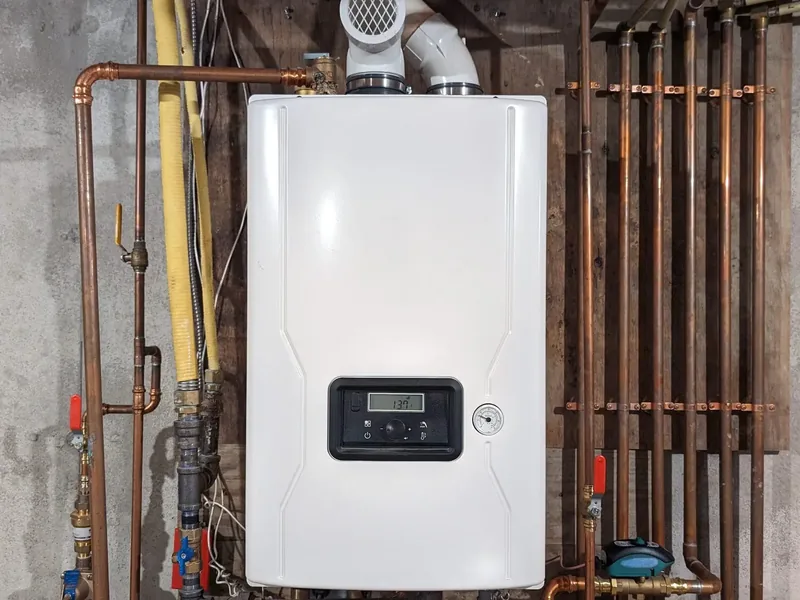
Tankless water heaters never run out of hot water — but they do collect mineral scale. Every gallon that passes through the heat exchanger leaves a trace of calcium and magnesium behind, and in hard-water areas like Attleboro and the surrounding Bristol County towns, that trace becomes a coating. A scaled heat exchanger heats water less efficiently, forces the burner to work harder, and eventually triggers shutdowns and error codes. The fix is descaling: circulating a mild acid solution through the unit to dissolve the buildup. It is the single most important maintenance a tankless owner can do, and most homeowners can handle it themselves in an afternoon.
This guide explains why descaling matters, how often to do it in Attleboro, what supplies you need, the full step-by-step flush procedure, and the situations where a professional should take over.
Why Descaling Matters for Tankless Heaters
Inside a tankless unit, water races through a compact copper or stainless-steel heat exchanger while the burner fires directly beneath it. Even a thin layer of mineral scale acts as insulation between the flame and the water, so the unit burns more fuel to deliver the same temperature. Symptoms of a scaled heat exchanger include noticeably reduced hot-water flow, temperatures that swing hot and cold, the unit cutting out mid-shower, unfamiliar rumbling or popping during operation, higher gas bills, and fault codes related to overheating or flow sensors.
Left alone, heavy scale shortens the life of the heat exchanger — the most expensive part of the unit — and can trip the high-limit safety switches repeatedly. Many manufacturers also require documented annual maintenance to keep warranty coverage intact, so check your owner's manual. In short, descaling is cheap insurance for a machine that costs several times what a tank heater does.
How Often Should You Descale in Attleboro?
For homes on Attleboro's municipal supply, once every 12 months is the standard. If your home in Norton, Rehoboth, Seekonk, or Mansfield runs on a private well — where mineral content is typically higher — plan on every six months. If you have a whole-house water softener, you can stretch the interval, but don't skip descaling entirely; softeners don't remove everything. Set a calendar reminder: tankless descaling is easy to forget because there's no tank to remind you.
What You Need
- A 5-gallon bucket
- A submersible utility pump (about 1/6 HP is plenty)
- Two washing-machine hoses (or short garden hoses with female fittings)
- 4–5 gallons of plain white vinegar, or a manufacturer-approved descaling solution
- Service (isolation) valves with hose-bib ports on the hot and cold lines — most properly installed tankless units have them
- Towels and a bucket for drips, plus gloves
Safety First
Shut off power to the unit — unplug it or switch off its dedicated breaker. You don't need to shut off the gas line for a descale (the burner won't fire with the unit powered off), but the heat exchanger stays hot for a while after use, so let the unit cool for at least 30 minutes. Close the hot and cold isolation valves at the unit before you open any service port.
Step-by-Step: Descaling Your Tankless Water Heater
- Power off and isolate. Switch off the breaker or unplug the unit. Close the hot-water and cold-water isolation valves at the unit so it is separated from the house plumbing.
- Set up the circulation loop. Remove the caps from the hot and cold service ports (the hose-bib fittings on the isolation valves). Connect one hose from the pump outlet to the cold-water service port, and a second hose from the hot-water service port back into the bucket. Set the pump in the bucket.
- Fill and circulate. Pour 4–5 gallons of plain white vinegar into the bucket (or your descaling solution, mixed per its instructions) and start the pump. The vinegar circulates through the heat exchanger, dissolving scale, and returns to the bucket. Let it run for 45–60 minutes. If the unit has a purge valve, crack it briefly early on to flush loose debris into the bucket.
- Rinse with clean water. Unplug the pump, dump the vinegar, and refill the bucket with clean water. Run the pump for another 5–10 minutes to flush all the acid out of the heat exchanger. Skipping the rinse leaves vinegar odor in your hot water for days.
- Disconnect and restore. Remove the hoses, replace the service port caps snugly, and reopen the hot and cold isolation valves.
- Restore power and bleed air. Restore the breaker or plug the unit back in. Open the nearest hot tap and let it run until the flow is steady and air-free.
- Verify operation. Run hot water at a couple of fixtures. Flow should feel stronger, temperature steadier, and any prior fault codes should be gone. Check the service ports and isolation valves for drips.
When to Call a Professional
Call for help if your unit has no isolation valves or service ports — they need to be installed before any flush is possible, and that involves cutting into the water lines. Also call if you find leaks at fittings during the procedure, if error codes persist after descaling, if the unit has never been serviced and is many years old, or if anything involves the gas line itself. Never open the gas connection or the combustion compartment; those are pro-only territory.
Water Heater Leak Repair Crew services tankless units across Attleboro, MA 02703 and the surrounding towns — North Attleboro, Norton, Mansfield, Taunton, Plainville, Wrentham, Rehoboth, Seekonk, and Franklin. Whether you need isolation valves installed, a stubborn fault code diagnosed, or a full professional descale, call (833) 713-2101.