Why Is My Water Heater Leaking From the Bottom?
Water pooling at the base of your water heater? It could be a simple valve fix — or a dying tank. Work through the cause
Water pooling at the base of your water heater is the sight every homeowner dreads — and for good reason. While some bottom leaks are minor and fixable, a leak from the tank bottom itself is the classic end-of-life failure. Telling the difference quickly determines whether you need a wrench or a replacement.
This guide walks through every cause of bottom leaking, in order from most hopeful to most serious, with the tests that distinguish them. If water is actively spreading, skip to the shutoff steps — or call Water Heater Leak Repair Crew right now at (833) 713-2101.
First: Rule Out Condensation
Before diagnosing a leak, rule out the impostor. In humid weather — or when a tank has just been filled with cold water — condensation forms on the cold tank shell and drips to the floor, looking exactly like a bottom leak. The test: dry the floor completely, then check back after the heater has run a full heating cycle. Condensation diminishes as the tank warms; a true leak persists or worsens. New installations and heavy-use days are the classic condensation scenarios. If the moisture appeared once and never returned, it was almost certainly condensation.
Cause 1: The Drain Valve
The drain valve sits at the very bottom of the tank, so its drips pool exactly where a tank-bottom leak would. Check it first: look for droplets at the spout, mineral trails below it, or dampness on the valve body. Plastic factory valves crack and weep with age — extremely common. The fix is replacement, ideally upgrading to a full-port brass ball valve (see our drain valve guide). This is the best-case bottom leak: cheap, fast, and permanent.
Cause 2: The T&P Discharge Pipe
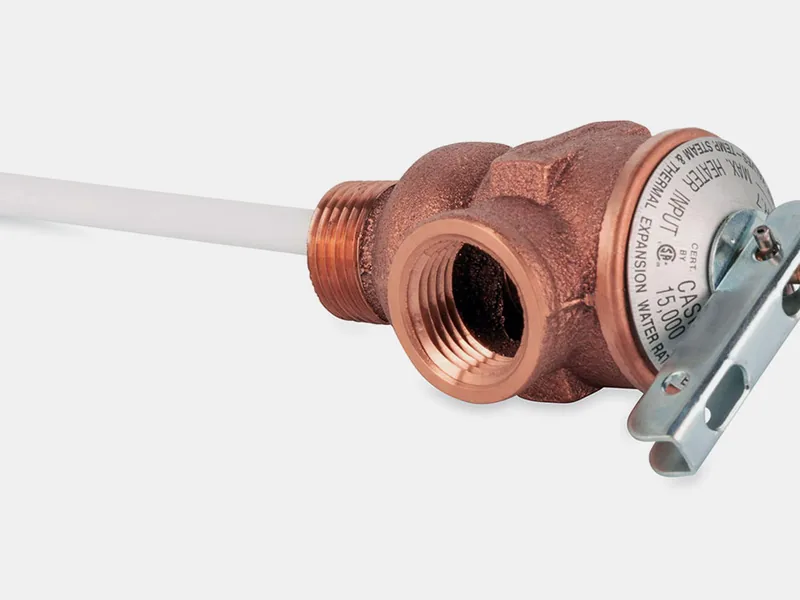
The temperature-and-pressure relief valve's discharge pipe runs down the side of the tank and terminates near the floor. When the valve weeps — usually from system pressure issues, not valve failure — water lands at the base and looks like a bottom leak. Trace the pipe upward: if the moisture tracks to the pipe's end, the relief valve is your source, and the real problem is pressure (check the expansion tank). Fix the pressure and the bottom dries up.
Cause 3: Leaking From Above, Traveling Down
Water obeys gravity. A drip from a top fitting, the relief valve, or a sweating cold-water pipe runs down the tank shell and pools at the base — framing the bottom for a crime committed at the top. The paper-towel test from our leak detection guide settles it: dry everything, wrap suspect upper fittings in paper towels, and see where moisture reappears first. More bottom leaks than you would expect are actually top leaks in disguise.
Cause 4: Electric Element Gaskets
On electric heaters, the lower heating element sits near the tank bottom behind an access panel. When its gasket fails, water seeps from behind the panel and runs down to the floor. Remove the lower access panel and insulation: moisture or rust around the element means a gasket (and usually element) replacement — a routine repair, not a death sentence. This is a common cause of bottom-area water on electric units specifically.
Cause 5: Internal Tank Leak — The Serious One
If you have ruled out the valve, the discharge pipe, top fittings, and element gaskets, what remains is the tank shell itself: a seam, the bottom head, or a rusted-through spot. Internal tank leaks cannot be repaired — no sealant, patch, or welding fixes a corroded pressure vessel safely. The leak will only grow, sometimes slowly for weeks, sometimes catastrophically overnight.
Confirm it with the dry-and-watch test: dry the base thoroughly, do not use hot water for a few hours, and check whether moisture reappears with no other source active. Also look for rust streaks originating from seams or the bottom edge — corrosion evidence supports the diagnosis. A tank-shell leak means replacement, and sooner is better than later: a weeping seam can become a ruptured seam, and 50 gallons on a basement floor is the scenario to avoid.
What To Do Right Now
Active spreading water: Shut off the cold-water inlet valve at the top of the heater, shut off energy (breaker for electric, gas control to OFF for gas), and call for help. If the tank shell is the source, consider draining the tank into a floor drain to limit further release.
Slow weep, source unknown: Run the diagnostic sequence above — condensation check, drain valve, discharge pipe, top fittings, element gaskets — before assuming the worst. Many bottom scares resolve at step one or two.
Confirmed tank-shell leak: Plan the replacement now, on your schedule, rather than waiting for the weep to become a flood. If your heater is over 10 years old, this is the expected end of its service life, not bad luck.
The Attleboro Angle: Why Bottom Leaks Cluster Here
Two local factors make bottom leaks more common in this area. First, moderately hard water builds sediment blankets on the tank bottom, and that sediment superheats the steel with every cycle — accelerating the corrosion that ends in bottom failure. Heaters that were never flushed are the ones that leak from the bottom first. Second, damp basements (common in Attleboro's older housing stock) corrode tanks from the outside in, attacking the bottom edge where moisture lingers. Annual flushing and keeping the area around the heater dry are the two habits that push bottom failure years into the future.
Water at the base of your heater? Water Heater Leak Repair Crew will find the true source fast — and if the tank is done, we replace it the same day. Call (833) 713-2101, Attleboro and nearby towns, 24/7.