Why Is My Water Heater Leaking From the Top?
Water pooling on top of your water heater is usually good news — top leaks come from fixable fittings and valves, not dy
Water on top of your water heater is, paradoxically, good news — most of the time. Unlike bottom leaks, which often signal tank failure, top leaks usually come from fittings, connections, and valves: parts that can be tightened, resealed, or replaced. The trick is identifying exactly which one is dripping, because water on top travels down and can masquerade as leaks elsewhere.
This guide maps every common top-leak source, the tests that isolate them, and the fixes. If you would rather have a technician handle it, Water Heater Leak Repair Crew is available around the clock at (833) 713-2101.
Source 1: Inlet and Outlet Fittings
The cold-water inlet and hot-water outlet at the tank top are the most common drip points. Causes include loose connections (thermal cycling slowly backs them off over years), failed thread sealant, corroded dielectric unions, and deteriorated flexible connectors. Look for: droplets forming at the joint, green or white mineral crust (evidence of long-term slow weeping), and rust streaks running down the tank from the fitting. The fix depends on condition — a sound fitting may just need tightening and resealing with fresh Teflon tape and pipe dope; a corroded nipple or union needs replacement. Dielectric unions deserve special mention: they join the steel tank nipples to copper house plumbing, and when their insulating separator fails, galvanic corrosion eats the joint — replacement with new dielectric unions is the correct fix.
Source 2: The T&P Relief Valve
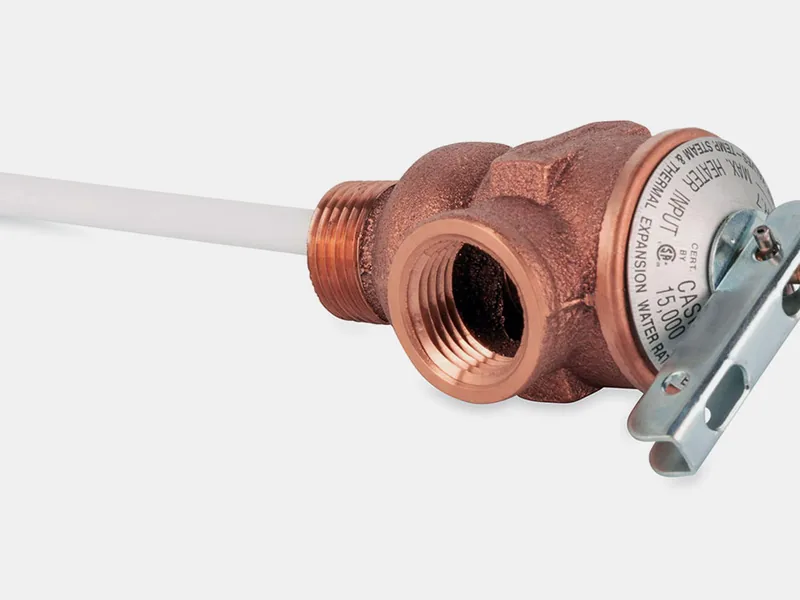
If your relief valve is top-mounted (common), its weeping drips directly onto the tank top and runs down. But remember the golden rule of relief valves: the valve is usually the messenger, not the problem. Top-mounted valve dripping means system pressure spikes — check the expansion tank and house pressure before replacing the valve. If the valve body itself is corroded or the lever will not reseat after testing, then replacement is warranted. See our pressure relief valve guide for the full diagnostic.
Source 3: The Anode Rod Port
The anode rod's hex-head plug is another top penetration, and it can weep — especially if the rod was recently serviced and the plug was not tightened quite enough, or if the threads have corroded over the years. A damp ring around the hex head or mineral crust radiating from it is the signature. Often a careful snug-tightening (with the water pressure relieved) stops it; persistent weeping may need the plug removed, threads cleaned, and resealed with fresh Teflon tape. If the tank's threaded spud is damaged, that is professional territory.
Source 4: Condensation on Cold Pipes
The cold-water inlet pipe sweats in humid conditions — Attleboro summers and damp basements are prime territory — and the drips land on the tank top. This is not a leak at all: it is condensation, and it stops when humidity drops or the pipe warms. The test is the same as for tank condensation: it is diffuse rather than localized at a joint, and insulating the cold-water pipe makes it vanish. Do not replace fittings to fix condensation — insulate the pipe.
Source 5: Leaking From Connected Equipment
Sometimes the water on top of the heater is not from the heater at all. An expansion tank mounted above can weep from its connection; a nearby water softener or filter can drip onto the heater; a sweating cold-water main running above can rain down. Look up, not just at the heater. Tracing the water upward past the heater itself has solved many misdiagnosed top leaks.
Source 6: Tank-Top Corrosion (The Bad One)
The least common but most serious top leak: the tank shell itself weeping around a top penetration or along the top seam. Years of fitting leaks dripping onto the tank top corrode the steel from the outside in, eventually perforating it. Signs that distinguish this from fitting leaks: rust blistering or pitting in the tank's top head away from any fitting, weeping that continues with all fittings dry, and a heater old enough (10+ years) for corrosion to have done its work. Like any shell leak, this means replacement — the tank is done.
The Isolation Procedure
When multiple top sources are possible, work systematically: dry the entire tank top thoroughly with towels. Wrap each fitting, the relief valve, and the anode plug in separate dry paper towels or rags. Wait two to three hours without using hot water (or run a normal cycle if the leak seems heat-related). Then inspect: the wet wrap marks the source. This simple test eliminates hours of guessing and prevents replacing the wrong part — the most common DIY error with top leaks is resealing a fitting when the relief valve was the actual source.
Fixes Ranked by Difficulty
- Tighten and reseal a fitting: Straightforward DIY — relieve pressure, tighten, reseal with Teflon tape and pipe dope.
- Replace a flexible connector or dielectric union: Moderate DIY — shut off water, drain pressure, swap the part.
- Replace the relief valve: Moderate — see our dedicated guide; remember to check expansion first.
- Reseal the anode plug: Easy to moderate — often just needs snug-tightening.
- Insulate a sweating pipe: Easy — foam insulation, ten minutes.
- Repair tank-top shell corrosion: Not repairable — replacement.
Preventing Top Leaks
Most top leaks are slow-motion failures that a glance would have caught years earlier. Include the tank top in your monthly visual check: look for the first hint of mineral crust at joints, the earliest rust bloom around the anode plug, the first dampness under the expansion tank connection. Catching a weeping dielectric union at the crust stage is a fifteen-minute reseal; catching it at the corroded-through stage is a bigger job. Attleboro's mineral-rich water leaves obvious white trails where it weeps — use that visibility as your early-warning system.
Water on top of your heater? Water Heater Leak Repair Crew finds the exact source and fixes it right — fittings, valves, unions, or honest advice when the tank is done. Call (833) 713-2101 in Attleboro and nearby towns.