Bellingham Water vs. Your Drain Valve
Bellingham's well-water pockets make drain valves work harder than anywhere else in our service area. Private wells here carry sediment — fine grit and mineral particulate that settles to the tank bottom and packs around the factory plastic drain valve until it can't pass water at all. Homeowners discover this during a DIY flush: the hose trickles, the valve handle snaps, and the tank can't be drained. Meanwhile the mill-village homes on town water face the opposite problem — valves that haven't been touched in fifteen years and have seized solid in damp utility closets. Either way, the answer is the same: a full-port brass ball valve that drains at full bore and actually survives sediment. Once it's in, annual flushing becomes a twenty-minute job instead of a fight, and the tank runs cooler, quieter, and longer.
What a Dying Drain Valve Looks Like
Here's how to read your valve in thirty seconds. Look at the spout: active dripping or fresh mineral staining means the seals have failed. Try the handle gently — if it crumbles, spins without engaging, or won't budge at all, the valve is finished. Check the body: white or green mineral crust mounding on the plastic, hairline cracks, or a chalky texture all signal embrittlement from years of Bellingham's mix of town water and private wells exposure. And the functional test: attach a hose and open it — a healthy valve flows strongly; a dying one trickles, sputters, or passes nothing, because sediment has packed around it. In 02019, the trickle-test failure is the most common finding, especially where well water carries heavy sediment. Any single failure on this checklist means the valve needs replacing, and a full-port brass valve is the replacement that ends the cycle permanently.
A valve that drips constantly at the spout, a handle that breaks off in your hand, or a hose connection that only trickles during a flush all mean the valve is done. In Bellingham's well neighborhoods, sediment visibly packed around the valve threads is a dead giveaway.
What the Service Visit Involves
The two complications we plan for on Bellingham calls are seizure and sediment. Seizure: after a decade or more of Bellingham's mix of town water and private wells, the plastic valve's threads can bond to the tank fitting with mineral scale — the answer is penetrating heat, patience, and backing the valve out squarely so the tank threads survive intact. If threads do get damaged, we have the tooling to restore them; replacing a tank because of a valve swap is never acceptable. Sediment: in mill-village homes and 1990s subdivisions, especially where wells run heavy, the valve area can be packed solid — we clear it mechanically before the swap so the new valve starts in a clean port. We also protect your space as standard: drop cloths, containment, and pump-out ready, because draining a tank always carries spill risk. The whole visit typically runs ninety minutes to two hours, and you get a valve that works for decades.
Well-sediment valves are often clogged solid, so we come prepared to clear the blockage and drain the tank fully before the swap. We remove the failed plastic valve, chase the threads clean, and install a full-port brass valve — then run a proper flush so you start fresh with a valve that can actually do its job.
What We Install — and Why
The full-port brass ball valve we install is a different species entirely. 'Full-port' means the bore through the valve is the same diameter as the pipe — no restriction, so sediment-laden water passes instead of packing. 'Ball valve' means a quarter-turn handle rotates a brass ball with a hole through it: open or closed, no washers to wear, no stem packing to weep, no multi-turn threading to seize. 'Brass' means a body that ignores the mineral exposure and temperature cycling that destroyed the plastic original — the valves we install in Bellingham today will still be operating smoothly when the tank itself is replaced. For mill-village homes and 1990s subdivisions, where valves face everything from heavy well sediment to freeze-prone utility spaces, brass isn't a luxury; it's the only valve material that reliably survives the full service life.
The factory valve is plastic for one reason: it costs pennies at the factory. It's a narrow-bore nylon or PVC spigot with a multi-turn stem, small seals, and a body that embrittles with heat and mineral exposure — a part designed to survive the warranty period, not the tank's life. In Bellingham, on Bellingham's mix of town water and private wells, that design life expires right on schedule: the seals harden and weep, the body chalks and cracks, the narrow bore clogs with the first serious sediment. We've removed hundreds of these across 02019, and the failure pattern never varies — only the timeline, which runs faster wherever water is hardest or most sediment-laden. Nobody should mourn the plastic valve. It was never meant to last, and replacing it isn't an upgrade so much as a correction.
What Changes With a Working Valve
Here's the maintenance pairing that matters most in Bellingham: the drain valve and the anode rod work as a system. The rod fights internal corrosion electrochemically; flushing removes the sediment that accelerates that corrosion physically. A tank with a fresh rod but no flushing still dies early from sediment-insulated overheating; a tank that's flushed but running on a dead rod still rusts from the inside. On Bellingham's mix of town water and private wells, the complete program is annual flushing plus a rod check every three to five years (closer to three on aggressive wells). In mill-village homes and 1990s subdivisions, we set homeowners up with both dates after the valve visit — because the valve replacement is the moment the tank becomes maintainable, and maintainable tanks are the ones that reach twenty years. Skip either half and you're protecting the tank with one hand tied behind your back.
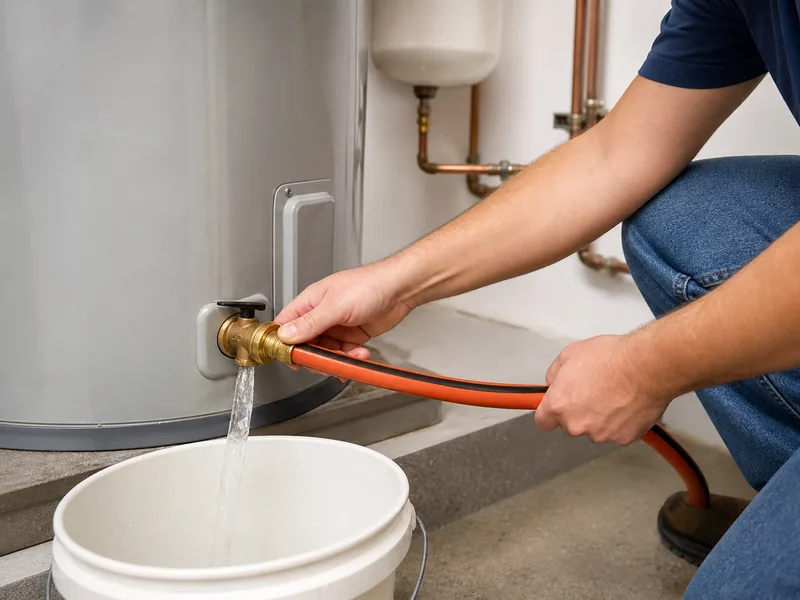
The new brass valve's first job is the flush the tank has been missing — possibly for years. On Bellingham calls we flush until the water runs clear, and on 02019's long-neglected tanks that can mean an astonishing volume of sediment: mineral sand, scale flakes, and rust particulate the tank has carried since installation. The effect is immediate and audible — the popping and rumbling quiets, recovery gets faster, and the burner or elements stop overheating. Going forward, the maintenance rhythm for Bellingham's mix of town water and private wells is annual flushing: attach a hose, open the brass valve full-bore for several minutes until clear, close it with the same quarter turn. Twenty minutes, once a year, no tools beyond a garden hose. Tanks on this rhythm in Bellingham routinely outlive their rated life; tanks without it die of sediment and corrosion years early. The valve makes the rhythm possible.
Book Your Valve Replacement
We serve all of Bellingham and the surrounding towns — mill-village homes and 1990s subdivisions, downtown streets, well-water neighborhoods, and everything in between — with drain-valve replacement, anode-rod service, full water-heater repair, and 24/7 emergency leak response from the same trucks. Calls to (833) 713-2101 reach people who know water heaters, not a call center; describe the drip or the snapped handle and you'll get a straight answer on timing and approach. Evenings and weekends included. A failed valve only gets worse — the weep becomes a stream, the seized valve becomes the reason a future emergency can't be drained. Get ahead of it: Water Heater Leak Repair Crew at (833) 713-2101.