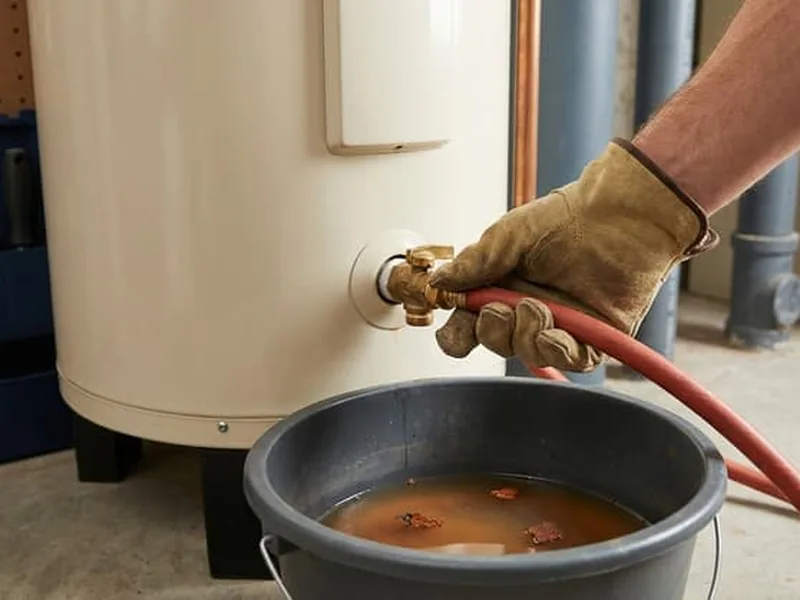
Why Berkley's Water Destroys Factory Drain Valves
Berkley's well water doesn't just eat anode rods — it buries drain valves in sediment. The mineral load in 02779's groundwater settles into a thick layer at the tank bottom, and the factory plastic valve sits right in it. Valves here clog, then seize, then snap when forced. We've seen Berkley tanks where the drain valve is essentially a sediment plug with a handle on it. That's a double problem: you can't flush the sediment that's killing the tank's efficiency, and if the tank ever needs emergency draining, the valve won't cooperate. A full-port brass ball valve is close to mandatory in Berkley — its wide opening passes sediment instead of choking on it, and the brass body doesn't go brittle with age. Pair it with an annual flush and a Berkley tank can outlive its warranty by years instead of dying early from the inside.
Reading Your Valve's Warning Signs
The factory drain valve on your water heater is a simple plastic spigot with a hard life: it sits at the tank's lowest point, submerged in the most mineral-laden water in the system, and Berkley's mineral-heavy private well water spends every year hardening its seals and embrittling its body. In Berkley homes the failure announces itself in stages. First the weep — a slow drip from the spout or the stem that leaves a mineral stain on the floor. Then the stiffness — the handle that used to turn now needs pliers. Then the terminal event: a flush attempt where the handle snaps, or the valve passes only a trickle because sediment has packed the bore solid. In farmhouses and colonials on large well-and-septic lots, we see all three stages weekly. The weep is the warning; the snap is the emergency. A valve at any stage deserves replacement, because plastic valves don't recover — they only deteriorate.
If your flush hose barely trickles, if the valve handle crumbles or spins freely, or if you see mineral crust mounding around the valve threads, the valve is finished. Berkley tanks that have never been flushed are the likeliest candidates — the sediment has had years to pack in.
The Swap, Step by Step
While the tank is drained and open in front of us, we do the inspection that turns a valve swap into a water-heater health check. On every 02779 visit we assess sediment volume (it tells us the flushing history), check the anode rod's likely condition from the tank's age and your water type, test the temperature-and-pressure relief valve, and examine inlet and outlet connections for the slow weeps that precede bigger failures. Berkley's mineral-heavy private well water leaves its signature everywhere — mineral crust patterns, sediment color and texture — and we read it into plain guidance: how the tank is really doing, what maintenance rhythm fits your water, and whether anything else deserves attention now. Berkley homeowners get the full picture, not just a new valve. And because a working valve makes future maintenance possible, we leave you with the flushing schedule your water actually needs.
We expect heavy sediment in Berkley, so we bring the gear to clear a packed valve and fully drain the tank before replacement. The old plastic valve comes out, threads get cleaned, and a full-port brass valve goes in with proper sealant — followed by a real flush so the new valve starts life in a clean tank.
Why Full-Port Brass Beats Plastic Every Time
The full-port brass ball valve we install is a different species entirely. 'Full-port' means the bore through the valve is the same diameter as the pipe — no restriction, so sediment-laden water passes instead of packing. 'Ball valve' means a quarter-turn handle rotates a brass ball with a hole through it: open or closed, no washers to wear, no stem packing to weep, no multi-turn threading to seize. 'Brass' means a body that ignores the mineral exposure and temperature cycling that destroyed the plastic original — the valves we install in Berkley today will still be operating smoothly when the tank itself is replaced. For farmhouses and colonials on large well-and-septic lots, where valves face everything from heavy well sediment to freeze-prone utility spaces, brass isn't a luxury; it's the only valve material that reliably survives the full service life.
We install lead-free full-port brass ball valves with quality thread sealant, sized to the tank's drain port — usually three-quarter inch — and we verify the installation under full system pressure before we leave. On Berkley calls we also assess the drain path: the valve needs a hose connection that reaches a safe discharge point, and in farmhouses and colonials on large well-and-septic lots we sometimes find valves installed where draining would flood the very space we're protecting. Where that's the case, we say so and suggest the fix. The valve itself carries the manufacturer's standard coverage, and our installation is backed by our own workmanship standard — if it weeps, sticks, or fails to operate, we make it right. It's a small part installed with the same care we'd give a full tank replacement, because in 02779's water conditions, this small part does outsized work.
The Maintenance Your Tank Can Finally Get
A word of honest scope: the brass valve solves the valve problem completely, but it can't reverse damage already done. If years without flushing have left the tank bottom deeply pitted, if the anode rod died half a decade ago, if the serial number says fifteen-plus years on hard water — the valve still gets replaced (a working valve is valuable on any tank), but we'll tell you plainly where the tank stands overall. In Berkley's older housing, farmhouses and colonials on large well-and-septic lots included, we regularly find tanks where the valve swap is worth doing and the tank still has years left, and tanks where the valve swap should be weighed against planning a replacement. The drained tank in front of us makes the call evidence-based, not speculative. Either way, the (833) 713-2101 visit ends with a straight answer and a clear next step.
The new brass valve's first job is the flush the tank has been missing — possibly for years. On Berkley calls we flush until the water runs clear, and on 02779's long-neglected tanks that can mean an astonishing volume of sediment: mineral sand, scale flakes, and rust particulate the tank has carried since installation. The effect is immediate and audible — the popping and rumbling quiets, recovery gets faster, and the burner or elements stop overheating. Going forward, the maintenance rhythm for Berkley's mineral-heavy private well water is annual flushing: attach a hose, open the brass valve full-bore for several minutes until clear, close it with the same quarter turn. Twenty minutes, once a year, no tools beyond a garden hose. Tanks on this rhythm in Berkley routinely outlive their rated life; tanks without it die of sediment and corrosion years early. The valve makes the rhythm possible.
Ready for a Valve That Works?
Before we arrive, two small preparations help: clear working space around the tank's base (the valve sits low, and the tech needs hose-routing room to a safe discharge point — a floor drain, sump, or outside), and note whether the valve is actively dripping, since an active leak gets priority scheduling. Everything else is ours: shutdown, cool-down, drain-down, extraction, installation, flush, and testing. In farmhouses and colonials on large well-and-septic lots, discharge routing sometimes needs creativity — utility sinks, laundry standpipes, or out a basement window with proper hose — and we've seen every configuration Berkley offers. If you're not sure where the water can go safely, mention it on the call and we'll plan for it. Reach us at (833) 713-2101.