Why Dighton's Water Destroys Factory Drain Valves
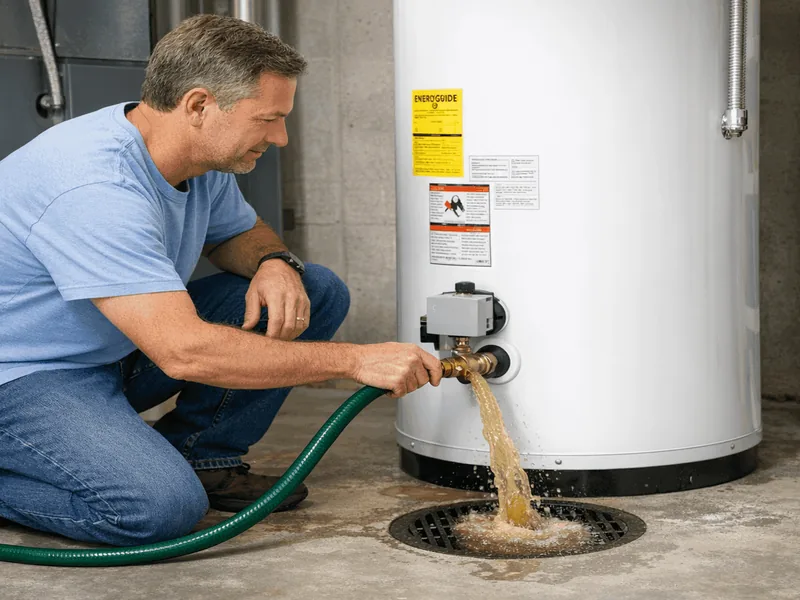
Dighton's wells carry fine sediment that settles exactly where the drain valve lives — at the tank bottom. Over the years it packs around the factory plastic valve until the valve is more sediment plug than valve, and the first anyone notices is during a flush attempt that produces a sad trickle. Meanwhile the plastic itself ages: years of mineral exposure make it brittle, and the valve starts weeping at the stem or the handle. For a Dighton tank, a working drain valve isn't a luxury — it's the only way to get the sediment out that's strangling the tank's efficiency and overheating its lower element or burner. We replace these with full-port brass ball valves whose wide opening passes sediment instead of choking, and suddenly the annual flush is a quick job instead of a lost cause. Given how hard Dighton water is on tanks generally, keeping sediment moving out is one of the best longevity moves available.
How to Tell Your Drain Valve Is Failing
Here's how to read your valve in thirty seconds. Look at the spout: active dripping or fresh mineral staining means the seals have failed. Try the handle gently — if it crumbles, spins without engaging, or won't budge at all, the valve is finished. Check the body: white or green mineral crust mounding on the plastic, hairline cracks, or a chalky texture all signal embrittlement from years of Dighton's private well water exposure. And the functional test: attach a hose and open it — a healthy valve flows strongly; a dying one trickles, sputters, or passes nothing, because sediment has packed around it. In 02715, the trickle-test failure is the most common finding, especially where well water carries heavy sediment. Any single failure on this checklist means the valve needs replacing, and a full-port brass valve is the replacement that ends the cycle permanently.
A flush hose that barely dribbles, a valve handle that snaps or spins uselessly, constant weeping from the spout, or visible grit packed around the valve threads — in Dighton, these are sediment-valve failures, and replacement beats repair every time.
How We Replace Your Drain Valve
A proper drain-valve replacement in a Dighton home is a methodical job, not a quick twist. First we shut off the cold-water inlet and kill power at the breaker — or set gas to pilot — then let the tank cool, because draining a scalding tank is how people get hurt. We attach a hose and drain the tank below the valve level (fully, if sediment demands it), which on 02715's older tanks can take a while through a clogged valve — we bring clearing tools for exactly this. Then the failed valve comes out: seized plastic gets controlled heat and the right wrench, never brute force that could damage the tank's threads. Threads get cleaned of mineral scale, the new full-port brass ball valve threads in with quality sealant, and the tank refills. We purge air, restore power or gas, pressure-test every connection, and finish with a proper flush so the new valve demonstrates full-bore flow immediately.
We come ready for packed sediment — clearing tools and full drain-down gear. The failed valve comes out, threads are cleaned, and a full-port brass valve goes in with proper sealant. Then we flush the tank properly, so you can see the difference a working valve makes from day one.
What We Install — and Why
We install lead-free full-port brass ball valves with quality thread sealant, sized to the tank's drain port — usually three-quarter inch — and we verify the installation under full system pressure before we leave. On Dighton calls we also assess the drain path: the valve needs a hose connection that reaches a safe discharge point, and in farmhouses and older colonials on country lots we sometimes find valves installed where draining would flood the very space we're protecting. Where that's the case, we say so and suggest the fix. The valve itself carries the manufacturer's standard coverage, and our installation is backed by our own workmanship standard — if it weeps, sticks, or fails to operate, we make it right. It's a small part installed with the same care we'd give a full tank replacement, because in 02715's water conditions, this small part does outsized work.
The factory valve is plastic for one reason: it costs pennies at the factory. It's a narrow-bore nylon or PVC spigot with a multi-turn stem, small seals, and a body that embrittles with heat and mineral exposure — a part designed to survive the warranty period, not the tank's life. In Dighton, on Dighton's private well water, that design life expires right on schedule: the seals harden and weep, the body chalks and cracks, the narrow bore clogs with the first serious sediment. We've removed hundreds of these across 02715, and the failure pattern never varies — only the timeline, which runs faster wherever water is hardest or most sediment-laden. Nobody should mourn the plastic valve. It was never meant to last, and replacing it isn't an upgrade so much as a correction.
Making the New Valve Pay Off
A word of honest scope: the brass valve solves the valve problem completely, but it can't reverse damage already done. If years without flushing have left the tank bottom deeply pitted, if the anode rod died half a decade ago, if the serial number says fifteen-plus years on hard water — the valve still gets replaced (a working valve is valuable on any tank), but we'll tell you plainly where the tank stands overall. In Dighton's older housing, farmhouses and older colonials on country lots included, we regularly find tanks where the valve swap is worth doing and the tank still has years left, and tanks where the valve swap should be weighed against planning a replacement. The drained tank in front of us makes the call evidence-based, not speculative. Either way, the (833) 713-2101 visit ends with a straight answer and a clear next step.
Here's the maintenance pairing that matters most in Dighton: the drain valve and the anode rod work as a system. The rod fights internal corrosion electrochemically; flushing removes the sediment that accelerates that corrosion physically. A tank with a fresh rod but no flushing still dies early from sediment-insulated overheating; a tank that's flushed but running on a dead rod still rusts from the inside. On Dighton's private well water, the complete program is annual flushing plus a rod check every three to five years (closer to three on aggressive wells). In farmhouses and older colonials on country lots, we set homeowners up with both dates after the valve visit — because the valve replacement is the moment the tank becomes maintainable, and maintainable tanks are the ones that reach twenty years. Skip either half and you're protecting the tank with one hand tied behind your back.
One Call, Permanent Fix
Calling (833) 713-2101 takes two minutes. We ask what's happening — dripping, seized, snapped, or trickling — plus gas or electric and the tank's rough age, then schedule the visit: most Dighton valve replacements happen within a few days, faster if it's actively leaking. The tech arrives with full-port brass valves in the standard sizes, plus clearing tools for sediment-packed 02715 tanks and thread-restoration tooling for the worst seizures. Ninety minutes to two hours later, the tank is flushed, the brass valve is pressure-tested, and you have a written note of the flushing rhythm your water needs. No return visits, no temporary fixes — the plastic era of your tank is over. Water Heater Leak Repair Crew: call (833) 713-2101.