What Makes 02766 Brutal on Drain Valves
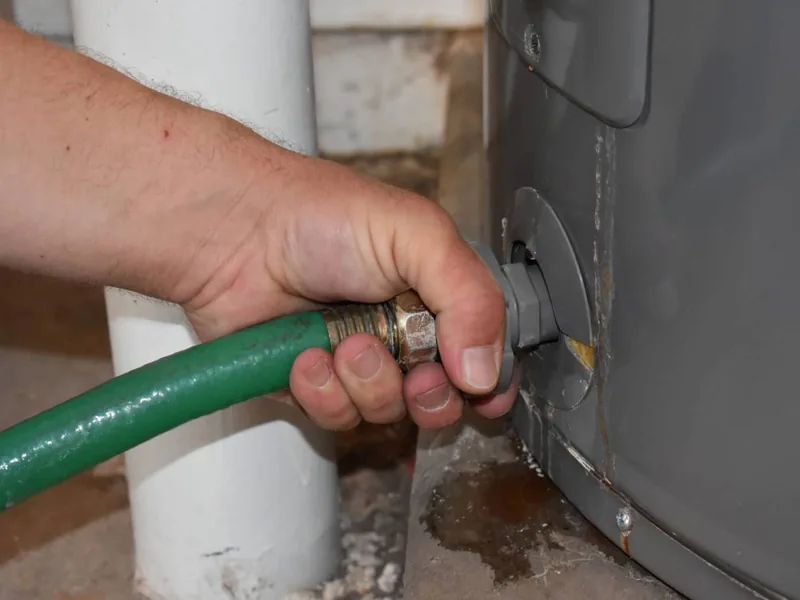
Norton's drain valves live the mixed-water life. In the well neighborhoods, sediment packs around the factory plastic valve until it's a plug with a handle — flush attempts trickle, forcing the handle snaps it. Near the town center, the failure is age: original valves on older tanks, brittle and mineral-crusted in damp basements, weeping at the stem for months unnoticed. The rental stock around Wheaton adds neglect to the mix — valves nobody has touched in fifteen years. Whatever the cause, a dead drain valve means the tank can't be flushed and can't be drained quickly, and in Norton's well areas that sediment is actively shortening tank life by insulating the bottom and overheating the heat source. A full-port brass ball valve ends all of it: full-bore flow that moves sediment, brass that doesn't embrittle, and a quarter-turn handle that works a decade from now. Small part, large consequences.
How to Tell Your Drain Valve Is Failing
The hidden cost of a dead drain valve isn't the drip — it's everything the dead valve prevents. A valve that can't open means the tank can't be flushed, and in Norton that matters enormously: Norton's town and well water deposits sediment continuously, and without flushing it accumulates into a thick insulating layer at the tank bottom. The burner or lower element then overheats trying to push heat through it — that's the popping and rumbling from neglected 02766 tanks — efficiency falls, and the overheated bottom accelerates the corrosion the anode rod is fighting. It also means the tank can't be drained quickly in an emergency, turning every future leak into a bigger flood. When we replace a valve in Wheaton-area colonials and rural homesteads, homeowners are often shocked at what comes out in the first real flush — gallons of sediment the tank has carried for years. The valve is small; its absence of function is enormous.
A flush hose that barely flows, a handle that snaps or spins, constant weeping from the spout, or mineral crust mounding on the valve body — Norton's valves fail in all four ways, and every one of them is a replacement case.
From Failed Plastic to Solid Brass
The two complications we plan for on Norton calls are seizure and sediment. Seizure: after a decade or more of Norton's town and well water, the plastic valve's threads can bond to the tank fitting with mineral scale — the answer is penetrating heat, patience, and backing the valve out squarely so the tank threads survive intact. If threads do get damaged, we have the tooling to restore them; replacing a tank because of a valve swap is never acceptable. Sediment: in Wheaton-area colonials and rural homesteads, especially where wells run heavy, the valve area can be packed solid — we clear it mechanically before the swap so the new valve starts in a clean port. We also protect your space as standard: drop cloths, containment, and pump-out ready, because draining a tank always carries spill risk. The whole visit typically runs ninety minutes to two hours, and you get a valve that works for decades.
Sediment-packed well valves get clearing tools; age-seized town valves get heat and patience. Either way: tank cooled and drained, old valve out, threads cleaned, full-port brass in with proper sealant — then a thorough flush so the tank starts clean and stays maintainable.
What We Install — and Why
We install lead-free full-port brass ball valves with quality thread sealant, sized to the tank's drain port — usually three-quarter inch — and we verify the installation under full system pressure before we leave. On Norton calls we also assess the drain path: the valve needs a hose connection that reaches a safe discharge point, and in Wheaton-area colonials and rural homesteads we sometimes find valves installed where draining would flood the very space we're protecting. Where that's the case, we say so and suggest the fix. The valve itself carries the manufacturer's standard coverage, and our installation is backed by our own workmanship standard — if it weeps, sticks, or fails to operate, we make it right. It's a small part installed with the same care we'd give a full tank replacement, because in 02766's water conditions, this small part does outsized work.
The full-port brass ball valve we install is a different species entirely. 'Full-port' means the bore through the valve is the same diameter as the pipe — no restriction, so sediment-laden water passes instead of packing. 'Ball valve' means a quarter-turn handle rotates a brass ball with a hole through it: open or closed, no washers to wear, no stem packing to weep, no multi-turn threading to seize. 'Brass' means a body that ignores the mineral exposure and temperature cycling that destroyed the plastic original — the valves we install in Norton today will still be operating smoothly when the tank itself is replaced. For Wheaton-area colonials and rural homesteads, where valves face everything from heavy well sediment to freeze-prone utility spaces, brass isn't a luxury; it's the only valve material that reliably survives the full service life.
The Maintenance Your Tank Can Finally Get
A word of honest scope: the brass valve solves the valve problem completely, but it can't reverse damage already done. If years without flushing have left the tank bottom deeply pitted, if the anode rod died half a decade ago, if the serial number says fifteen-plus years on hard water — the valve still gets replaced (a working valve is valuable on any tank), but we'll tell you plainly where the tank stands overall. In Norton's older housing, Wheaton-area colonials and rural homesteads included, we regularly find tanks where the valve swap is worth doing and the tank still has years left, and tanks where the valve swap should be weighed against planning a replacement. The drained tank in front of us makes the call evidence-based, not speculative. Either way, the (833) 713-2101 visit ends with a straight answer and a clear next step.
Here's the maintenance pairing that matters most in Norton: the drain valve and the anode rod work as a system. The rod fights internal corrosion electrochemically; flushing removes the sediment that accelerates that corrosion physically. A tank with a fresh rod but no flushing still dies early from sediment-insulated overheating; a tank that's flushed but running on a dead rod still rusts from the inside. On Norton's town and well water, the complete program is annual flushing plus a rod check every three to five years (closer to three on aggressive wells). In Wheaton-area colonials and rural homesteads, we set homeowners up with both dates after the valve visit — because the valve replacement is the moment the tank becomes maintainable, and maintainable tanks are the ones that reach twenty years. Skip either half and you're protecting the tank with one hand tied behind your back.
Book Your Valve Replacement
Before we arrive, two small preparations help: clear working space around the tank's base (the valve sits low, and the tech needs hose-routing room to a safe discharge point — a floor drain, sump, or outside), and note whether the valve is actively dripping, since an active leak gets priority scheduling. Everything else is ours: shutdown, cool-down, drain-down, extraction, installation, flush, and testing. In Wheaton-area colonials and rural homesteads, discharge routing sometimes needs creativity — utility sinks, laundry standpipes, or out a basement window with proper hose — and we've seen every configuration Norton offers. If you're not sure where the water can go safely, mention it on the call and we'll plan for it. Reach us at (833) 713-2101.