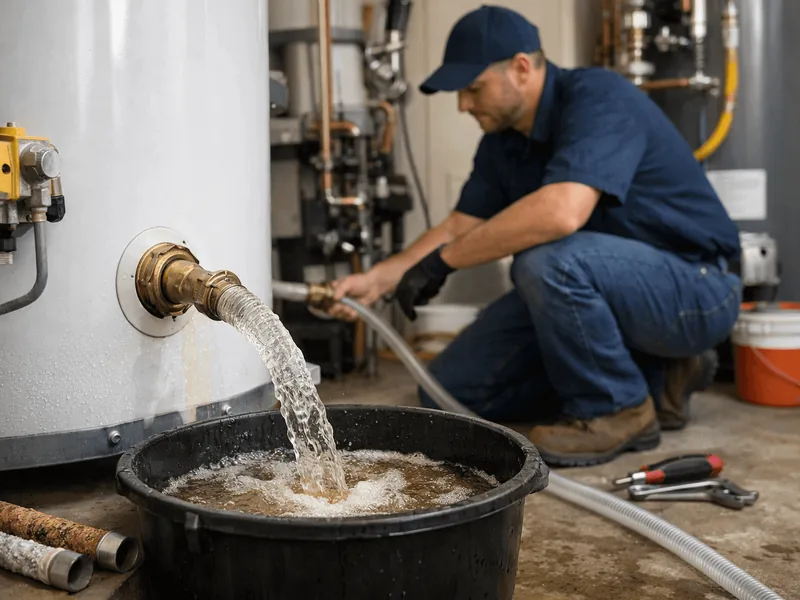
Plainville Water vs. Your Drain Valve
Plainville's ranch-house tanks mostly wear their original drain valves — builder-grade plastic now fifteen to thirty years old, depending on the neighborhood. The failure mode is consistent: the plastic embrittles, the valve starts weeping at the stem, and the first time anyone tries to use it — usually during a long-overdue flush attempt — the handle snaps or the valve seizes solid. In the well-water pockets, sediment compounds everything, packing around the valve until it can't pass water. A dead valve on a Plainville tank means two things: the slow drip nobody notices in the utility corner, and a tank that can never be flushed — so sediment keeps accumulating, efficiency keeps dropping, and the bottom keeps overheating. The full-port brass replacement changes the equation entirely: quarter-turn operation, full-bore drainage, and a body that outlasts the tank itself. For the cost of a small repair, the tank becomes maintainable again.
The Failure Signs Nobody Should Ignore
Here's how to read your valve in thirty seconds. Look at the spout: active dripping or fresh mineral staining means the seals have failed. Try the handle gently — if it crumbles, spins without engaging, or won't budge at all, the valve is finished. Check the body: white or green mineral crust mounding on the plastic, hairline cracks, or a chalky texture all signal embrittlement from years of Plainville's mixed town and well water exposure. And the functional test: attach a hose and open it — a healthy valve flows strongly; a dying one trickles, sputters, or passes nothing, because sediment has packed around it. In 02762, the trickle-test failure is the most common finding, especially where well water carries heavy sediment. Any single failure on this checklist means the valve needs replacing, and a full-port brass valve is the replacement that ends the cycle permanently.
Weeping at the spout, a handle that crumbles or spins freely, a flush that produces only a trickle, or mineral crust around the valve body — Plainville's aging builder-grade valves show these constantly, and replacement is the fix.
From Failed Plastic to Solid Brass
While the tank is drained and open in front of us, we do the inspection that turns a valve swap into a water-heater health check. On every 02762 visit we assess sediment volume (it tells us the flushing history), check the anode rod's likely condition from the tank's age and your water type, test the temperature-and-pressure relief valve, and examine inlet and outlet connections for the slow weeps that precede bigger failures. Plainville's mixed town and well water leaves its signature everywhere — mineral crust patterns, sediment color and texture — and we read it into plain guidance: how the tank is really doing, what maintenance rhythm fits your water, and whether anything else deserves attention now. Plainville homeowners get the full picture, not just a new valve. And because a working valve makes future maintenance possible, we leave you with the flushing schedule your water actually needs.
We work around Plainville's ranch layouts efficiently — tanks are usually accessible, so the job is quick. Cool and drain the tank, extract the failed valve (heat and patience for seized ones), clean the threads, install full-port brass with proper sealant, then flush and pressure-test.
The Valve Your Tank Deserves
The full-port brass ball valve we install is a different species entirely. 'Full-port' means the bore through the valve is the same diameter as the pipe — no restriction, so sediment-laden water passes instead of packing. 'Ball valve' means a quarter-turn handle rotates a brass ball with a hole through it: open or closed, no washers to wear, no stem packing to weep, no multi-turn threading to seize. 'Brass' means a body that ignores the mineral exposure and temperature cycling that destroyed the plastic original — the valves we install in Plainville today will still be operating smoothly when the tank itself is replaced. For postwar ranches and newer subdivisions, where valves face everything from heavy well sediment to freeze-prone utility spaces, brass isn't a luxury; it's the only valve material that reliably survives the full service life.
We install lead-free full-port brass ball valves with quality thread sealant, sized to the tank's drain port — usually three-quarter inch — and we verify the installation under full system pressure before we leave. On Plainville calls we also assess the drain path: the valve needs a hose connection that reaches a safe discharge point, and in postwar ranches and newer subdivisions we sometimes find valves installed where draining would flood the very space we're protecting. Where that's the case, we say so and suggest the fix. The valve itself carries the manufacturer's standard coverage, and our installation is backed by our own workmanship standard — if it weeps, sticks, or fails to operate, we make it right. It's a small part installed with the same care we'd give a full tank replacement, because in 02762's water conditions, this small part does outsized work.
Making the New Valve Pay Off
The new brass valve's first job is the flush the tank has been missing — possibly for years. On Plainville calls we flush until the water runs clear, and on 02762's long-neglected tanks that can mean an astonishing volume of sediment: mineral sand, scale flakes, and rust particulate the tank has carried since installation. The effect is immediate and audible — the popping and rumbling quiets, recovery gets faster, and the burner or elements stop overheating. Going forward, the maintenance rhythm for Plainville's mixed town and well water is annual flushing: attach a hose, open the brass valve full-bore for several minutes until clear, close it with the same quarter turn. Twenty minutes, once a year, no tools beyond a garden hose. Tanks on this rhythm in Plainville routinely outlive their rated life; tanks without it die of sediment and corrosion years early. The valve makes the rhythm possible.
A word of honest scope: the brass valve solves the valve problem completely, but it can't reverse damage already done. If years without flushing have left the tank bottom deeply pitted, if the anode rod died half a decade ago, if the serial number says fifteen-plus years on hard water — the valve still gets replaced (a working valve is valuable on any tank), but we'll tell you plainly where the tank stands overall. In Plainville's older housing, postwar ranches and newer subdivisions included, we regularly find tanks where the valve swap is worth doing and the tank still has years left, and tanks where the valve swap should be weighed against planning a replacement. The drained tank in front of us makes the call evidence-based, not speculative. Either way, the (833) 713-2101 visit ends with a straight answer and a clear next step.
What Happens When You Call (833) 713-2101
We serve all of Plainville and the surrounding towns — postwar ranches and newer subdivisions, downtown streets, well-water neighborhoods, and everything in between — with drain-valve replacement, anode-rod service, full water-heater repair, and 24/7 emergency leak response from the same trucks. Calls to (833) 713-2101 reach people who know water heaters, not a call center; describe the drip or the snapped handle and you'll get a straight answer on timing and approach. Evenings and weekends included. A failed valve only gets worse — the weep becomes a stream, the seized valve becomes the reason a future emergency can't be drained. Get ahead of it: Water Heater Leak Repair Crew at (833) 713-2101.