The Seekonk Factor: Water, Sediment, and Valve Failure
Seekonk's drain valves fail on the town's two timelines. In the well-water pockets, sediment is the killer — fine particulate packing around the factory plastic valve until flushes trickle and handles snap. On district water, it's age and neglect: builder-grade plastic valves now fifteen-plus years old, brittle and mineral-crusted, weeping at the stem in utility corners nobody inspects. The town's ranches often put tanks in tight utility closets or garage corners where a slow valve drip goes unnoticed until it stains the floor or feeds mildew. And in both water zones, a dead valve means the tank can't be flushed — so sediment accumulates, efficiency drops, and the tank bottom runs hotter than it should, accelerating the corrosion cycle. The full-port brass replacement solves it uniformly: wide bore that passes sediment, brass that doesn't embrittle, quarter-turn operation that still works in a decade. For Seekonk's mixed-water housing, it's the single most cost-effective valve upgrade there is.
The Failure Signs Nobody Should Ignore
The factory drain valve on your water heater is a simple plastic spigot with a hard life: it sits at the tank's lowest point, submerged in the most mineral-laden water in the system, and Seekonk's district and well water spends every year hardening its seals and embrittling its body. In Seekonk homes the failure announces itself in stages. First the weep — a slow drip from the spout or the stem that leaves a mineral stain on the floor. Then the stiffness — the handle that used to turn now needs pliers. Then the terminal event: a flush attempt where the handle snaps, or the valve passes only a trickle because sediment has packed the bore solid. In suburban ranches and colonials near the Providence line, we see all three stages weekly. The weep is the warning; the snap is the emergency. A valve at any stage deserves replacement, because plastic valves don't recover — they only deteriorate.
A flush that barely flows, a handle that breaks or spins freely, constant weeping from the spout, or sediment visibly packed around the valve — Seekonk's valves fail both ways, and brass replacement fixes both.
How We Replace Your Drain Valve
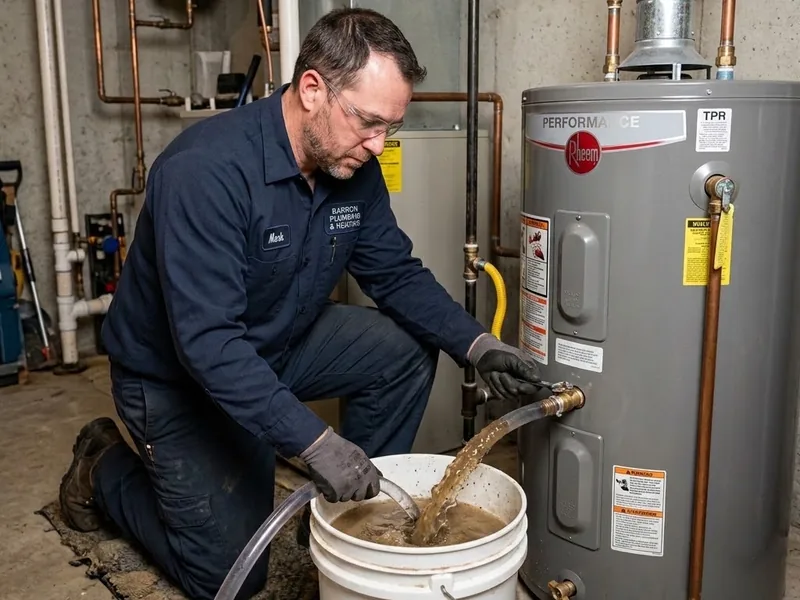
A proper drain-valve replacement in a Seekonk home is a methodical job, not a quick twist. First we shut off the cold-water inlet and kill power at the breaker — or set gas to pilot — then let the tank cool, because draining a scalding tank is how people get hurt. We attach a hose and drain the tank below the valve level (fully, if sediment demands it), which on 02771's older tanks can take a while through a clogged valve — we bring clearing tools for exactly this. Then the failed valve comes out: seized plastic gets controlled heat and the right wrench, never brute force that could damage the tank's threads. Threads get cleaned of mineral scale, the new full-port brass ball valve threads in with quality sealant, and the tank refills. We purge air, restore power or gas, pressure-test every connection, and finish with a proper flush so the new valve demonstrates full-bore flow immediately.
Well-pocket valves get sediment-clearing tools; age-seized district valves get heat and patience. Tank cooled and drained, old valve out, threads cleaned, full-port brass in with proper sealant — then a full flush and pressure test, so the new valve demonstrates its flow immediately.
Why Full-Port Brass Beats Plastic Every Time
We install lead-free full-port brass ball valves with quality thread sealant, sized to the tank's drain port — usually three-quarter inch — and we verify the installation under full system pressure before we leave. On Seekonk calls we also assess the drain path: the valve needs a hose connection that reaches a safe discharge point, and in suburban ranches and colonials near the Providence line we sometimes find valves installed where draining would flood the very space we're protecting. Where that's the case, we say so and suggest the fix. The valve itself carries the manufacturer's standard coverage, and our installation is backed by our own workmanship standard — if it weeps, sticks, or fails to operate, we make it right. It's a small part installed with the same care we'd give a full tank replacement, because in 02771's water conditions, this small part does outsized work.
The practical differences show up from the first use. Draining a tank through the old plastic valve — when it works at all — is a slow, sputtering affair; through a full-port brass valve, it's a strong, steady flow that actually carries sediment out instead of leaving it behind. Flushing becomes a twenty-minute annual task instead of a fight, which means Seekonk homeowners actually do it — and tanks that get flushed annually live measurably longer on Seekonk's district and well water. Emergency draining, the scenario nobody plans for, goes from impossible to quick: a quarter turn and the tank empties at full bore. And the valve's own reliability transforms — no weeping stem, no crumbling handle, no freeze-cracked body. Across 02771, the brass valve is the rare repair that makes every future interaction with the tank easier, cheaper, and safer.
Making the New Valve Pay Off
A word of honest scope: the brass valve solves the valve problem completely, but it can't reverse damage already done. If years without flushing have left the tank bottom deeply pitted, if the anode rod died half a decade ago, if the serial number says fifteen-plus years on hard water — the valve still gets replaced (a working valve is valuable on any tank), but we'll tell you plainly where the tank stands overall. In Seekonk's older housing, suburban ranches and colonials near the Providence line included, we regularly find tanks where the valve swap is worth doing and the tank still has years left, and tanks where the valve swap should be weighed against planning a replacement. The drained tank in front of us makes the call evidence-based, not speculative. Either way, the (833) 713-2101 visit ends with a straight answer and a clear next step.
Here's the maintenance pairing that matters most in Seekonk: the drain valve and the anode rod work as a system. The rod fights internal corrosion electrochemically; flushing removes the sediment that accelerates that corrosion physically. A tank with a fresh rod but no flushing still dies early from sediment-insulated overheating; a tank that's flushed but running on a dead rod still rusts from the inside. On Seekonk's district and well water, the complete program is annual flushing plus a rod check every three to five years (closer to three on aggressive wells). In suburban ranches and colonials near the Providence line, we set homeowners up with both dates after the valve visit — because the valve replacement is the moment the tank becomes maintainable, and maintainable tanks are the ones that reach twenty years. Skip either half and you're protecting the tank with one hand tied behind your back.
Book Your Valve Replacement
We serve all of Seekonk and the surrounding towns — suburban ranches and colonials near the Providence line, downtown streets, well-water neighborhoods, and everything in between — with drain-valve replacement, anode-rod service, full water-heater repair, and 24/7 emergency leak response from the same trucks. Calls to (833) 713-2101 reach people who know water heaters, not a call center; describe the drip or the snapped handle and you'll get a straight answer on timing and approach. Evenings and weekends included. A failed valve only gets worse — the weep becomes a stream, the seized valve becomes the reason a future emergency can't be drained. Get ahead of it: Water Heater Leak Repair Crew at (833) 713-2101.