Sharon Water vs. Your Drain Valve
Sharon's drain valves face a threat most towns' valves don't: freeze. Tanks and their piping in unheated garages, crawlspaces, and lake-cottage utility areas see ambient temperatures that can freeze a weeping valve's drip into an ice plug — or crack a brittle plastic valve body outright when a hard freeze hits. Even in heated basements, Sharon's winter inlet water is cold enough that tanks cycle hard, and the thermal expansion stresses every fitting including the drain valve. The factory plastic valves on Sharon's mid-life tanks are now old enough to be brittle, and a brittle valve plus a freeze event is how a small drip becomes a burst fitting. A full-port brass ball valve is far more freeze-tolerant than plastic — brass doesn't crack the way aged plastic does — and its reliable shutoff means you can actually drain a tank quickly if a freeze emergency threatens. For Sharon's colder installations especially, brass isn't an upgrade, it's winterization.
What a Dying Drain Valve Looks Like
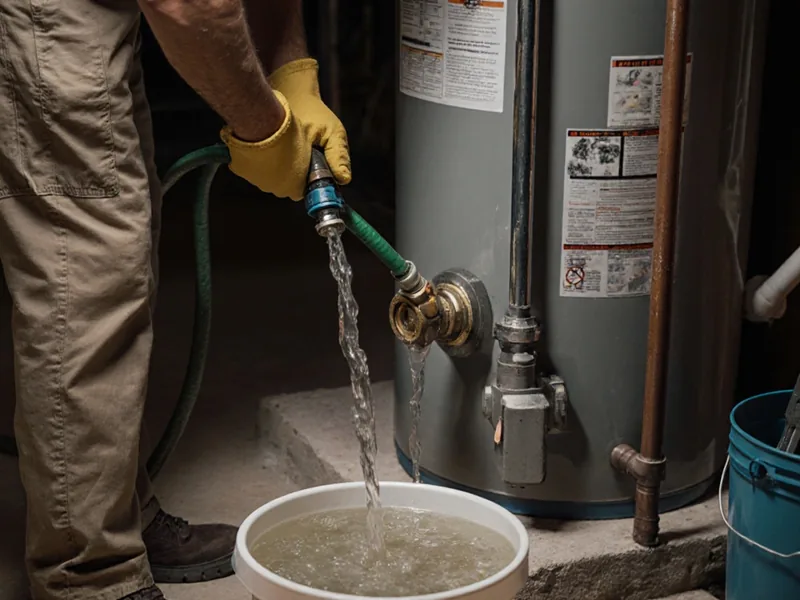
Here's how to read your valve in thirty seconds. Look at the spout: active dripping or fresh mineral staining means the seals have failed. Try the handle gently — if it crumbles, spins without engaging, or won't budge at all, the valve is finished. Check the body: white or green mineral crust mounding on the plastic, hairline cracks, or a chalky texture all signal embrittlement from years of Sharon's municipal supply exposure. And the functional test: attach a hose and open it — a healthy valve flows strongly; a dying one trickles, sputters, or passes nothing, because sediment has packed around it. In 02067, the trickle-test failure is the most common finding, especially where well water carries heavy sediment. Any single failure on this checklist means the valve needs replacing, and a full-port brass valve is the replacement that ends the cycle permanently.
A valve that weeps and freezes into an icicle, a plastic body showing hairline cracks after a cold snap, a handle too stiff to operate in winter, or mineral crust around the spout — in Sharon, these are pre-freeze warnings. Replace before the next deep cold.
Our Replacement Process
While the tank is drained and open in front of us, we do the inspection that turns a valve swap into a water-heater health check. On every 02067 visit we assess sediment volume (it tells us the flushing history), check the anode rod's likely condition from the tank's age and your water type, test the temperature-and-pressure relief valve, and examine inlet and outlet connections for the slow weeps that precede bigger failures. Sharon's municipal supply leaves its signature everywhere — mineral crust patterns, sediment color and texture — and we read it into plain guidance: how the tank is really doing, what maintenance rhythm fits your water, and whether anything else deserves attention now. Sharon homeowners get the full picture, not just a new valve. And because a working valve makes future maintenance possible, we leave you with the flushing schedule your water actually needs.
Cold-space installs get extra care: we verify the surrounding piping insulation and check for freeze damage while we're there. Tank cooled and drained, old valve extracted (heat and patience for seized ones), full-port brass installed with proper sealant, then a flush and full pressure test.
Plastic vs. Brass: No Contest
The practical differences show up from the first use. Draining a tank through the old plastic valve — when it works at all — is a slow, sputtering affair; through a full-port brass valve, it's a strong, steady flow that actually carries sediment out instead of leaving it behind. Flushing becomes a twenty-minute annual task instead of a fight, which means Sharon homeowners actually do it — and tanks that get flushed annually live measurably longer on Sharon's municipal supply. Emergency draining, the scenario nobody plans for, goes from impossible to quick: a quarter turn and the tank empties at full bore. And the valve's own reliability transforms — no weeping stem, no crumbling handle, no freeze-cracked body. Across 02067, the brass valve is the rare repair that makes every future interaction with the tank easier, cheaper, and safer.
The factory valve is plastic for one reason: it costs pennies at the factory. It's a narrow-bore nylon or PVC spigot with a multi-turn stem, small seals, and a body that embrittles with heat and mineral exposure — a part designed to survive the warranty period, not the tank's life. In Sharon, on Sharon's municipal supply, that design life expires right on schedule: the seals harden and weep, the body chalks and cracks, the narrow bore clogs with the first serious sediment. We've removed hundreds of these across 02067, and the failure pattern never varies — only the timeline, which runs faster wherever water is hardest or most sediment-laden. Nobody should mourn the plastic valve. It was never meant to last, and replacing it isn't an upgrade so much as a correction.
Making the New Valve Pay Off
Here's the maintenance pairing that matters most in Sharon: the drain valve and the anode rod work as a system. The rod fights internal corrosion electrochemically; flushing removes the sediment that accelerates that corrosion physically. A tank with a fresh rod but no flushing still dies early from sediment-insulated overheating; a tank that's flushed but running on a dead rod still rusts from the inside. On Sharon's municipal supply, the complete program is annual flushing plus a rod check every three to five years (closer to three on aggressive wells). In wooded-lot colonials and split-levels around Lake Massapoag, we set homeowners up with both dates after the valve visit — because the valve replacement is the moment the tank becomes maintainable, and maintainable tanks are the ones that reach twenty years. Skip either half and you're protecting the tank with one hand tied behind your back.
A word of honest scope: the brass valve solves the valve problem completely, but it can't reverse damage already done. If years without flushing have left the tank bottom deeply pitted, if the anode rod died half a decade ago, if the serial number says fifteen-plus years on hard water — the valve still gets replaced (a working valve is valuable on any tank), but we'll tell you plainly where the tank stands overall. In Sharon's older housing, wooded-lot colonials and split-levels around Lake Massapoag included, we regularly find tanks where the valve swap is worth doing and the tank still has years left, and tanks where the valve swap should be weighed against planning a replacement. The drained tank in front of us makes the call evidence-based, not speculative. Either way, the (833) 713-2101 visit ends with a straight answer and a clear next step.
Book Your Valve Replacement
Before we arrive, two small preparations help: clear working space around the tank's base (the valve sits low, and the tech needs hose-routing room to a safe discharge point — a floor drain, sump, or outside), and note whether the valve is actively dripping, since an active leak gets priority scheduling. Everything else is ours: shutdown, cool-down, drain-down, extraction, installation, flush, and testing. In wooded-lot colonials and split-levels around Lake Massapoag, discharge routing sometimes needs creativity — utility sinks, laundry standpipes, or out a basement window with proper hose — and we've seen every configuration Sharon offers. If you're not sure where the water can go safely, mention it on the call and we'll plan for it. Reach us at (833) 713-2101.