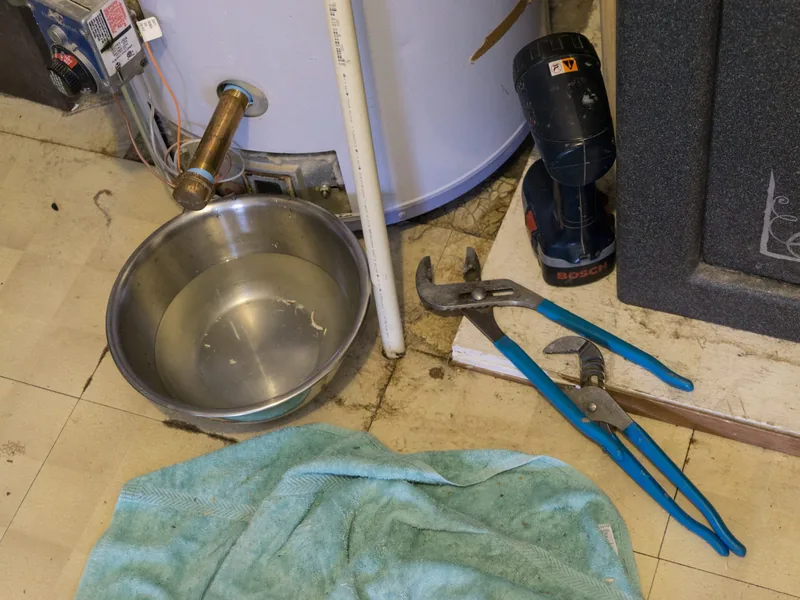
Wrentham Water vs. Your Drain Valve
Wrentham's drain valves tell the town's two-water story. On the well-water streets, sediment packs around the factory plastic valve — flushes trickle, handles snap, and the valve becomes a sediment plug with a spout. Around the town common, the story is age: original valves on older tanks, brittle and mineral-crusted in old basements, weeping at the stem for months before anyone ventures behind the tank. The subdivision homes have the mildest version — builder-grade valves simply reaching the age where plastic gives up. In every case, the dead valve blocks the maintenance the tank needs: no flushing means sediment accumulates, efficiency falls, and the tank bottom overheats — accelerating the corrosion the anode rod is fighting. A full-port brass ball valve resolves it across all three patterns: full-bore flow that moves sediment, brass that doesn't embrittle, and a quarter-turn handle that works a decade hence. For Wrentham's mixed housing, it's the universal small repair with outsized returns.
How to Tell Your Drain Valve Is Failing
Here's how to read your valve in thirty seconds. Look at the spout: active dripping or fresh mineral staining means the seals have failed. Try the handle gently — if it crumbles, spins without engaging, or won't budge at all, the valve is finished. Check the body: white or green mineral crust mounding on the plastic, hairline cracks, or a chalky texture all signal embrittlement from years of Wrentham's town and well water exposure. And the functional test: attach a hose and open it — a healthy valve flows strongly; a dying one trickles, sputters, or passes nothing, because sediment has packed around it. In 02093, the trickle-test failure is the most common finding, especially where well water carries heavy sediment. Any single failure on this checklist means the valve needs replacing, and a full-port brass valve is the replacement that ends the cycle permanently.
A flush that barely flows (well streets), a valve weeping unnoticed in an old basement (town common), or a builder-grade handle crumbling with age (subdivisions) — Wrentham's valves fail three ways, and brass replacement answers all three.
How We Replace Your Drain Valve
A proper drain-valve replacement in a Wrentham home is a methodical job, not a quick twist. First we shut off the cold-water inlet and kill power at the breaker — or set gas to pilot — then let the tank cool, because draining a scalding tank is how people get hurt. We attach a hose and drain the tank below the valve level (fully, if sediment demands it), which on 02093's older tanks can take a while through a clogged valve — we bring clearing tools for exactly this. Then the failed valve comes out: seized plastic gets controlled heat and the right wrench, never brute force that could damage the tank's threads. Threads get cleaned of mineral scale, the new full-port brass ball valve threads in with quality sealant, and the tank refills. We purge air, restore power or gas, pressure-test every connection, and finish with a proper flush so the new valve demonstrates full-bore flow immediately.
We match the approach to the failure: sediment-clearing tools for packed well valves, heat and patience for age-seized ones. Tank cooled and drained, old valve out, threads cleaned, full-port brass in with proper sealant — then a full flush and pressure test to prove the new valve's worth.
Why Full-Port Brass Beats Plastic Every Time
The full-port brass ball valve we install is a different species entirely. 'Full-port' means the bore through the valve is the same diameter as the pipe — no restriction, so sediment-laden water passes instead of packing. 'Ball valve' means a quarter-turn handle rotates a brass ball with a hole through it: open or closed, no washers to wear, no stem packing to weep, no multi-turn threading to seize. 'Brass' means a body that ignores the mineral exposure and temperature cycling that destroyed the plastic original — the valves we install in Wrentham today will still be operating smoothly when the tank itself is replaced. For town-common colonials and subdivision homes, where valves face everything from heavy well sediment to freeze-prone utility spaces, brass isn't a luxury; it's the only valve material that reliably survives the full service life.
The factory valve is plastic for one reason: it costs pennies at the factory. It's a narrow-bore nylon or PVC spigot with a multi-turn stem, small seals, and a body that embrittles with heat and mineral exposure — a part designed to survive the warranty period, not the tank's life. In Wrentham, on Wrentham's town and well water, that design life expires right on schedule: the seals harden and weep, the body chalks and cracks, the narrow bore clogs with the first serious sediment. We've removed hundreds of these across 02093, and the failure pattern never varies — only the timeline, which runs faster wherever water is hardest or most sediment-laden. Nobody should mourn the plastic valve. It was never meant to last, and replacing it isn't an upgrade so much as a correction.
What Changes With a Working Valve
The new brass valve's first job is the flush the tank has been missing — possibly for years. On Wrentham calls we flush until the water runs clear, and on 02093's long-neglected tanks that can mean an astonishing volume of sediment: mineral sand, scale flakes, and rust particulate the tank has carried since installation. The effect is immediate and audible — the popping and rumbling quiets, recovery gets faster, and the burner or elements stop overheating. Going forward, the maintenance rhythm for Wrentham's town and well water is annual flushing: attach a hose, open the brass valve full-bore for several minutes until clear, close it with the same quarter turn. Twenty minutes, once a year, no tools beyond a garden hose. Tanks on this rhythm in Wrentham routinely outlive their rated life; tanks without it die of sediment and corrosion years early. The valve makes the rhythm possible.
Here's the maintenance pairing that matters most in Wrentham: the drain valve and the anode rod work as a system. The rod fights internal corrosion electrochemically; flushing removes the sediment that accelerates that corrosion physically. A tank with a fresh rod but no flushing still dies early from sediment-insulated overheating; a tank that's flushed but running on a dead rod still rusts from the inside. On Wrentham's town and well water, the complete program is annual flushing plus a rod check every three to five years (closer to three on aggressive wells). In town-common colonials and subdivision homes, we set homeowners up with both dates after the valve visit — because the valve replacement is the moment the tank becomes maintainable, and maintainable tanks are the ones that reach twenty years. Skip either half and you're protecting the tank with one hand tied behind your back.
What Happens When You Call (833) 713-2101
Before we arrive, two small preparations help: clear working space around the tank's base (the valve sits low, and the tech needs hose-routing room to a safe discharge point — a floor drain, sump, or outside), and note whether the valve is actively dripping, since an active leak gets priority scheduling. Everything else is ours: shutdown, cool-down, drain-down, extraction, installation, flush, and testing. In town-common colonials and subdivision homes, discharge routing sometimes needs creativity — utility sinks, laundry standpipes, or out a basement window with proper hose — and we've seen every configuration Wrentham offers. If you're not sure where the water can go safely, mention it on the call and we'll plan for it. Reach us at (833) 713-2101.