Water-Heater Emergencies in Berkley: The Local Picture
Berkley emergencies have a rural character: long driveways, well equipment in the mix, and tanks that fail from the inside out. The mineral-heavy well water here doesn't just shorten anode life — it accelerates the internal corrosion that ends in a ruptured tank bottom, and rural homeowners often discover it late because the tank sits in an unfinished farmhouse basement nobody visits daily. Add well-system pressure variables, and Berkley sees more sudden tank failures than its population would suggest. When you call (833) 713-2101, tell us it's a well system — we'll walk you through killing the well pump along with the heater's inlet valve, which stops the water feed completely. Our techs carry replacement tanks and full fittings kits because a second trip to Berkley costs everyone time. Nights, weekends, holidays — the phone gets answered.
Stop the Damage Before We Arrive
After the shutoffs, containment buys time until the tech arrives. In Berkley homes, that means towels or mops at the water's leading edge, buckets under active drips, and moving anything valuable — electronics, stored boxes, laundry — away from the wet zone. If the tank is upstairs or water is coming through a ceiling in your farmhouses and colonials on large well-and-septic lots home, put a bucket under the drip and poke no holes; we'll handle the ceiling assessment. A hose on the drain valve routed to a floor drain or outside can lower the tank's water level if the leak is from the tank body itself — we'll advise whether that's safe for your situation when you call (833) 713-2101. Take a photo of the leak source if you can do it safely; it helps our 02779 dispatcher send the right equipment. Then clear a path to the tank. That's the complete first response — everything after that is our job.
A spreading puddle under the tank, water seeping from the bottom seam, a relief valve that won't stop discharging, or a well pump cycling constantly with no fixtures running — in Berkley, any of these means call now, then shut the well pump and the heater's inlet valve.
From Doorbell to Diagnosis
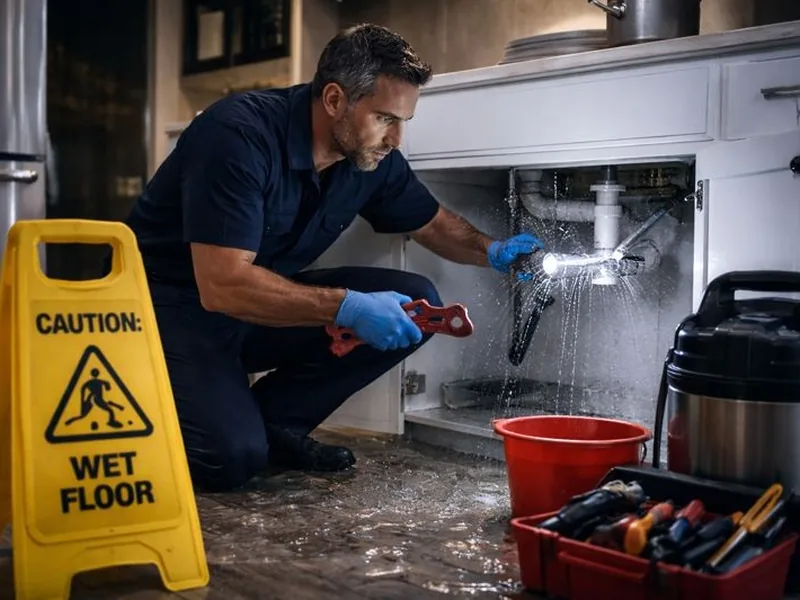
The tech's first sixty seconds at your Berkley door are about the active leak, not paperwork. Water verified off, energy verified safe, then eyes on the source: is it the tank body, a fitting, the relief valve, the drain valve, or supply piping? In 02779, the answer determines everything, and an experienced tech reads it fast — rust patterns, drip origin, the sound of the tank, the condition of the fittings. Next comes stabilization: pump-out or extraction if there's standing water, because working in a flooded space helps nobody and farmhouses and colonials on large well-and-septic lots floors deserve protection fast. Only then does the full diagnosis begin, with the tank opened up and every suspect component inspected in front of you. You'll hear the verdict in plain language — what's failed, why it failed, and what fixes it — before any repair work starts. No surprises, no jargon.
Rural response is about arriving ready: we roll to Berkley with replacement tanks, brass valves, and pump-out equipment so one trip resolves it. First we stop the water — well pump off, inlet closed, tank drained to a safe spot — then diagnose fitting versus valve versus ruptured tank and fix or swap on the spot.
What's Actually Leaking: A Field Guide
Supply connections and fittings are the good-news leaks. The cold inlet and hot outlet nipples, dielectric unions, and supply-line connections corrode over years of Berkley's mineral-heavy private well water exposure — in farmhouses and colonials on large well-and-septic lots, we see green-crusted fittings weeping for months before anyone notices. These are straightforwardly repairable: shut down, drain below the fitting, cut out the failed connection, and rebuild with brass fittings and proper dielectric isolation so dissimilar metals stop eating each other. Drain-valve failures get the same treatment — full-port brass replacement — and they're among the most satisfying fixes because the improvement is permanent. None of these require replacing the tank. When our Berkley tech says 'it's a fitting,' that's genuinely good news: an hour or two of work and the emergency is over.
Condensation and 'mystery moisture' deserve a mention because they cause real Berkley panic over nothing — and real damage when misread the other way. A cold tank in a humid basement sweats; a flue issue on a gas unit drips condensate; a nearby plumbing leak runs down and pools at the tank's base, framing the water heater for a crime it didn't commit. Our 02779 diagnosis separates these carefully: moisture pattern analysis, checking whether the water is hot (tank leak) or cold (condensation or external source), and tracing the actual path. In farmhouses and colonials on large well-and-septic lots, we've exonerated many tanks and found the real culprit in a washing-machine hose or a sweating cold-water line. The point of the emergency visit isn't to sell — it's to find the truth. Sometimes the truth is good news, and we deliver that with the same seriousness.
After the Emergency: Keeping It From Happening Again
Know your tank's birthday — it's the single most useful fact in water-heater ownership, and almost nobody in Berkley knows theirs. The serial number on the tank's label encodes the manufacture date; we read it on every 02779 visit and tell you plainly where the tank is in its life. A tank at year six with a fresh rod and annual flushing has a decade ahead of it. A tank at year thirteen on aggressive water with no maintenance history is living on borrowed time, and planning its replacement beats meeting it at 2 a.m. In farmhouses and colonials on large well-and-septic lots, we give every homeowner the honest timeline after an emergency visit — not to sell a tank, but so the next replacement happens on your schedule, with hot water intact and the basement dry. That's the difference between maintenance and emergency, and it's entirely a matter of knowing where you stand. Call (833) 713-2101 for the read on yours.
Every emergency we resolve in Berkley ends with the same conversation: what would have caught this earlier, and what prevents the next one. The answers are consistent because Berkley's mineral-heavy private well water fails tanks in consistent ways. Annual flushing removes the sediment that overheats tank bottoms and accelerates corrosion — twenty minutes with a hose once a year. Anode-rod checks every three to five years keep the tank's internal protection alive; most 02779 emergency ruptures we see are tanks whose rods died years earlier. Relief-valve testing takes seconds and confirms the safety device works. And knowing your shutoffs — the cold-water inlet valve, the breaker or gas control, the main water valve — turns the next emergency's first five minutes from panic into procedure. In farmhouses and colonials on large well-and-septic lots, we leave homeowners with all of it written down: the tank's age, its condition, and the dates that keep it safe.
One Number for Every Water-Heater Emergency
The emergency line at (833) 713-2101 is answered around the clock — nights, weekends, holidays — by people who know water heaters, not a voicemail system. When you call from Berkley, here's the sequence: we confirm you're safe (gas smell means leave and call the gas company first), walk you through the two shutoffs if you haven't done them, ask what's leaking and where the tank sits, and dispatch the tech with the right equipment for your farmhouses and colonials on large well-and-septic lots home. Most 02779 emergencies get same-visit resolution — repair or replacement, decided honestly on site with the failed part in front of you. Save the number now, before you need it: (833) 713-2101. Water Heater Leak Repair Crew — when water is where it shouldn't be.