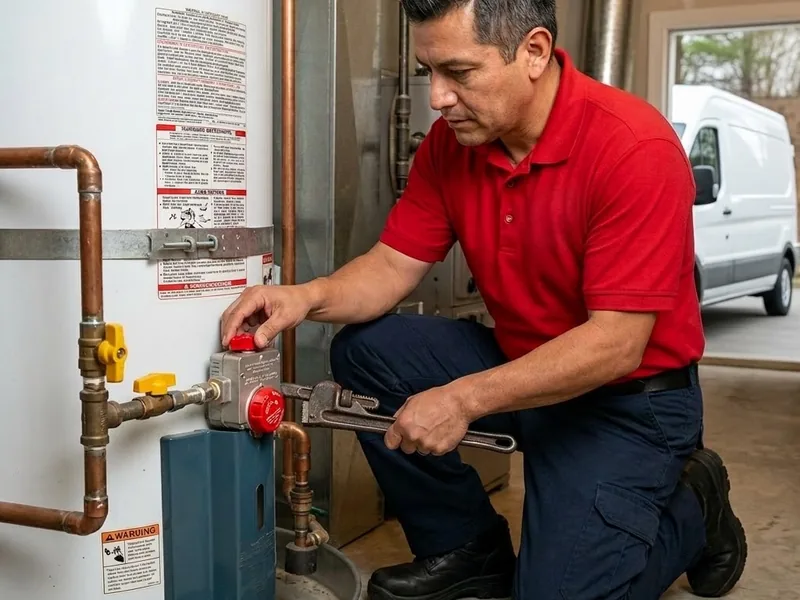
What the Gas Control Valve Actually Does
The gas control valve is the boxy control with the temperature dial at the bottom front of a gas tank water heater, and it does three jobs at once. First, it is the thermostat: a temperature probe reaches into the tank, and the valve meters gas to the main burner to hold the water at whatever you set on the dial. Second, it is the gas regulator for the heater, feeding the pilot assembly and the burner through separate internal passages. Third — and most important — it is the safety shutoff. When you light the pilot, its flame heats the thermocouple, a small sensor that generates a tiny millivolt signal. That signal holds an electromagnet open inside the valve, which is the only thing keeping gas flowing. If the pilot blows out, the signal dies, the magnet drops, and the gas shuts off. That is the mechanism that keeps raw gas from filling your basement while you sleep. Most valves also carry an ECO, an energy cut-off high-limit switch that kills the burner if the water ever overheats. Newer electronic models add a status LED that blinks fault codes when something goes wrong. The valve threads directly into the tank and connects to the gas supply line, the pilot tube, the thermocouple, and the burner manifold — and because it sits inches from the burner, it lives in the hottest, harshest spot on the entire heater. That location is exactly why it eventually fails.
Symptoms That Point to the Valve
Not every hot-water problem is the valve, but these patterns point at it strongly. First: the pilot dies the instant you release the lighting knob, again and again. Homeowners in Berkley often replace the thermocouple themselves and find the problem persists — that is the moment the valve becomes the prime suspect, because a good thermocouple with a valve that still drops the pilot means the internal magnet has lost its strength. Second: pilot lit, dial up, and the main burner stays silent. The valve is simply not opening the gas path to the burner. Third: water that never gets past lukewarm despite a roaring pilot, or temperatures that swing unpredictably from one shower to the next — the regulating side of the valve is worn out. Fourth: fault-code blinks on electronic gas valves, which narrow the problem to a specific internal failure. Fifth: mechanical damage, like a temperature dial that turns without resistance or a valve body showing heavy corrosion. And the critical safety note: any smell of gas around the heater overrides all troubleshooting. Get out, call the gas utility from a safe distance, and only after they clear the home should you call (833) 713-2101 for the repair.
Why Gas Control Valves Fail
Gas control valves do not fail randomly; they fail for reasons you can understand, and most of them come down to age and heat. A valve typically lasts ten to fifteen years — roughly the same span as the heater it serves. Every heating cycle expands and contracts its internal springs, seals, and diaphragms, and thousands of cycles eventually wear them out. Heat is the constant enemy: the valve is threaded into the tank wall inches from the burner, so it bakes for the life of the heater. Sediment makes everything worse. When mineral sediment blankets the bottom of the tank, the burner has to fire longer and hotter to heat water through that insulating layer, and the valve absorbs the extra punishment. Corrosion is the other big killer, especially in damp Berkley basements where moisture works on the valve body and its connections year after year. Mineral scale can also coat the temperature probe, so the valve misreads the water temperature and either overheats the tank or never fires at all. Sometimes the failure is electrical rather than mechanical: the safety magnet weakens until even a healthy thermocouple signal cannot hold it open. And occasionally the culprit is upstream — low or surging gas pressure from the supply line can make a valve behave as though it has failed, which is one more reason we test the whole gas path before condemning the part.
Repair the Valve or Replace the Tank?
A failed valve forces a decision, and we walk Berkley homeowners through it the same way every time — with testing, not assumptions. Step one is ruling out the cheap fix: a weak thermocouple mimics valve failure perfectly, so we test it before we touch the valve. Step two is reading the tank's remaining life. Heaters in this area commonly run eight to twelve years; a younger tank that looks sound, heats quietly, and shows no rust is worth saving with a new valve. An older tank that rumbles from sediment, shows corrosion around the fittings, or has a history of pilot trouble is a different story — a fresh valve buys you a working heater bolted to a tank that could spring a leak next winter. Step three is the supporting cast: we check the anode rod, the T and P relief valve, and the venting, because a valve replacement is the ideal moment to catch the next problem early. What you get from us is a plain-English recommendation with the why attached. Plenty of our valve-replacement customers in Berkley get five or more good years afterward; plenty of others wisely choose a new heater. The right call depends on your tank, and we will help you read it. Reach us at (833) 713-2101.
Berkley Homes and Water Heaters: Local Notes
Berkley is rural Bristol County — working farms, large lots, and long driveways, with a housing stock of older farmhouses, colonials, and capes, many of them dating well before 1960. A large share of Berkley homes run on private wells with septic systems, and well water here commonly carries iron and sediment that city water does not. Basements are the norm, and the water heater often shares space with well equipment and treatment systems.
Well water changes the water heater equation: iron and mineral sediment accumulate faster, anode rods get consumed sooner, and tank bottoms run hotter under their insulating blanket. We see the consequences in Berkley regularly — elements burned out prematurely, valves stressed by overheated tanks, relief valves dripping from expansion in closed well systems. With long winter heating seasons keeping burners firing for months, valve wear shows up early in this area — a dying pilot is one of our most common calls. If your Berkley heater is struggling, call (833) 713-2101 — we will read the tank's condition honestly and fix what is fixable.
Why Gas Valve Work Isn't a DIY Project
Replacing a gas control valve looks straightforward on a video, but the gas connection is what makes it professional work. Disconnecting and reconnecting a gas line means breaking into your home's fuel supply; a joint that is not sealed and tested properly can seep gas slowly for weeks before anyone notices. The valve threads directly into the steel tank, and cross-threading it during installation ruins the tank spud — turning a valve job into a heater replacement. Sealant choice matters too: the wrong compound on gas threads either leaks or seizes, and both outcomes are bad. Then there is the relight: an improperly lit pilot or a burner starved of combustion air can produce carbon monoxide, which is odorless and dangerous. Venting has to be verified as well, because a water heater that cannot draft properly spills exhaust into the home. Add in the thermocouple testing, the leak-detection procedure, and the temperature calibration, and you have a job with real consequences for getting it wrong. Our technicians do this work every week across Berkley and the surrounding towns, with the testing equipment to prove every joint is tight before we leave. For the safety of your household, keep gas valve work in trained hands — call (833) 713-2101 and let us handle it.
Our Valve Replacement Process, Step by Step
Here is exactly what a gas control valve replacement looks like when we do it in Berkley 02779. First comes verification: we test the thermocouple, confirm gas pressure at the heater, and watch the burner attempt to fire, because replacing a valve that is not actually dead helps nobody. Once confirmed, we close the gas shutoff at the heater and drain the tank below the valve port. The gas line, pilot tube, thermocouple lead, and burner assembly come off in order and are set aside carefully — these parts go back on, so they are treated gently. The failed valve is unscrewed from the tank spud, the threads are cleaned and inspected, and the new valve is installed with gas-rated thread sealant, seated firmly but never cross-threaded or over-torqued. Reassembly is the reverse: manifold, thermocouple, pilot tube, gas line. Then the tank refills fully — a critical step, since even brief dry-firing overheats the tank bottom. We light the pilot, confirm the safety magnet holds, and brush leak-detection solution over every gas connection while the burner runs, watching for bubbles that would betray even a slight seep. We finish by checking flame quality, vent draft, and water temperature at a tap. Then we walk you through what was done. That is the whole job, done right: (833) 713-2101.
Same-Day Gas Valve Service in Berkley 02779
When the pilot will not stay lit, waiting is the worst option — every day without hot water is a day of cold showers and inconvenience. Call us now at (833) 713-2101 and we will get a technician to your Berkley home fast. We test the thermocouple and gas supply before condemning the valve, replace the valve cleanly when it is truly dead, and prove every connection tight before we go. That is the whole promise: the right fix, done safely, the same day. (833) 713-2101 — we are ready when you are. Call the crew at (833) 713-2101.