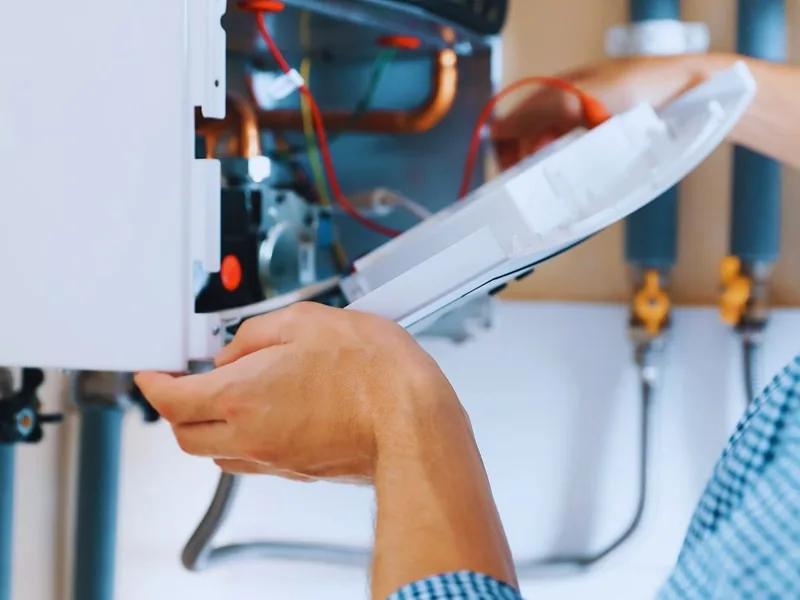
Your Water Heater's Gas Control Valve, Explained
Every gas tank water heater in Millville has the same small command center bolted to its lower front: the gas control valve. Turn the dial and you are setting a thermostat, but there is much more happening inside that housing. The valve decides how much gas reaches the burner based on what its temperature probe senses in the tank water. It also manages the pilot circuit — the small standing flame on older units — through a clever safety chain. Pilot flame heats the thermocouple, the thermocouple makes a whisper of electricity, and that electricity holds the valve's safety magnet open. Break any link in that chain and the gas stops. It is a beautifully simple failsafe, and it is why a heater with a dead pilot cannot leak gas into your home through the burner. On top of that, the valve carries a high-limit ECO switch as a second layer of protection against overheating, and modern versions report their own health through blinking status lights. Because the whole assembly is threaded into the tank wall right beside the combustion chamber, it endures years of heat cycling. Springs weaken, magnets lose their pull, and internal seals harden — and one day the valve stops doing one of its three jobs.
Signs Your Gas Control Valve Is Failing
A failing gas control valve announces itself in a few recognizable ways, and learning them can save you from a week of cold showers in Millville. The classic symptom is a pilot that will not stay lit: you follow the lighting instructions perfectly, the pilot catches, and the moment you release the knob it dies. That can also be a weak thermocouple, which is why we always test that part first — but when the thermocouple checks out and the pilot still will not hold, the valve's safety magnet is usually done. Another tell is a burner that never fires even though the pilot is burning steadily and the dial is turned up; the thermostat section of the valve has stopped calling for heat. Lukewarm water with a healthy pilot points the same direction. So do wild temperature swings, where the water alternates between scalding and tepid because the valve cannot regulate consistently. On newer electronic valves, a blinking status light is the valve literally telling you its fault code. Physical clues count too: a dial that spins loosely or will not turn, or visible corrosion around the valve body. One symptom deserves special mention. If you ever smell gas near the heater — a rotten-egg odor — do not try to diagnose anything. Leave the house, and call your gas utility from outside. Once the area is declared safe, call us at (833) 713-2101 and we will take it from there.
What Wears a Gas Valve Out
Ask what kills gas control valves in Millville homes and the answer is usually a combination of three things: heat, time, and sediment. Time first — the internal thermostat, safety magnet, and seals are mechanical parts with a finite life, commonly ten to fifteen years of daily cycling. Heat second — no other part of the water heater sits as close to the flame for as many hours, and that relentless thermal cycling fatigues springs and hardens seals until they stop sealing. Sediment third, and it is the silent accelerator: a thick layer of mineral sediment on the tank floor insulates the water from the burner, forcing longer, hotter burns that cook the valve's thermal components and trip the ECO high-limit switch repeatedly. Repeated ECO trips are themselves a warning sign that the bottom of the tank is running far hotter than it should. Beyond those three, we see valves finished off by chronic dampness in basement installations, by scale buildup on the temperature probe that blinds the thermostat, and by gas pressure irregularities that starve or flood the valve. Prior do-it-yourself tampering — cross-threaded fittings, wrong sealants, forced dials — ends more than a few valves prematurely too. When we arrive, we sort through these causes rather than guessing, because the right fix depends on which one got your valve.
New Valve or New Water Heater? How We Decide
The honest question every Millville homeowner asks when the valve fails is whether the money is better spent on a whole new heater. Here is how we think about it on every call. First, we test the thermocouple and the pilot assembly, because a twenty-minute thermocouple replacement beats a valve replacement every time when that is the real problem. If the valve is genuinely dead, we look at the tank: its age, its condition, and its behavior. A tank under eight years old with a clean exterior, a working anode rod, and no rumbling from sediment is an excellent candidate for a valve swap — you get years more service for a fraction of replacement cost. A tank pushing twelve to fifteen years with rust streaks, a weeping seam, or a T and P valve that dribbles is telling you its own end is near, and putting a new valve on a dying tank is false economy. We also check the anode rod and drain a little water to read the sediment situation while we are there, so you get the full picture. Our recommendation is straightforward and we explain the reasoning out loud: replace the valve when the tank has life left, replace the heater when it does not. Either way you decide with real information, not a sales pitch. Call (833) 713-2101 and we will give you that straight answer at your home.
On the Ground in Millville 01529
Millville is a small Blackstone Valley town with an older housing stock — village-center homes from the early 1900s and mid-century houses scattered along the rural roads. It is the kind of town where water heaters get replaced when they fail rather than on schedule, so we encounter tanks of advanced age doing their best. Town water serves the village area, with wells on the outskirts.
In a town where heaters run until they quit, we see the end-stage failures: valves that finally give up after fifteen years, elements that have been dead so long the household adapted to lukewarm water, tanks weeping at the seam. The good news is that most of these are still serviceable — a valve or element replacement buys real additional life when the shell is sound. Gas tank heaters are the workhorses in these basements, and the control valve takes the brunt of the burner's heat — it is one of the parts we replace most often around here. Millville 01529 gets same-day visits from our Attleboro crew — call (833) 713-2101.
What Happens During the Replacement Visit
When our technician arrives at your Millville home for a gas control valve replacement, the visit follows a careful order — gas work rewards patience, not speed. We start by confirming the diagnosis: thermocouple test, gas supply check, and a look at the burner's behavior, so we are certain the valve is the problem. Then the gas is shut off at the heater's own shutoff valve and the tank is drained down below the valve level. We disconnect the gas supply line, the pilot tube, the thermocouple, and the burner manifold, then unscrew the old valve from the tank. The new valve goes in with the proper thread sealant for gas service, tightened to spec — never forced. Everything reconnects: gas line, pilot, thermocouple, manifold. Then we refill the tank completely, which matters because firing a burner against an empty tank damages it. We relight the pilot, verify it holds, and then leak-test every gas joint with leak-detection solution while watching for the tiniest bubble. Finally we confirm a steady blue burner flame, check the draft at the vent, set your temperature, and run hot water to prove the repair. Most visits run about one to two hours, and you will have hot water before we leave. Call (833) 713-2101 to schedule.
Why Gas Valve Work Isn't a DIY Project
Replacing a gas control valve looks straightforward on a video, but the gas connection is what makes it professional work. Disconnecting and reconnecting a gas line means breaking into your home's fuel supply; a joint that is not sealed and tested properly can seep gas slowly for weeks before anyone notices. The valve threads directly into the steel tank, and cross-threading it during installation ruins the tank spud — turning a valve job into a heater replacement. Sealant choice matters too: the wrong compound on gas threads either leaks or seizes, and both outcomes are bad. Then there is the relight: an improperly lit pilot or a burner starved of combustion air can produce carbon monoxide, which is odorless and dangerous. Venting has to be verified as well, because a water heater that cannot draft properly spills exhaust into the home. Add in the thermocouple testing, the leak-detection procedure, and the temperature calibration, and you have a job with real consequences for getting it wrong. Our technicians do this work every week across Millville and the surrounding towns, with the testing equipment to prove every joint is tight before we leave. For the safety of your household, keep gas valve work in trained hands — call (833) 713-2101 and let us handle it.
Same-Day Gas Valve Service in Millville 01529
When the pilot will not stay lit, waiting is the worst option — every day without hot water is a day of cold showers and inconvenience. Call us now at (833) 713-2101 and we will get a technician to your Millville home fast. We test the thermocouple and gas supply before condemning the valve, replace the valve cleanly when it is truly dead, and prove every connection tight before we go. That is the whole promise: the right fix, done safely, the same day. (833) 713-2101 — we are ready when you are. Call the crew at (833) 713-2101.