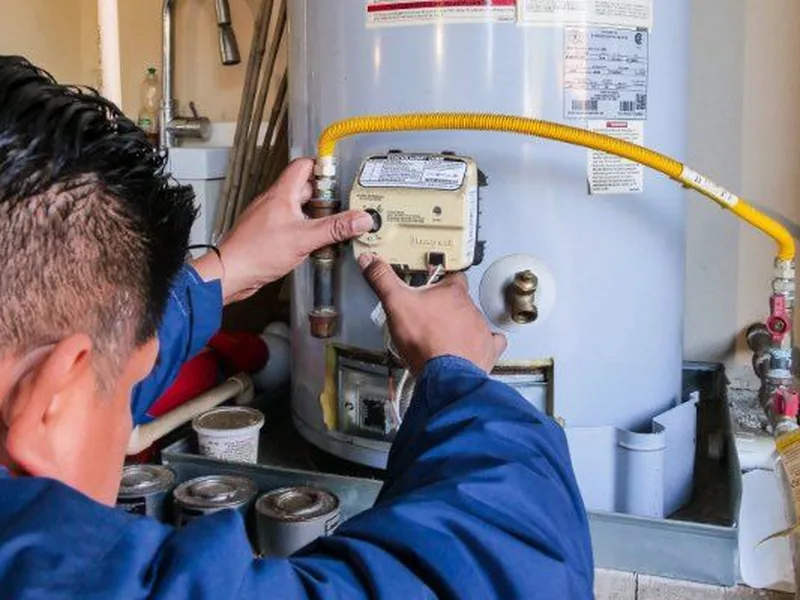
What the Gas Control Valve Actually Does
The gas control valve is the boxy control with the temperature dial at the bottom front of a gas tank water heater, and it does three jobs at once. First, it is the thermostat: a temperature probe reaches into the tank, and the valve meters gas to the main burner to hold the water at whatever you set on the dial. Second, it is the gas regulator for the heater, feeding the pilot assembly and the burner through separate internal passages. Third — and most important — it is the safety shutoff. When you light the pilot, its flame heats the thermocouple, a small sensor that generates a tiny millivolt signal. That signal holds an electromagnet open inside the valve, which is the only thing keeping gas flowing. If the pilot blows out, the signal dies, the magnet drops, and the gas shuts off. That is the mechanism that keeps raw gas from filling your basement while you sleep. Most valves also carry an ECO, an energy cut-off high-limit switch that kills the burner if the water ever overheats. Newer electronic models add a status LED that blinks fault codes when something goes wrong. The valve threads directly into the tank and connects to the gas supply line, the pilot tube, the thermocouple, and the burner manifold — and because it sits inches from the burner, it lives in the hottest, harshest spot on the entire heater. That location is exactly why it eventually fails.
Symptoms That Point to the Valve
Not every hot-water problem is the valve, but these patterns point at it strongly. First: the pilot dies the instant you release the lighting knob, again and again. Homeowners in Norton often replace the thermocouple themselves and find the problem persists — that is the moment the valve becomes the prime suspect, because a good thermocouple with a valve that still drops the pilot means the internal magnet has lost its strength. Second: pilot lit, dial up, and the main burner stays silent. The valve is simply not opening the gas path to the burner. Third: water that never gets past lukewarm despite a roaring pilot, or temperatures that swing unpredictably from one shower to the next — the regulating side of the valve is worn out. Fourth: fault-code blinks on electronic gas valves, which narrow the problem to a specific internal failure. Fifth: mechanical damage, like a temperature dial that turns without resistance or a valve body showing heavy corrosion. And the critical safety note: any smell of gas around the heater overrides all troubleshooting. Get out, call the gas utility from a safe distance, and only after they clear the home should you call (833) 713-2101 for the repair.
What Wears a Gas Valve Out
Ask what kills gas control valves in Norton homes and the answer is usually a combination of three things: heat, time, and sediment. Time first — the internal thermostat, safety magnet, and seals are mechanical parts with a finite life, commonly ten to fifteen years of daily cycling. Heat second — no other part of the water heater sits as close to the flame for as many hours, and that relentless thermal cycling fatigues springs and hardens seals until they stop sealing. Sediment third, and it is the silent accelerator: a thick layer of mineral sediment on the tank floor insulates the water from the burner, forcing longer, hotter burns that cook the valve's thermal components and trip the ECO high-limit switch repeatedly. Repeated ECO trips are themselves a warning sign that the bottom of the tank is running far hotter than it should. Beyond those three, we see valves finished off by chronic dampness in basement installations, by scale buildup on the temperature probe that blinds the thermostat, and by gas pressure irregularities that starve or flood the valve. Prior do-it-yourself tampering — cross-threaded fittings, wrong sealants, forced dials — ends more than a few valves prematurely too. When we arrive, we sort through these causes rather than guessing, because the right fix depends on which one got your valve.
New Valve or New Water Heater? How We Decide
The honest question every Norton homeowner asks when the valve fails is whether the money is better spent on a whole new heater. Here is how we think about it on every call. First, we test the thermocouple and the pilot assembly, because a twenty-minute thermocouple replacement beats a valve replacement every time when that is the real problem. If the valve is genuinely dead, we look at the tank: its age, its condition, and its behavior. A tank under eight years old with a clean exterior, a working anode rod, and no rumbling from sediment is an excellent candidate for a valve swap — you get years more service for a fraction of replacement cost. A tank pushing twelve to fifteen years with rust streaks, a weeping seam, or a T and P valve that dribbles is telling you its own end is near, and putting a new valve on a dying tank is false economy. We also check the anode rod and drain a little water to read the sediment situation while we are there, so you get the full picture. Our recommendation is straightforward and we explain the reasoning out loud: replace the valve when the tank has life left, replace the heater when it does not. Either way you decide with real information, not a sales pitch. Call (833) 713-2101 and we will give you that straight answer at your home.
On the Ground in Norton 02766
Norton is home to Wheaton College and a classic suburban mix: 1960s-through-1990s colonials and ranches in established subdivisions, plus older homes near the town center. Most houses have full basements where the water heater sits, and town water serves the majority of the town, with some outlying properties on wells. It is a town of settled neighborhoods where water heaters age quietly until they don't.
The subdivision homes from the 70s, 80s, and 90s are prime territory for component failures right now — gas valves losing their safety magnets, lower elements burned out in sediment, drain valves that will not seat. We also see pressure-related relief-valve dripping in neighborhoods with pressure-reducing valves and no expansion tank. Gas tank heaters are the workhorses in these basements, and the control valve takes the brunt of the burner's heat — it is one of the parts we replace most often around here. Norton 02766 is a short drive from Attleboro; call (833) 713-2101 for same-day service.
What Happens During the Replacement Visit
When our technician arrives at your Norton home for a gas control valve replacement, the visit follows a careful order — gas work rewards patience, not speed. We start by confirming the diagnosis: thermocouple test, gas supply check, and a look at the burner's behavior, so we are certain the valve is the problem. Then the gas is shut off at the heater's own shutoff valve and the tank is drained down below the valve level. We disconnect the gas supply line, the pilot tube, the thermocouple, and the burner manifold, then unscrew the old valve from the tank. The new valve goes in with the proper thread sealant for gas service, tightened to spec — never forced. Everything reconnects: gas line, pilot, thermocouple, manifold. Then we refill the tank completely, which matters because firing a burner against an empty tank damages it. We relight the pilot, verify it holds, and then leak-test every gas joint with leak-detection solution while watching for the tiniest bubble. Finally we confirm a steady blue burner flame, check the draft at the vent, set your temperature, and run hot water to prove the repair. Most visits run about one to two hours, and you will have hot water before we leave. Call (833) 713-2101 to schedule.
Gas Connections Belong in Trained Hands
There is a reason gas valve replacement is not a weekend project, and it is not the wrench work — it is the gas. The moment you break the gas line loose from the old valve, you are working directly with your home's fuel supply. Every reconnection has to be sealed with the correct gas-rated compound, tightened properly, and then proven tight with leak-detection solution under pressure; skipping or rushing that test is how slow leaks start. The valve-to-tank connection is equally unforgiving: those threads cut into the tank itself, and a cross-threaded installation damages the tank beyond practical repair. Pilot relighting has its own hazards — flooding the combustion chamber with unburned gas before establishing the flame, or setting the burner up with poor combustion that elevates carbon monoxide. And none of it matters if the vent does not draft, because exhaust has to leave the house reliably. Our crew carries combustion and leak-testing equipment on every truck and follows the same verification checklist on every Norton job: joints tested, flame checked, draft confirmed, temperature verified. It is careful, methodical work, and it is exactly what keeps your family safe. When the valve fails, call (833) 713-2101.
Ready When You Are
A failed gas control valve is disruptive, but the fix is straightforward in experienced hands — and ours are experienced. Call the crew at (833) 713-2101 for gas valve replacement anywhere in Norton 02766. Same-day visits, honest diagnosis, careful gas work with full leak testing, and hot water restored before we leave. That is what the Water Heater Leak Repair Crew does, every day. (833) 713-2101. Ring (833) 713-2101.