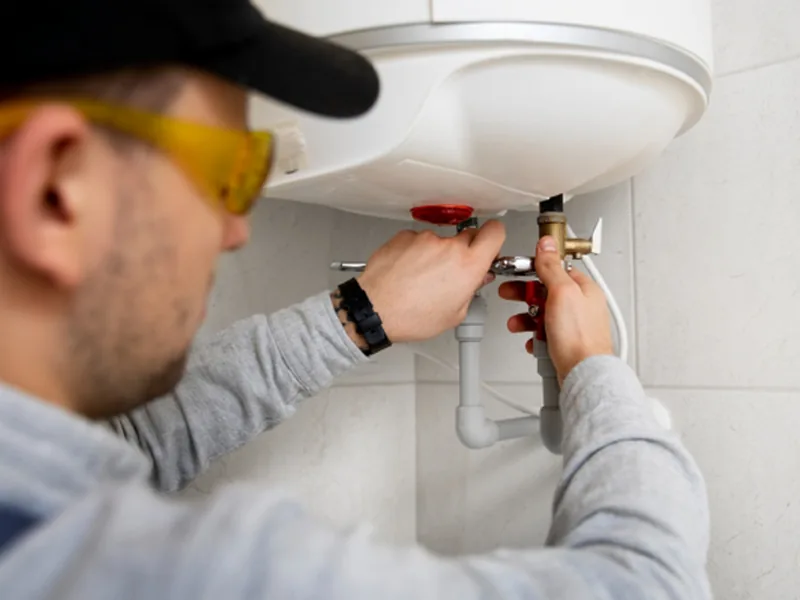
What the Gas Control Valve Actually Does
The gas control valve is the boxy control with the temperature dial at the bottom front of a gas tank water heater, and it does three jobs at once. First, it is the thermostat: a temperature probe reaches into the tank, and the valve meters gas to the main burner to hold the water at whatever you set on the dial. Second, it is the gas regulator for the heater, feeding the pilot assembly and the burner through separate internal passages. Third — and most important — it is the safety shutoff. When you light the pilot, its flame heats the thermocouple, a small sensor that generates a tiny millivolt signal. That signal holds an electromagnet open inside the valve, which is the only thing keeping gas flowing. If the pilot blows out, the signal dies, the magnet drops, and the gas shuts off. That is the mechanism that keeps raw gas from filling your basement while you sleep. Most valves also carry an ECO, an energy cut-off high-limit switch that kills the burner if the water ever overheats. Newer electronic models add a status LED that blinks fault codes when something goes wrong. The valve threads directly into the tank and connects to the gas supply line, the pilot tube, the thermocouple, and the burner manifold — and because it sits inches from the burner, it lives in the hottest, harshest spot on the entire heater. That location is exactly why it eventually fails.
Symptoms That Point to the Valve
Not every hot-water problem is the valve, but these patterns point at it strongly. First: the pilot dies the instant you release the lighting knob, again and again. Homeowners in Sharon often replace the thermocouple themselves and find the problem persists — that is the moment the valve becomes the prime suspect, because a good thermocouple with a valve that still drops the pilot means the internal magnet has lost its strength. Second: pilot lit, dial up, and the main burner stays silent. The valve is simply not opening the gas path to the burner. Third: water that never gets past lukewarm despite a roaring pilot, or temperatures that swing unpredictably from one shower to the next — the regulating side of the valve is worn out. Fourth: fault-code blinks on electronic gas valves, which narrow the problem to a specific internal failure. Fifth: mechanical damage, like a temperature dial that turns without resistance or a valve body showing heavy corrosion. And the critical safety note: any smell of gas around the heater overrides all troubleshooting. Get out, call the gas utility from a safe distance, and only after they clear the home should you call (833) 713-2101 for the repair.
What Wears a Gas Valve Out
Ask what kills gas control valves in Sharon homes and the answer is usually a combination of three things: heat, time, and sediment. Time first — the internal thermostat, safety magnet, and seals are mechanical parts with a finite life, commonly ten to fifteen years of daily cycling. Heat second — no other part of the water heater sits as close to the flame for as many hours, and that relentless thermal cycling fatigues springs and hardens seals until they stop sealing. Sediment third, and it is the silent accelerator: a thick layer of mineral sediment on the tank floor insulates the water from the burner, forcing longer, hotter burns that cook the valve's thermal components and trip the ECO high-limit switch repeatedly. Repeated ECO trips are themselves a warning sign that the bottom of the tank is running far hotter than it should. Beyond those three, we see valves finished off by chronic dampness in basement installations, by scale buildup on the temperature probe that blinds the thermostat, and by gas pressure irregularities that starve or flood the valve. Prior do-it-yourself tampering — cross-threaded fittings, wrong sealants, forced dials — ends more than a few valves prematurely too. When we arrive, we sort through these causes rather than guessing, because the right fix depends on which one got your valve.
Repair the Valve or Replace the Tank?
A failed valve forces a decision, and we walk Sharon homeowners through it the same way every time — with testing, not assumptions. Step one is ruling out the cheap fix: a weak thermocouple mimics valve failure perfectly, so we test it before we touch the valve. Step two is reading the tank's remaining life. Heaters in this area commonly run eight to twelve years; a younger tank that looks sound, heats quietly, and shows no rust is worth saving with a new valve. An older tank that rumbles from sediment, shows corrosion around the fittings, or has a history of pilot trouble is a different story — a fresh valve buys you a working heater bolted to a tank that could spring a leak next winter. Step three is the supporting cast: we check the anode rod, the T and P relief valve, and the venting, because a valve replacement is the ideal moment to catch the next problem early. What you get from us is a plain-English recommendation with the why attached. Plenty of our valve-replacement customers in Sharon get five or more good years afterward; plenty of others wisely choose a new heater. The right call depends on your tank, and we will help you read it. Reach us at (833) 713-2101.
On the Ground in Sharon 02067
Sharon is a commuter suburb wrapped around Lake Massapoag, with a housing stock of 1950s-through-1970s ranches and colonials mixed with newer construction on the remaining lots. It is a town of established neighborhoods where homes have been updated gradually — kitchens and baths remodeled while the basement water heater soldiers on. Town water serves Sharon.
That pattern — remodeled upstairs, original-era mechanicals downstairs — means we often find water heaters in Sharon that are far older than the kitchen above them. Gas valves with weakened safety magnets, elements scaled beyond efficiency, anodes consumed years ago: the basement tells the real age of the house. Finished basements are common here, raising the stakes on leak response. With long winter heating seasons keeping burners firing for months, valve wear shows up early in this area — a dying pilot is one of our most common calls. Sharon 02067 is in our service area — call (833) 713-2101.
Why Gas Valve Work Isn't a DIY Project
Replacing a gas control valve looks straightforward on a video, but the gas connection is what makes it professional work. Disconnecting and reconnecting a gas line means breaking into your home's fuel supply; a joint that is not sealed and tested properly can seep gas slowly for weeks before anyone notices. The valve threads directly into the steel tank, and cross-threading it during installation ruins the tank spud — turning a valve job into a heater replacement. Sealant choice matters too: the wrong compound on gas threads either leaks or seizes, and both outcomes are bad. Then there is the relight: an improperly lit pilot or a burner starved of combustion air can produce carbon monoxide, which is odorless and dangerous. Venting has to be verified as well, because a water heater that cannot draft properly spills exhaust into the home. Add in the thermocouple testing, the leak-detection procedure, and the temperature calibration, and you have a job with real consequences for getting it wrong. Our technicians do this work every week across Sharon and the surrounding towns, with the testing equipment to prove every joint is tight before we leave. For the safety of your household, keep gas valve work in trained hands — call (833) 713-2101 and let us handle it.
Our Valve Replacement Process, Step by Step
Here is exactly what a gas control valve replacement looks like when we do it in Sharon 02067. First comes verification: we test the thermocouple, confirm gas pressure at the heater, and watch the burner attempt to fire, because replacing a valve that is not actually dead helps nobody. Once confirmed, we close the gas shutoff at the heater and drain the tank below the valve port. The gas line, pilot tube, thermocouple lead, and burner assembly come off in order and are set aside carefully — these parts go back on, so they are treated gently. The failed valve is unscrewed from the tank spud, the threads are cleaned and inspected, and the new valve is installed with gas-rated thread sealant, seated firmly but never cross-threaded or over-torqued. Reassembly is the reverse: manifold, thermocouple, pilot tube, gas line. Then the tank refills fully — a critical step, since even brief dry-firing overheats the tank bottom. We light the pilot, confirm the safety magnet holds, and brush leak-detection solution over every gas connection while the burner runs, watching for bubbles that would betray even a slight seep. We finish by checking flame quality, vent draft, and water temperature at a tap. Then we walk you through what was done. That is the whole job, done right: (833) 713-2101.
Ready When You Are
A failed gas control valve is disruptive, but the fix is straightforward in experienced hands — and ours are experienced. Call the crew at (833) 713-2101 for gas valve replacement anywhere in Sharon 02067. Same-day visits, honest diagnosis, careful gas work with full leak testing, and hot water restored before we leave. That is what the Water Heater Leak Repair Crew does, every day. (833) 713-2101. Call the crew at (833) 713-2101.