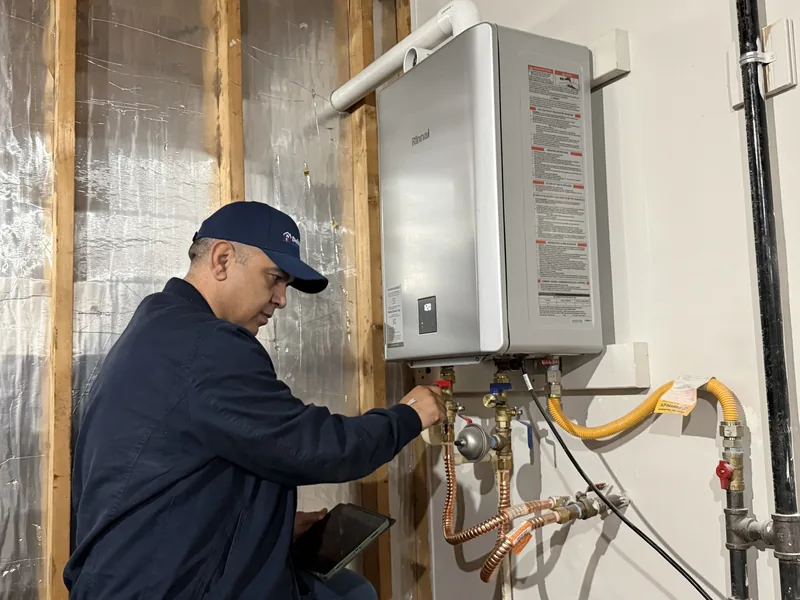
What the Gas Control Valve Actually Does
The gas control valve is the boxy control with the temperature dial at the bottom front of a gas tank water heater, and it does three jobs at once. First, it is the thermostat: a temperature probe reaches into the tank, and the valve meters gas to the main burner to hold the water at whatever you set on the dial. Second, it is the gas regulator for the heater, feeding the pilot assembly and the burner through separate internal passages. Third — and most important — it is the safety shutoff. When you light the pilot, its flame heats the thermocouple, a small sensor that generates a tiny millivolt signal. That signal holds an electromagnet open inside the valve, which is the only thing keeping gas flowing. If the pilot blows out, the signal dies, the magnet drops, and the gas shuts off. That is the mechanism that keeps raw gas from filling your basement while you sleep. Most valves also carry an ECO, an energy cut-off high-limit switch that kills the burner if the water ever overheats. Newer electronic models add a status LED that blinks fault codes when something goes wrong. The valve threads directly into the tank and connects to the gas supply line, the pilot tube, the thermocouple, and the burner manifold — and because it sits inches from the burner, it lives in the hottest, harshest spot on the entire heater. That location is exactly why it eventually fails.
Signs Your Gas Control Valve Is Failing
A failing gas control valve announces itself in a few recognizable ways, and learning them can save you from a week of cold showers in Wrentham. The classic symptom is a pilot that will not stay lit: you follow the lighting instructions perfectly, the pilot catches, and the moment you release the knob it dies. That can also be a weak thermocouple, which is why we always test that part first — but when the thermocouple checks out and the pilot still will not hold, the valve's safety magnet is usually done. Another tell is a burner that never fires even though the pilot is burning steadily and the dial is turned up; the thermostat section of the valve has stopped calling for heat. Lukewarm water with a healthy pilot points the same direction. So do wild temperature swings, where the water alternates between scalding and tepid because the valve cannot regulate consistently. On newer electronic valves, a blinking status light is the valve literally telling you its fault code. Physical clues count too: a dial that spins loosely or will not turn, or visible corrosion around the valve body. One symptom deserves special mention. If you ever smell gas near the heater — a rotten-egg odor — do not try to diagnose anything. Leave the house, and call your gas utility from outside. Once the area is declared safe, call us at (833) 713-2101 and we will take it from there.
Why Gas Control Valves Fail
Gas control valves do not fail randomly; they fail for reasons you can understand, and most of them come down to age and heat. A valve typically lasts ten to fifteen years — roughly the same span as the heater it serves. Every heating cycle expands and contracts its internal springs, seals, and diaphragms, and thousands of cycles eventually wear them out. Heat is the constant enemy: the valve is threaded into the tank wall inches from the burner, so it bakes for the life of the heater. Sediment makes everything worse. When mineral sediment blankets the bottom of the tank, the burner has to fire longer and hotter to heat water through that insulating layer, and the valve absorbs the extra punishment. Corrosion is the other big killer, especially in damp Wrentham basements where moisture works on the valve body and its connections year after year. Mineral scale can also coat the temperature probe, so the valve misreads the water temperature and either overheats the tank or never fires at all. Sometimes the failure is electrical rather than mechanical: the safety magnet weakens until even a healthy thermocouple signal cannot hold it open. And occasionally the culprit is upstream — low or surging gas pressure from the supply line can make a valve behave as though it has failed, which is one more reason we test the whole gas path before condemning the part.
New Valve or New Water Heater? How We Decide
The honest question every Wrentham homeowner asks when the valve fails is whether the money is better spent on a whole new heater. Here is how we think about it on every call. First, we test the thermocouple and the pilot assembly, because a twenty-minute thermocouple replacement beats a valve replacement every time when that is the real problem. If the valve is genuinely dead, we look at the tank: its age, its condition, and its behavior. A tank under eight years old with a clean exterior, a working anode rod, and no rumbling from sediment is an excellent candidate for a valve swap — you get years more service for a fraction of replacement cost. A tank pushing twelve to fifteen years with rust streaks, a weeping seam, or a T and P valve that dribbles is telling you its own end is near, and putting a new valve on a dying tank is false economy. We also check the anode rod and drain a little water to read the sediment situation while we are there, so you get the full picture. Our recommendation is straightforward and we explain the reasoning out loud: replace the valve when the tank has life left, replace the heater when it does not. Either way you decide with real information, not a sales pitch. Call (833) 713-2101 and we will give you that straight answer at your home.
On the Ground in Wrentham 02093
Wrentham is known for its outlets and its classic New England town center, with a housing mix of genuine antique homes near the center and subdivisions from the 1960s onward spreading outward. The antique homes bring antique plumbing — and water heaters shoehorned into old basements and crawlspaces — while the subdivisions bring the standard aging curve of replacement-era units. Town water serves most of Wrentham.
The antique homes near the center are where we see the most challenging installations: tight basements, old piping, and heaters that have been nursed along for years. In the subdivisions it is the familiar pattern — valves failing, elements burning out, relief valves weeping as components age out together. Gas tank heaters are the workhorses in these basements, and the control valve takes the brunt of the burner's heat — it is one of the parts we replace most often around here. Wrentham 02093 is right in our Attleboro service range; call (833) 713-2101.
Our Valve Replacement Process, Step by Step
Here is exactly what a gas control valve replacement looks like when we do it in Wrentham 02093. First comes verification: we test the thermocouple, confirm gas pressure at the heater, and watch the burner attempt to fire, because replacing a valve that is not actually dead helps nobody. Once confirmed, we close the gas shutoff at the heater and drain the tank below the valve port. The gas line, pilot tube, thermocouple lead, and burner assembly come off in order and are set aside carefully — these parts go back on, so they are treated gently. The failed valve is unscrewed from the tank spud, the threads are cleaned and inspected, and the new valve is installed with gas-rated thread sealant, seated firmly but never cross-threaded or over-torqued. Reassembly is the reverse: manifold, thermocouple, pilot tube, gas line. Then the tank refills fully — a critical step, since even brief dry-firing overheats the tank bottom. We light the pilot, confirm the safety magnet holds, and brush leak-detection solution over every gas connection while the burner runs, watching for bubbles that would betray even a slight seep. We finish by checking flame quality, vent draft, and water temperature at a tap. Then we walk you through what was done. That is the whole job, done right: (833) 713-2101.
Why Gas Valve Work Isn't a DIY Project
Replacing a gas control valve looks straightforward on a video, but the gas connection is what makes it professional work. Disconnecting and reconnecting a gas line means breaking into your home's fuel supply; a joint that is not sealed and tested properly can seep gas slowly for weeks before anyone notices. The valve threads directly into the steel tank, and cross-threading it during installation ruins the tank spud — turning a valve job into a heater replacement. Sealant choice matters too: the wrong compound on gas threads either leaks or seizes, and both outcomes are bad. Then there is the relight: an improperly lit pilot or a burner starved of combustion air can produce carbon monoxide, which is odorless and dangerous. Venting has to be verified as well, because a water heater that cannot draft properly spills exhaust into the home. Add in the thermocouple testing, the leak-detection procedure, and the temperature calibration, and you have a job with real consequences for getting it wrong. Our technicians do this work every week across Wrentham and the surrounding towns, with the testing equipment to prove every joint is tight before we leave. For the safety of your household, keep gas valve work in trained hands — call (833) 713-2101 and let us handle it.
Same-Day Gas Valve Service in Wrentham 02093
When the pilot will not stay lit, waiting is the worst option — every day without hot water is a day of cold showers and inconvenience. Call us now at (833) 713-2101 and we will get a technician to your Wrentham home fast. We test the thermocouple and gas supply before condemning the valve, replace the valve cleanly when it is truly dead, and prove every connection tight before we go. That is the whole promise: the right fix, done safely, the same day. (833) 713-2101 — we are ready when you are. Ring (833) 713-2101.