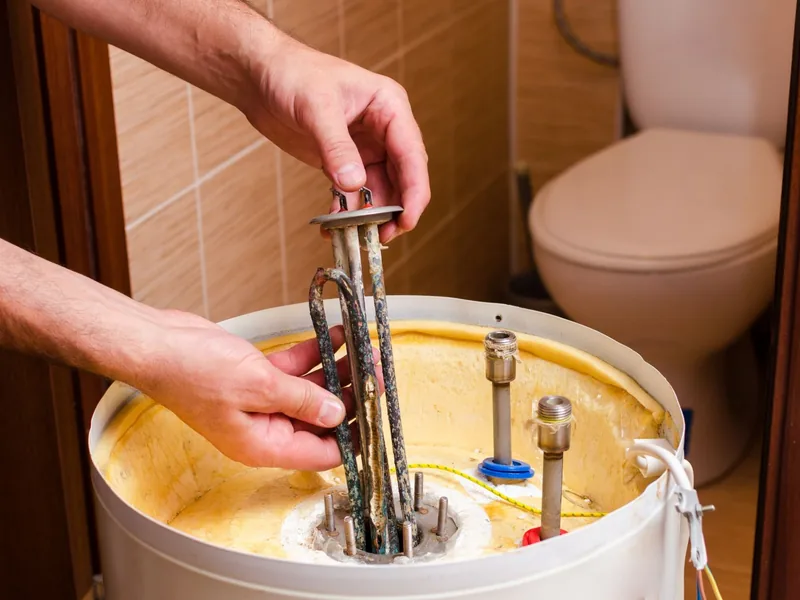
Upper Element, Lower Element: Who Does What
Every standard electric tank heater in Berkley runs a two-element relay race, and knowing the positions helps you read the symptoms. The upper element sits behind the top access panel with the upper thermostat; it heats the water at the top of the tank — the water that exits first when you open a tap. The lower element sits behind the lower panel near the tank floor, and it does the heavy lifting, heating the large volume of incoming cold water. Control logic gives the upper element priority: if the top of the tank is below setpoint, the upper element fires and the lower waits. Once the top is satisfied, power switches to the lower element until the whole tank reaches temperature. This division of labor is why failures feel different. A dead upper element often means no hot water at all, because the top of the tank never gets heated and the lower element never gets its turn. A dead lower element means a short burst of hot water from the top, then a fast fade to lukewarm — the most common complaint we hear. The elements themselves are simple resistive heaters, but their placement and the thermostat sequencing turn them into a system. When we service your heater, we test both elements and both thermostats, because replacing one failed part while its partner is weak just schedules a second visit.
Symptoms of a Dead Heating Element
Electric heater trouble in Berkley tends to follow a script, and the heating element is the lead actor. Symptom one: the shower starts hot and turns lukewarm within minutes. That is the textbook dead lower element — the top of the tank holds a little hot water, the bottom never heats, and the reserve vanishes fast. Symptom two: water that is uniformly lukewarm no matter how long you wait between uses, suggesting an element coated in scale that can no longer transfer heat efficiently. Symptom three: no hot water whatsoever, which usually traces to the upper element or its thermostat, since the heating sequence stalls at the top of the tank. Symptom four: the double breaker for the heater keeps tripping. That is the serious one — it often means the element sheath has split and current is finding a path through the water to the grounded tank. Turn that breaker off, leave it off, and call (833) 713-2101. Symptom five is audible: rumbling, popping, or a harsh hum from the tank, the sound of an element fighting through sediment. We see all five weekly, and each one gets the same careful diagnosis: elements tested with a meter, thermostats checked, and only the actually failed parts replaced.
Why Heating Elements Burn Out
Heating elements do not die of old age so much as they die of their working conditions, and the number-one killer is sediment. Minerals in the water supply — calcium and magnesium especially — settle to the bottom of the tank over the years and bury the lower element. An element encased in sediment cannot shed its heat into the water, so its own temperature climbs until the resistive core burns through the sheath. That is why the lower element fails far more often than the upper one in Berkley homes. The second great killer is dry-firing: if power reaches an element while the tank is not completely full of water, the element destroys itself in seconds — there is no water to absorb the heat. This happens after do-it-yourself drain-downs more than anywhere else, which is why our procedure refills the tank fully before the breaker ever goes back on. Scale buildup is the slower version of the same story: minerals bake onto the element surface, insulating it until it overheats. Electrical issues contribute too — loose connections at the element terminals create hot spots, and voltage problems stress the resistive core. And simple cycling wear matters: years of expanding and contracting eventually fatigue the sheath. The good news is that most of these causes are manageable with maintenance, which we will get to below.
Not All Elements Are Interchangeable
Walk into a store and you will see a wall of heating elements that all look roughly alike — and most of them are wrong for your specific heater. Getting the replacement right means matching four things. First, wattage, which must equal what your tank was built for; the wrong wattage either starves you of hot water or overloads your wiring and breaker. Second, voltage, which must suit your 240-volt supply. Third, physical fit: screw-in versus flange mounting, the correct thread and length for your tank's diameter, and a fresh gasket — reusing an old gasket is asking for a seep. Fourth, the design suited to your water: in Berkley, where mineral content runs moderate to high depending on the supply, we lean toward low-density foldback elements whose longer, cooler-running loops accumulate scale more slowly than standard high-density elements. Sheath material is part of that decision too. This is also why we check the thermostats during the same visit — an element and its thermostat work as a pair, and a weak thermostat will make even a perfect new element perform badly. When you call (833) 713-2101, tell us your heater's brand and approximate age if you know it; we will arrive with the right element options for your tank.
Berkley Homes and Water Heaters: Local Notes
Berkley is rural Bristol County — working farms, large lots, and long driveways, with a housing stock of older farmhouses, colonials, and capes, many of them dating well before 1960. A large share of Berkley homes run on private wells with septic systems, and well water here commonly carries iron and sediment that city water does not. Basements are the norm, and the water heater often shares space with well equipment and treatment systems.
Well water changes the water heater equation: iron and mineral sediment accumulate faster, anode rods get consumed sooner, and tank bottoms run hotter under their insulating blanket. We see the consequences in Berkley regularly — elements burned out prematurely, valves stressed by overheated tanks, relief valves dripping from expansion in closed well systems. Electric tank heaters are common in these neighborhoods, and mineral-heavy water shortens element life — sediment flushing is the best defense we recommend. If your Berkley heater is struggling, call (833) 713-2101 — we will read the tank's condition honestly and fix what is fixable.
Our Element Replacement Process
Here is the exact sequence we follow for heating element replacement in Berkley 02779, and every step exists for a reason. One: kill the power at the breaker and prove it dead with a meter — 240 volts plus water demands zero assumptions. Two: diagnose properly, testing both elements and both thermostats with a meter so we replace what failed and catch what is weakening. Three: drain the tank to below the element port, or drain fully for a flush if sediment is heavy. Four: remove the access cover, disconnect and label the wiring, and extract the failed element. Five: install the correctly matched new element — right wattage, right length, right mount — with a new gasket, seated to proper torque. Six: close everything up and refill the tank completely, running a hot tap until the air purges and water flows solid. This step is non-negotiable: an element energized in air burns out almost instantly. Seven: restore power and watch both thermostats cycle, confirming the upper-to-lower handoff works. Eight: verify hot water at the tap and recheck for any seep at the element port. Methodical, unhurried, and complete — that is how we do it. (833) 713-2101.
After the Swap: Protecting Your Investment
The new element is in and the hot water is back — now let us keep it that way. The enemies of element life in Berkley are sediment and corrosion, and both are manageable. Sediment control means flushing: opening the drain valve periodically to carry precipitated minerals out of the tank before they entomb the lower element. If your water leaves heavy scale on fixtures, your tank is collecting it too, and more frequent flushing pays for itself in element life. Corrosion control means the anode rod — that long metal rod inside the tank sacrifices itself to protect the steel, and when it is gone, rust joins the sediment attacking your elements. We can check its condition during our visit and tell you honestly whether it has life left. Thermostat discipline helps as well: both thermostats set to the same sensible temperature, around 120 degrees, keeps the system balanced and reduces scale-baking heat. And never drain the tank yourself and restore power before it is completely refilled — dry-firing kills even a brand-new element in seconds. Fold these habits in and your new element should serve for years. We will walk you through all of it on site — (833) 713-2101.
Hot Water Again in Berkley
You do not need to limp along with lukewarm showers. Call (833) 713-2101 and our crew will be at your Berkley home — usually the same day — with the right element for your tank. We test both elements and both thermostats, replace what failed with an exact-match part, refill and verify everything, and leave you with a full tank of properly heated water. One visit, done right. (833) 713-2101. Call (833) 713-2101.