How an Electric Tank Heater Makes Hot Water
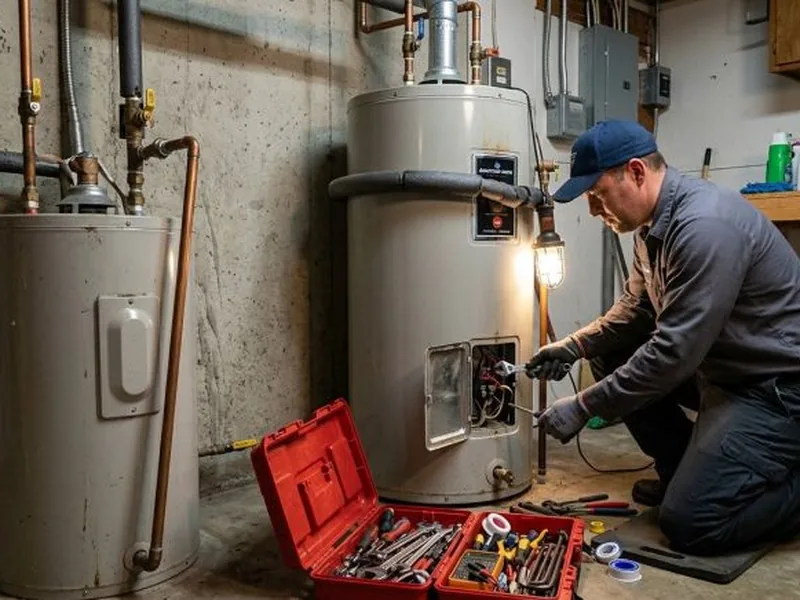
An electric tank water heater is beautifully simple inside: two heating elements, two thermostats, and a tank full of water. The elements are resistive metal loops sealed in a sheath, threaded into the side of the tank — one near the top, one near the bottom. When you draw hot water, cold water enters the bottom of the tank and the lower thermostat senses the temperature drop and powers the lower element, which heats the bulk of the water. The upper element and thermostat handle the top of the tank and get priority: if the upper water is cool, the upper element heats first, then hands off to the lower one. Each element typically draws serious power — these are 240-volt circuits — which is why your heater has its own double breaker in the panel. The thermostats stagger the work so both elements never run at once, keeping the electrical load manageable. When the system is healthy, you get a full tank of evenly heated water. When one element burns out, the choreography breaks: the remaining element tries to compensate, and you get the classic symptoms — water that starts warm and fades, or a tank that never fully recovers between uses. Understanding this two-element teamwork is the key to diagnosing electric heater problems in Blackstone homes.
Symptoms of a Dead Heating Element
Electric heater trouble in Blackstone tends to follow a script, and the heating element is the lead actor. Symptom one: the shower starts hot and turns lukewarm within minutes. That is the textbook dead lower element — the top of the tank holds a little hot water, the bottom never heats, and the reserve vanishes fast. Symptom two: water that is uniformly lukewarm no matter how long you wait between uses, suggesting an element coated in scale that can no longer transfer heat efficiently. Symptom three: no hot water whatsoever, which usually traces to the upper element or its thermostat, since the heating sequence stalls at the top of the tank. Symptom four: the double breaker for the heater keeps tripping. That is the serious one — it often means the element sheath has split and current is finding a path through the water to the grounded tank. Turn that breaker off, leave it off, and call (833) 713-2101. Symptom five is audible: rumbling, popping, or a harsh hum from the tank, the sound of an element fighting through sediment. We see all five weekly, and each one gets the same careful diagnosis: elements tested with a meter, thermostats checked, and only the actually failed parts replaced.
Sediment: The Number-One Element Killer
If you take one thing away from this page, let it be this: sediment is what kills most heating elements in Blackstone. Every gallon of water entering your heater carries dissolved minerals, and when the water is heated, those minerals precipitate out and sink. Year after year, a layer of calcium sediment builds on the tank floor — right where the lower element lives. At first the element just works a little harder. Eventually it is entombed, and the heat it generates has nowhere to go. The sheath temperature soars past its design limits, the internal resistance wire burns through, and the element dies — sometimes quietly, sometimes by shorting and tripping your breaker. Water with higher mineral content builds that burial mound faster, which is why homes on certain wells see shorter element life. The defense is straightforward: periodic tank flushing to wash sediment out through the drain valve, and anode rod maintenance to slow tank corrosion that adds to the debris. When we replace your element, we will show you what came out of your tank and give you an honest read on its sediment load. An element replacement without addressing heavy sediment is just scheduling the next failure, so we treat the cause and the symptom together. Call (833) 713-2101 and we will handle both.
Choosing the Right Replacement Element
Heating elements are not one-size-fits-all, and installing the wrong one causes real problems. The critical match is wattage: your heater's wiring, breaker, and thermostats were sized for a specific element rating — commonly 4500 watts on residential tanks — and installing a higher-wattage element overloads the circuit while a lower-wattage one leaves you with sluggish recovery. We match the original rating exactly. Length matters too: the element must reach into the tank properly without touching the opposite wall, so we size it to your tank's diameter. Then there is the mounting style — most modern tanks use screw-in elements, but older units may have flange or bolt-in types that need their own gasket kits. Density is the subtler choice: standard high-density elements concentrate heat in a short loop, while low-density foldback elements spread the same wattage over a longer loop that runs cooler. In mineral-heavy Blackstone water, the cooler-running foldback design resists scale buildup and typically outlasts the standard type, so we often recommend it. Material matters as well — copper-sheathed, stainless, and Incoloy elements each suit different water conditions. We carry the common configurations on the truck and match your tank's spec plate before anything gets installed. The right element, correctly chosen, is the difference between a repair that lasts and one that repeats.
On the Ground in Blackstone 01504
Blackstone is a classic Blackstone Valley mill town along the river, with dense neighborhoods of older homes — many built between 1900 and 1950, including multifamily houses that have been divided and re-divided over the decades. That older housing stock means older plumbing: galvanized supply lines in pre-1960 homes, aging water heaters in low basements, and components that have simply reached the end of their service life. Town water serves the community.
In mill-town housing like Blackstone's, water heaters work hard and get replaced late — we regularly find tanks fifteen-plus years old still limping along on borrowed time. Original-era gas valves, scaled-over elements, and corroded fittings are everyday sights here. Electric tank heaters are common in these neighborhoods, and mineral-heavy water shortens element life — sediment flushing is the best defense we recommend. Blackstone 01504 is right in our service range from Attleboro; call (833) 713-2101 and we will give your heater a straight assessment.
Our Element Replacement Process
Here is the exact sequence we follow for heating element replacement in Blackstone 01504, and every step exists for a reason. One: kill the power at the breaker and prove it dead with a meter — 240 volts plus water demands zero assumptions. Two: diagnose properly, testing both elements and both thermostats with a meter so we replace what failed and catch what is weakening. Three: drain the tank to below the element port, or drain fully for a flush if sediment is heavy. Four: remove the access cover, disconnect and label the wiring, and extract the failed element. Five: install the correctly matched new element — right wattage, right length, right mount — with a new gasket, seated to proper torque. Six: close everything up and refill the tank completely, running a hot tap until the air purges and water flows solid. This step is non-negotiable: an element energized in air burns out almost instantly. Seven: restore power and watch both thermostats cycle, confirming the upper-to-lower handoff works. Eight: verify hot water at the tap and recheck for any seep at the element port. Methodical, unhurried, and complete — that is how we do it. (833) 713-2101.
After the Swap: Protecting Your Investment
The new element is in and the hot water is back — now let us keep it that way. The enemies of element life in Blackstone are sediment and corrosion, and both are manageable. Sediment control means flushing: opening the drain valve periodically to carry precipitated minerals out of the tank before they entomb the lower element. If your water leaves heavy scale on fixtures, your tank is collecting it too, and more frequent flushing pays for itself in element life. Corrosion control means the anode rod — that long metal rod inside the tank sacrifices itself to protect the steel, and when it is gone, rust joins the sediment attacking your elements. We can check its condition during our visit and tell you honestly whether it has life left. Thermostat discipline helps as well: both thermostats set to the same sensible temperature, around 120 degrees, keeps the system balanced and reduces scale-baking heat. And never drain the tank yourself and restore power before it is completely refilled — dry-firing kills even a brand-new element in seconds. Fold these habits in and your new element should serve for years. We will walk you through all of it on site — (833) 713-2101.
Same-Day Element Service in Blackstone 01504
When the hot water fades halfway through every shower, every day you wait is another cold finish. Call us now at (833) 713-2101: we will diagnose your electric heater, replace the burned-out element with the correct wattage and fit, check the thermostats and sediment load, and prove the repair with hot water at the tap before we leave. Blackstone 01504 gets same-day service in most cases. (833) 713-2101. Ring (833) 713-2101.