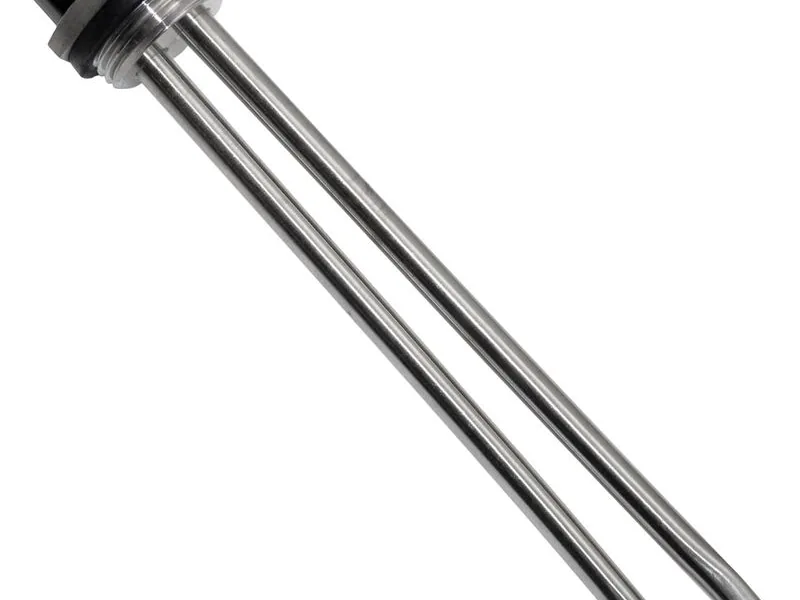
Upper Element, Lower Element: Who Does What
Every standard electric tank heater in Mansfield runs a two-element relay race, and knowing the positions helps you read the symptoms. The upper element sits behind the top access panel with the upper thermostat; it heats the water at the top of the tank — the water that exits first when you open a tap. The lower element sits behind the lower panel near the tank floor, and it does the heavy lifting, heating the large volume of incoming cold water. Control logic gives the upper element priority: if the top of the tank is below setpoint, the upper element fires and the lower waits. Once the top is satisfied, power switches to the lower element until the whole tank reaches temperature. This division of labor is why failures feel different. A dead upper element often means no hot water at all, because the top of the tank never gets heated and the lower element never gets its turn. A dead lower element means a short burst of hot water from the top, then a fast fade to lukewarm — the most common complaint we hear. The elements themselves are simple resistive heaters, but their placement and the thermostat sequencing turn them into a system. When we service your heater, we test both elements and both thermostats, because replacing one failed part while its partner is weak just schedules a second visit.
Signs an Element Has Burned Out
A burned-out heating element rarely fails silently — your Mansfield home will tell you in one of several ways. The most common is hot water that runs out far too fast: you get a few good minutes and then it fades to lukewarm, which usually means the lower element is dead and only the small hot layer at the top of the tank is available. Complete loss of hot water more often implicates the upper element or an upper thermostat, since the heating sequence never properly starts. A breaker that trips when the heater runs points to an element whose sheath has cracked, letting water contact the resistive core and short to ground — that is an electrical fault that needs prompt attention, and you should leave the breaker off and call (833) 713-2101. Sometimes you will hear the heater: a loud humming, sizzling, or popping from the tank often means an element is buried in sediment and overheating as it struggles to transfer heat. And occasionally there is no drama at all — just water that never quite gets hot, because a scaled-over element cannot deliver its rated wattage anymore. Any of these symptoms in an electric heater deserves a proper element and thermostat test, which is exactly what our visit includes.
Why Heating Elements Burn Out
Heating elements do not die of old age so much as they die of their working conditions, and the number-one killer is sediment. Minerals in the water supply — calcium and magnesium especially — settle to the bottom of the tank over the years and bury the lower element. An element encased in sediment cannot shed its heat into the water, so its own temperature climbs until the resistive core burns through the sheath. That is why the lower element fails far more often than the upper one in Mansfield homes. The second great killer is dry-firing: if power reaches an element while the tank is not completely full of water, the element destroys itself in seconds — there is no water to absorb the heat. This happens after do-it-yourself drain-downs more than anywhere else, which is why our procedure refills the tank fully before the breaker ever goes back on. Scale buildup is the slower version of the same story: minerals bake onto the element surface, insulating it until it overheats. Electrical issues contribute too — loose connections at the element terminals create hot spots, and voltage problems stress the resistive core. And simple cycling wear matters: years of expanding and contracting eventually fatigue the sheath. The good news is that most of these causes are manageable with maintenance, which we will get to below.
Not All Elements Are Interchangeable
Walk into a store and you will see a wall of heating elements that all look roughly alike — and most of them are wrong for your specific heater. Getting the replacement right means matching four things. First, wattage, which must equal what your tank was built for; the wrong wattage either starves you of hot water or overloads your wiring and breaker. Second, voltage, which must suit your 240-volt supply. Third, physical fit: screw-in versus flange mounting, the correct thread and length for your tank's diameter, and a fresh gasket — reusing an old gasket is asking for a seep. Fourth, the design suited to your water: in Mansfield, where mineral content runs moderate to high depending on the supply, we lean toward low-density foldback elements whose longer, cooler-running loops accumulate scale more slowly than standard high-density elements. Sheath material is part of that decision too. This is also why we check the thermostats during the same visit — an element and its thermostat work as a pair, and a weak thermostat will make even a perfect new element perform badly. When you call (833) 713-2101, tell us your heater's brand and approximate age if you know it; we will arrive with the right element options for your tank.
Serving Mansfield 02048: What We See in Local Homes
Mansfield is a commuter-rail hub with the Xfinity Center drawing crowds all summer, and its housing reflects steady growth: older homes near the center, big 1980s-and-90s subdivisions, and newer apartment and condo complexes near the train. The single-family neighborhoods mostly have full basements housing the water heater, and town water serves the community with moderate hardness.
The 1980s-and-90s subdivisions are the sweet spot for water heater failures right now — original tanks long gone, but even second-generation heaters are aging out. We see gas valves that will not hold pilots, elements entombed in sediment, and the occasional tank seam letting go. Proximity to our Attleboro base means fast response across Mansfield. Where electric heaters serve these homes, burned-out lower elements are a weekly call for us — usually buried in years of accumulated sediment. If your 02048 heater is failing, call (833) 713-2101.
After the Swap: Protecting Your Investment
The new element is in and the hot water is back — now let us keep it that way. The enemies of element life in Mansfield are sediment and corrosion, and both are manageable. Sediment control means flushing: opening the drain valve periodically to carry precipitated minerals out of the tank before they entomb the lower element. If your water leaves heavy scale on fixtures, your tank is collecting it too, and more frequent flushing pays for itself in element life. Corrosion control means the anode rod — that long metal rod inside the tank sacrifices itself to protect the steel, and when it is gone, rust joins the sediment attacking your elements. We can check its condition during our visit and tell you honestly whether it has life left. Thermostat discipline helps as well: both thermostats set to the same sensible temperature, around 120 degrees, keeps the system balanced and reduces scale-baking heat. And never drain the tank yourself and restore power before it is completely refilled — dry-firing kills even a brand-new element in seconds. Fold these habits in and your new element should serve for years. We will walk you through all of it on site — (833) 713-2101.
What Happens During the Service Visit
An element replacement is electrical work inside a water-filled tank, so our procedure in Mansfield is built around safety first. We start at your electrical panel, switching off the heater's double breaker — and then we verify with a meter that the power is truly dead, because a mislabeled breaker is not something we gamble on. With the power confirmed off, we connect a hose to the drain valve and drain the tank below the level of the failed element, or fully if a flush is due. The access panel and insulation come off, the wires are disconnected and labeled, and the old element is unscrewed with an element wrench. We inspect the tank threads, install the new element with a fresh gasket, and torque it properly. Then comes the step that do-it-yourselfers most often get wrong: we refill the tank completely and purge the air through a hot tap before the breaker goes back on. Powering an element in a partially filled tank — dry-firing — destroys it in seconds. Only with the tank full do we restore power, then we verify both thermostats cycle correctly and confirm hot water at a tap. The whole visit typically runs about an hour, and we test everything twice before we leave. Call (833) 713-2101 to schedule yours.
Same-Day Element Service in Mansfield 02048
When the hot water fades halfway through every shower, every day you wait is another cold finish. Call us now at (833) 713-2101: we will diagnose your electric heater, replace the burned-out element with the correct wattage and fit, check the thermostats and sediment load, and prove the repair with hot water at the tap before we leave. Mansfield 02048 gets same-day service in most cases. (833) 713-2101. Ring (833) 713-2101.