How an Electric Tank Heater Makes Hot Water
An electric tank water heater is beautifully simple inside: two heating elements, two thermostats, and a tank full of water. The elements are resistive metal loops sealed in a sheath, threaded into the side of the tank — one near the top, one near the bottom. When you draw hot water, cold water enters the bottom of the tank and the lower thermostat senses the temperature drop and powers the lower element, which heats the bulk of the water. The upper element and thermostat handle the top of the tank and get priority: if the upper water is cool, the upper element heats first, then hands off to the lower one. Each element typically draws serious power — these are 240-volt circuits — which is why your heater has its own double breaker in the panel. The thermostats stagger the work so both elements never run at once, keeping the electrical load manageable. When the system is healthy, you get a full tank of evenly heated water. When one element burns out, the choreography breaks: the remaining element tries to compensate, and you get the classic symptoms — water that starts warm and fades, or a tank that never fully recovers between uses. Understanding this two-element teamwork is the key to diagnosing electric heater problems in Mendon homes.
Signs an Element Has Burned Out
A burned-out heating element rarely fails silently — your Mendon home will tell you in one of several ways. The most common is hot water that runs out far too fast: you get a few good minutes and then it fades to lukewarm, which usually means the lower element is dead and only the small hot layer at the top of the tank is available. Complete loss of hot water more often implicates the upper element or an upper thermostat, since the heating sequence never properly starts. A breaker that trips when the heater runs points to an element whose sheath has cracked, letting water contact the resistive core and short to ground — that is an electrical fault that needs prompt attention, and you should leave the breaker off and call (833) 713-2101. Sometimes you will hear the heater: a loud humming, sizzling, or popping from the tank often means an element is buried in sediment and overheating as it struggles to transfer heat. And occasionally there is no drama at all — just water that never quite gets hot, because a scaled-over element cannot deliver its rated wattage anymore. Any of these symptoms in an electric heater deserves a proper element and thermostat test, which is exactly what our visit includes.
Sediment: The Number-One Element Killer
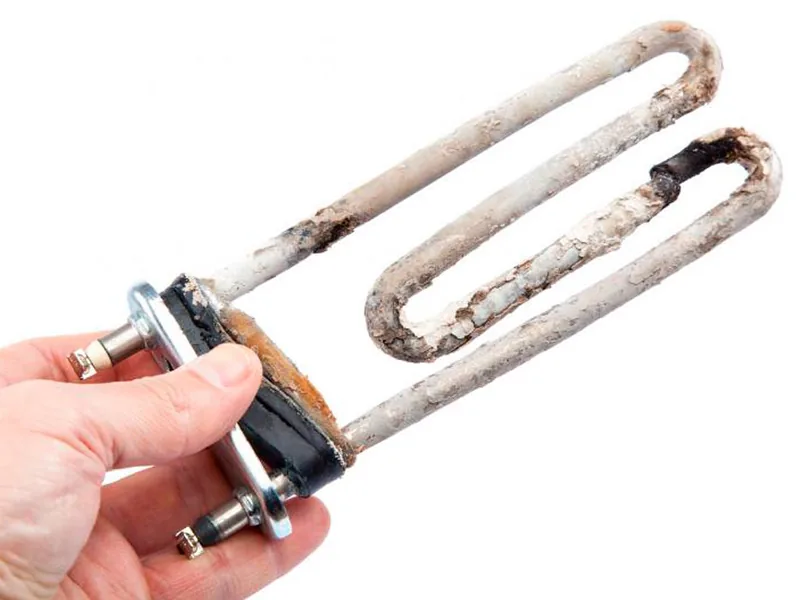
If you take one thing away from this page, let it be this: sediment is what kills most heating elements in Mendon. Every gallon of water entering your heater carries dissolved minerals, and when the water is heated, those minerals precipitate out and sink. Year after year, a layer of calcium sediment builds on the tank floor — right where the lower element lives. At first the element just works a little harder. Eventually it is entombed, and the heat it generates has nowhere to go. The sheath temperature soars past its design limits, the internal resistance wire burns through, and the element dies — sometimes quietly, sometimes by shorting and tripping your breaker. Water with higher mineral content builds that burial mound faster, which is why homes on certain wells see shorter element life. The defense is straightforward: periodic tank flushing to wash sediment out through the drain valve, and anode rod maintenance to slow tank corrosion that adds to the debris. When we replace your element, we will show you what came out of your tank and give you an honest read on its sediment load. An element replacement without addressing heavy sediment is just scheduling the next failure, so we treat the cause and the symptom together. Call (833) 713-2101 and we will handle both.
Not All Elements Are Interchangeable
Walk into a store and you will see a wall of heating elements that all look roughly alike — and most of them are wrong for your specific heater. Getting the replacement right means matching four things. First, wattage, which must equal what your tank was built for; the wrong wattage either starves you of hot water or overloads your wiring and breaker. Second, voltage, which must suit your 240-volt supply. Third, physical fit: screw-in versus flange mounting, the correct thread and length for your tank's diameter, and a fresh gasket — reusing an old gasket is asking for a seep. Fourth, the design suited to your water: in Mendon, where mineral content runs moderate to high depending on the supply, we lean toward low-density foldback elements whose longer, cooler-running loops accumulate scale more slowly than standard high-density elements. Sheath material is part of that decision too. This is also why we check the thermostats during the same visit — an element and its thermostat work as a pair, and a weak thermostat will make even a perfect new element perform badly. When you call (833) 713-2101, tell us your heater's brand and approximate age if you know it; we will arrive with the right element options for your tank.
Mendon Homes and Water Heaters: Local Notes
Mendon is rural and proud of it — home of the Mendon Twin Drive-In, with large lots, older colonials and farmhouses, and plenty of homes on private wells with septic. The housing stock leans older, and many properties have the water heater in a basement or crawlspace alongside well pressure tanks and treatment equipment. Well water here varies, but mineral content and sediment are common themes.
Private wells change water heater maintenance math: more sediment, faster anode consumption, and in some cases aggressive water that shortens tank life. Mendon heaters tend to fail from the inside out — corroded shells, burned-out elements, valves stressed by overheated sediment-laden tanks. Electric tank heaters are common in these neighborhoods, and mineral-heavy water shortens element life — sediment flushing is the best defense we recommend. Mendon 01756 is in our regular service range from Attleboro; call (833) 713-2101 and we will sort out your heater honestly.
What Happens During the Service Visit
An element replacement is electrical work inside a water-filled tank, so our procedure in Mendon is built around safety first. We start at your electrical panel, switching off the heater's double breaker — and then we verify with a meter that the power is truly dead, because a mislabeled breaker is not something we gamble on. With the power confirmed off, we connect a hose to the drain valve and drain the tank below the level of the failed element, or fully if a flush is due. The access panel and insulation come off, the wires are disconnected and labeled, and the old element is unscrewed with an element wrench. We inspect the tank threads, install the new element with a fresh gasket, and torque it properly. Then comes the step that do-it-yourselfers most often get wrong: we refill the tank completely and purge the air through a hot tap before the breaker goes back on. Powering an element in a partially filled tank — dry-firing — destroys it in seconds. Only with the tank full do we restore power, then we verify both thermostats cycle correctly and confirm hot water at a tap. The whole visit typically runs about an hour, and we test everything twice before we leave. Call (833) 713-2101 to schedule yours.
Making New Elements Last: Flush and Anode
A new element in a neglected tank is a short-lived victory, so we treat every element replacement in Mendon as a chance to reset the heater's maintenance clock. The single most valuable habit is periodic flushing: draining a few gallons — or a full flush — through the drain valve washes out the mineral sediment that buries lower elements. How often depends on your water; we will show you what your tank held and suggest a rhythm. The anode rod is the second half of the equation. This sacrificial metal rod hangs inside the tank and corrodes so the steel tank does not; once it is consumed, corrosion accelerates and adds rust debris to the sediment pile attacking your elements. Checking it every few years and replacing it when depleted is the cheapest life-extension a water heater gets. Temperature setting plays a role too — running the thermostats at a sensible 120 degrees reduces scale formation compared to cranking them to maximum, and it is safer against scalding as a bonus. When we visit, we can flush the tank, inspect the anode, and set the thermostats correctly in the same appointment. It turns a simple element swap into a proper tune-up. Ask about it when you call (833) 713-2101.
Hot Water Again in Mendon
You do not need to limp along with lukewarm showers. Call (833) 713-2101 and our crew will be at your Mendon home — usually the same day — with the right element for your tank. We test both elements and both thermostats, replace what failed with an exact-match part, refill and verify everything, and leave you with a full tank of properly heated water. One visit, done right. (833) 713-2101. Call us now at (833) 713-2101.