Upper Element, Lower Element: Who Does What
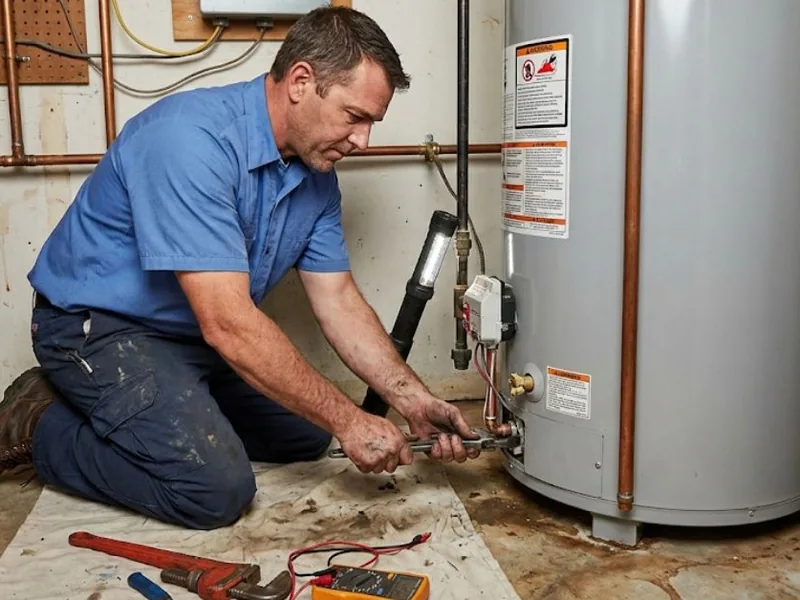
Every standard electric tank heater in Wrentham runs a two-element relay race, and knowing the positions helps you read the symptoms. The upper element sits behind the top access panel with the upper thermostat; it heats the water at the top of the tank — the water that exits first when you open a tap. The lower element sits behind the lower panel near the tank floor, and it does the heavy lifting, heating the large volume of incoming cold water. Control logic gives the upper element priority: if the top of the tank is below setpoint, the upper element fires and the lower waits. Once the top is satisfied, power switches to the lower element until the whole tank reaches temperature. This division of labor is why failures feel different. A dead upper element often means no hot water at all, because the top of the tank never gets heated and the lower element never gets its turn. A dead lower element means a short burst of hot water from the top, then a fast fade to lukewarm — the most common complaint we hear. The elements themselves are simple resistive heaters, but their placement and the thermostat sequencing turn them into a system. When we service your heater, we test both elements and both thermostats, because replacing one failed part while its partner is weak just schedules a second visit.
Signs an Element Has Burned Out
A burned-out heating element rarely fails silently — your Wrentham home will tell you in one of several ways. The most common is hot water that runs out far too fast: you get a few good minutes and then it fades to lukewarm, which usually means the lower element is dead and only the small hot layer at the top of the tank is available. Complete loss of hot water more often implicates the upper element or an upper thermostat, since the heating sequence never properly starts. A breaker that trips when the heater runs points to an element whose sheath has cracked, letting water contact the resistive core and short to ground — that is an electrical fault that needs prompt attention, and you should leave the breaker off and call (833) 713-2101. Sometimes you will hear the heater: a loud humming, sizzling, or popping from the tank often means an element is buried in sediment and overheating as it struggles to transfer heat. And occasionally there is no drama at all — just water that never quite gets hot, because a scaled-over element cannot deliver its rated wattage anymore. Any of these symptoms in an electric heater deserves a proper element and thermostat test, which is exactly what our visit includes.
Why Heating Elements Burn Out
Heating elements do not die of old age so much as they die of their working conditions, and the number-one killer is sediment. Minerals in the water supply — calcium and magnesium especially — settle to the bottom of the tank over the years and bury the lower element. An element encased in sediment cannot shed its heat into the water, so its own temperature climbs until the resistive core burns through the sheath. That is why the lower element fails far more often than the upper one in Wrentham homes. The second great killer is dry-firing: if power reaches an element while the tank is not completely full of water, the element destroys itself in seconds — there is no water to absorb the heat. This happens after do-it-yourself drain-downs more than anywhere else, which is why our procedure refills the tank fully before the breaker ever goes back on. Scale buildup is the slower version of the same story: minerals bake onto the element surface, insulating it until it overheats. Electrical issues contribute too — loose connections at the element terminals create hot spots, and voltage problems stress the resistive core. And simple cycling wear matters: years of expanding and contracting eventually fatigue the sheath. The good news is that most of these causes are manageable with maintenance, which we will get to below.
Choosing the Right Replacement Element
Heating elements are not one-size-fits-all, and installing the wrong one causes real problems. The critical match is wattage: your heater's wiring, breaker, and thermostats were sized for a specific element rating — commonly 4500 watts on residential tanks — and installing a higher-wattage element overloads the circuit while a lower-wattage one leaves you with sluggish recovery. We match the original rating exactly. Length matters too: the element must reach into the tank properly without touching the opposite wall, so we size it to your tank's diameter. Then there is the mounting style — most modern tanks use screw-in elements, but older units may have flange or bolt-in types that need their own gasket kits. Density is the subtler choice: standard high-density elements concentrate heat in a short loop, while low-density foldback elements spread the same wattage over a longer loop that runs cooler. In mineral-heavy Wrentham water, the cooler-running foldback design resists scale buildup and typically outlasts the standard type, so we often recommend it. Material matters as well — copper-sheathed, stainless, and Incoloy elements each suit different water conditions. We carry the common configurations on the truck and match your tank's spec plate before anything gets installed. The right element, correctly chosen, is the difference between a repair that lasts and one that repeats.
Water Heaters in Wrentham: What's Typical Here
Wrentham is known for its outlets and its classic New England town center, with a housing mix of genuine antique homes near the center and subdivisions from the 1960s onward spreading outward. The antique homes bring antique plumbing — and water heaters shoehorned into old basements and crawlspaces — while the subdivisions bring the standard aging curve of replacement-era units. Town water serves most of Wrentham.
The antique homes near the center are where we see the most challenging installations: tight basements, old piping, and heaters that have been nursed along for years. In the subdivisions it is the familiar pattern — valves failing, elements burning out, relief valves weeping as components age out together. Electric tank heaters are common in these neighborhoods, and mineral-heavy water shortens element life — sediment flushing is the best defense we recommend. Wrentham 02093 is right in our Attleboro service range; call (833) 713-2101.
What Happens During the Service Visit
An element replacement is electrical work inside a water-filled tank, so our procedure in Wrentham is built around safety first. We start at your electrical panel, switching off the heater's double breaker — and then we verify with a meter that the power is truly dead, because a mislabeled breaker is not something we gamble on. With the power confirmed off, we connect a hose to the drain valve and drain the tank below the level of the failed element, or fully if a flush is due. The access panel and insulation come off, the wires are disconnected and labeled, and the old element is unscrewed with an element wrench. We inspect the tank threads, install the new element with a fresh gasket, and torque it properly. Then comes the step that do-it-yourselfers most often get wrong: we refill the tank completely and purge the air through a hot tap before the breaker goes back on. Powering an element in a partially filled tank — dry-firing — destroys it in seconds. Only with the tank full do we restore power, then we verify both thermostats cycle correctly and confirm hot water at a tap. The whole visit typically runs about an hour, and we test everything twice before we leave. Call (833) 713-2101 to schedule yours.
Making New Elements Last: Flush and Anode
A new element in a neglected tank is a short-lived victory, so we treat every element replacement in Wrentham as a chance to reset the heater's maintenance clock. The single most valuable habit is periodic flushing: draining a few gallons — or a full flush — through the drain valve washes out the mineral sediment that buries lower elements. How often depends on your water; we will show you what your tank held and suggest a rhythm. The anode rod is the second half of the equation. This sacrificial metal rod hangs inside the tank and corrodes so the steel tank does not; once it is consumed, corrosion accelerates and adds rust debris to the sediment pile attacking your elements. Checking it every few years and replacing it when depleted is the cheapest life-extension a water heater gets. Temperature setting plays a role too — running the thermostats at a sensible 120 degrees reduces scale formation compared to cranking them to maximum, and it is safer against scalding as a bonus. When we visit, we can flush the tank, inspect the anode, and set the thermostats correctly in the same appointment. It turns a simple element swap into a proper tune-up. Ask about it when you call (833) 713-2101.
Ready When You Are
A burned-out heating element is one of the most straightforward water heater repairs there is — in experienced hands, with the power handled safely and the tank refilled properly. Call the crew at (833) 713-2101 for heating element replacement anywhere in Wrentham 02093. Same-day visits, exact-match parts, thermostats checked, and hot water back before we go. That is the Water Heater Leak Repair Crew promise. (833) 713-2101. Call (833) 713-2101.