Reading the Leak: What the Location Tells Us
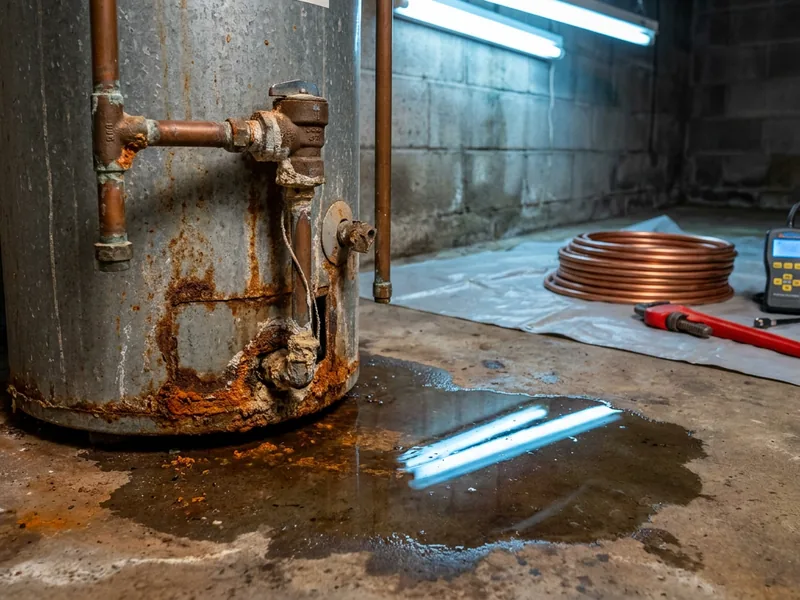
You can learn a lot before we arrive by noting where the water is. Water at the top of the heater in a Mendon basement usually means a supply connection: the cold inlet, hot outlet, or the fittings joining them to your house plumbing. These are the most repairable leaks we see — often a washer, a union, or a flex connector. Water running from the relief valve's discharge pipe points to the T and P valve: either the tank is over-pressurized or overheating, which needs investigation, or the valve has simply worn out, which needs a replacement valve. Water at the base around the drain valve is usually the drain valve itself, a straightforward swap. Water with no clear origin — dampness under the tank, rust streaks down the jacket, moisture at a seam — is the ominous one, suggesting the shell has corroded through. And water that appears only in humid weather, with no drip source at all, may be condensation on a cold tank or cold pipes, which is a ventilation matter rather than a leak. When you call (833) 713-2101, tell us where you see the water. That one detail often lets us arrive with the right parts already on the truck.
Not Every Puddle Means a Dead Tank
Before anyone talks about replacing your water heater, the puddle deserves a proper investigation — because in our experience across Mendon, the tank is guilty only about half the time. We start with the simple checks. Is the moisture condensation? Drying the jacket and watching where water reappears answers that in minutes. Is water arriving from above? We inspect the piping over the heater and the supply connections, since ceiling leaks and sweating pipes love to frame the water heater. Is the relief valve discharging because of system pressure rather than a bad valve? A pressure gauge on the drain valve tells us quickly, and high readings point to thermal expansion on a closed system — fixed with an expansion tank, not a new heater. Then we work the heater's own leak points in order: drain valve, T and P valve, inlet and outlet fittings, dielectric unions. Each gets inspected, tightened where appropriate, and tested. What is left after that process is the tank shell — and if the shell is breached, we will show you the evidence rather than just declaring it. Honest diagnosis is the core of our leak service: fix what is fixable, prove what is not, and never sell a replacement on a guess. (833) 713-2101.
Why Tanks Start Leaking
Tank water heaters leak for reasons that build up quietly over years, which is why the puddle always feels sudden. The fundamental story is corrosion. The inside of the steel tank is protected by a glass lining and a sacrificial anode rod — a metal rod that corrodes so the tank does not. Once that rod is consumed, and it always is eventually, the tank steel starts corroding, and corrosion does not stop. It works outward from the inside until it finds the surface, usually at a weld or fitting, and then you have a shell leak. Sediment accelerates the process: mineral layers on the tank floor create hot spots where the steel overheats and weakens, and the debris itself holds corrosive water against the metal. Pressure plays its part too — chronic high water pressure, or thermal expansion hammering a closed system without an expansion tank, stresses every joint and seam. Age ties it together: most tanks in Mendon give eight to twelve years, and past that point the anode is long gone and the clock is ticking. Hard or aggressive water shortens the timeline; soft, well-maintained conditions stretch it. None of this is visible from the outside until the leak appears, which is why we recommend a periodic look at the anode and a flush schedule — the two habits that most delay the day the tank lets go.
What We Do on a Leak Call
When you call (833) 713-2101 about a leaking water heater in Mendon, here is what happens. First, we talk you through immediate containment over the phone if the leak is active — where the shutoffs are and what to turn. Then our technician arrives and goes straight to diagnosis: tracing the water to its exact source using the sequence described above, because the repair depends entirely on what is actually leaking. If it is the T and P relief valve, we replace the valve and check system pressure and temperature to make sure we are not masking an expansion problem. If it is the drain valve, we swap it — and if sediment is the reason it would not seat, we flush the tank while we are at it. Leaking supply connections get new washers, unions, or flex connectors as needed, tightened properly and tested under pressure. We also look at the bigger picture during the visit: anode condition, sediment load, pressure readings, and the state of the tank shell. If the shell is breached, we will show you exactly where and explain why repair is not an option — and then discuss replacement sizing and options without pressure. Most fitting and valve leaks are resolved in a single visit. Whatever the outcome, you will know precisely what leaked, why, and what comes next.
Serving Mendon 01756: What We See in Local Homes
Mendon is rural and proud of it — home of the Mendon Twin Drive-In, with large lots, older colonials and farmhouses, and plenty of homes on private wells with septic. The housing stock leans older, and many properties have the water heater in a basement or crawlspace alongside well pressure tanks and treatment equipment. Well water here varies, but mineral content and sediment are common themes.
Private wells change water heater maintenance math: more sediment, faster anode consumption, and in some cases aggressive water that shortens tank life. Mendon heaters tend to fail from the inside out — corroded shells, burned-out elements, valves stressed by overheated sediment-laden tanks. With many heaters here past the ten-year mark, we see every leak type weekly — and we fix what is fixable before ever suggesting a replacement. Mendon 01756 is in our regular service range from Attleboro; call (833) 713-2101 and we will sort out your heater honestly.
Heater Leaking Now? Do This First
Water spreading across the floor focuses the mind, so here is the short version for Mendon homeowners dealing with an active leak. Energy off first: gas valve to pilot or off, or the heater's breaker switched off at the panel — a heater should never fire with a falling water level. Water off second: the shutoff on the cold pipe into the heater's top; if that valve is stuck or missing, go to the main house shutoff. Pressure relieved third: open any hot tap and leave it running to prevent vacuum-lock and let the tank drain down gracefully. Containment fourth: towels and a clear path to the floor drain, valuables and boxes lifted off the floor. What not to do: do not wrench on fittings, do not smear sealant on a spraying joint, and do not keep resetting a tripping breaker — each of those makes things worse. Keep people and pets away from water near electrical equipment. Then call (833) 713-2101. Tell us where the water is coming from as best you can tell, and whether you got the water and energy shut off. We will take it from there — same-day service, and we will guide you by phone until the technician arrives.
If You Need a New Heater: Sizing It Right
A breached tank forces a replacement decision, and getting the sizing right is the most important part of that decision for your Mendon home. Capacity is the headline number — 40 and 50 gallons cover most households — but the real question is your peak demand: morning showers overlapping, laundry running, dishwasher going. We size to that peak, not to the old tank's label, because the old one may have been wrong all along. Recovery rate is the quiet partner of capacity: it measures how fast the heater reheats, and a high-recovery 40-gallon can beat a slow 50-gallon in real use. Fuel and venting follow your home's existing setup — gas needs proper venting with verified draft, electric needs the right circuit — and we confirm both before recommending. We also correct the conditions that shortened the old tank's life: an expansion tank where the system is closed, a pressure check, a fresh anode from day one, and a drain pan with drainage when the heater sits over finished space. The installation includes full testing — temperature, pressure, leak checks, and venting verification — and we take the failed unit away. It is a complete job, not a drop-off. Start it with a call to (833) 713-2101.
Talk to a Water Heater Tech Right Now
Not sure where the water is coming from, or whether it is even the heater? Call (833) 713-2101 and describe what you see — where the water is, how fast it is spreading, what kind of heater you have. We will help you read the situation, walk you through shutoffs if needed, and schedule a same-day visit to your Mendon home for a proper diagnosis. Straight answers from people who trace leaks every day. (833) 713-2101. Call us now at (833) 713-2101.