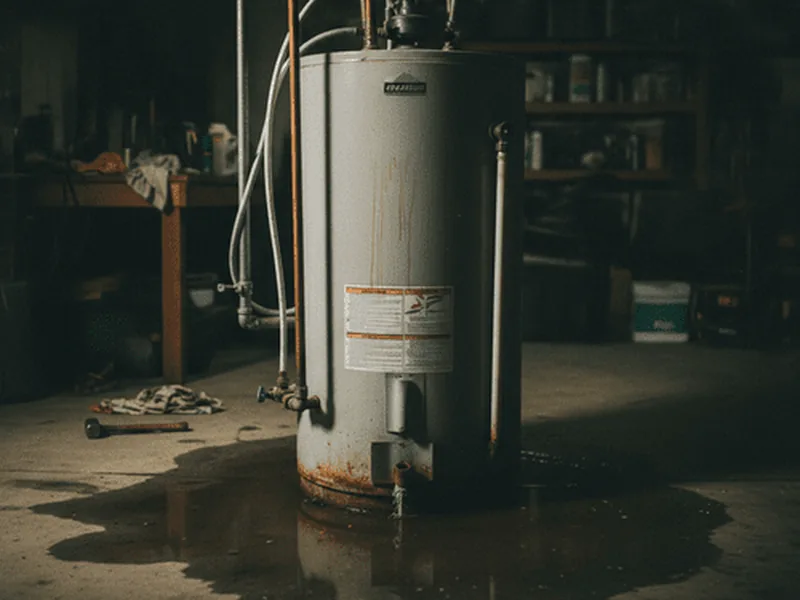
Reading the Leak: What the Location Tells Us
You can learn a lot before we arrive by noting where the water is. Water at the top of the heater in a Plainville basement usually means a supply connection: the cold inlet, hot outlet, or the fittings joining them to your house plumbing. These are the most repairable leaks we see — often a washer, a union, or a flex connector. Water running from the relief valve's discharge pipe points to the T and P valve: either the tank is over-pressurized or overheating, which needs investigation, or the valve has simply worn out, which needs a replacement valve. Water at the base around the drain valve is usually the drain valve itself, a straightforward swap. Water with no clear origin — dampness under the tank, rust streaks down the jacket, moisture at a seam — is the ominous one, suggesting the shell has corroded through. And water that appears only in humid weather, with no drip source at all, may be condensation on a cold tank or cold pipes, which is a ventilation matter rather than a leak. When you call (833) 713-2101, tell us where you see the water. That one detail often lets us arrive with the right parts already on the truck.
Leak or Something Else? How We Diagnose It
A surprising share of our leak calls in Plainville turn out to be something other than a leaking tank, and the diagnosis matters because the fixes are completely different. Condensation is the great impersonator: in humid weather, a cold tank sweats like a cold drink, and that sweat runs down and pools at the base looking exactly like a leak. We check for it by drying the tank and watching where moisture reforms. Plumbing leaks above the heater are the second impersonator — a dripping joint in the ceiling or a sweating cold-water line sends water down onto the heater, and the puddle at the base gets blamed on the tank. We trace upward before we condemn anything. Then there is the T and P valve doing its actual job: on homes with a pressure-reducing valve or backflow preventer creating a closed system, heated water has nowhere to expand, pressure spikes, and the relief valve drips exactly as designed. That is not a valve failure; it is a missing expansion tank. Only after ruling these out do we examine the tank itself: fittings tightened and inspected, valves tested, and the shell checked for the rust streaks and seam dampness that mark a breach. This methodical order — rule out the innocent explanations first — is what keeps Plainville homeowners from replacing heaters that were never the problem. Call (833) 713-2101 and we will run the full sequence at your home.
Corrosion, Pressure, and Age: Why Heaters Leak
Every tank leak in Plainville comes down to one of three forces, usually working together. First, corrosion — the slow, inevitable enemy. Your tank's steel is defended by its glass lining and the anode rod, but linings have imperfections and anodes get consumed, typically within five to eight years. After that, the steel is on its own, corroding from the inside out until a weld or fitting gives way. Second, pressure and thermal stress. Water expands as it heats; in a closed plumbing system that expansion has nowhere to go, so pressure spikes with every heating cycle, flexing seams and joints thousands of times. Add high municipal pressure on top and the tank lives a hard life. Third, heat and sediment. Mineral sediment blanketing the tank floor insulates the steel from the water, creating localized overheating that weakens the metal and bakes scale into every surface. Gas heaters add burner heat to that equation; electric heaters add element hot spots. Put a fifteen-year-old tank with a long-dead anode, heavy sediment, and no expansion tank in a Plainville basement and a leak is not a surprise — it is chemistry and physics running their course. Understanding these forces is also how we advise you after a repair: fix the leak, then fix the conditions where you can.
What We Do on a Leak Call
When you call (833) 713-2101 about a leaking water heater in Plainville, here is what happens. First, we talk you through immediate containment over the phone if the leak is active — where the shutoffs are and what to turn. Then our technician arrives and goes straight to diagnosis: tracing the water to its exact source using the sequence described above, because the repair depends entirely on what is actually leaking. If it is the T and P relief valve, we replace the valve and check system pressure and temperature to make sure we are not masking an expansion problem. If it is the drain valve, we swap it — and if sediment is the reason it would not seat, we flush the tank while we are at it. Leaking supply connections get new washers, unions, or flex connectors as needed, tightened properly and tested under pressure. We also look at the bigger picture during the visit: anode condition, sediment load, pressure readings, and the state of the tank shell. If the shell is breached, we will show you exactly where and explain why repair is not an option — and then discuss replacement sizing and options without pressure. Most fitting and valve leaks are resolved in a single visit. Whatever the outcome, you will know precisely what leaked, why, and what comes next.
Serving Plainville 02762: What We See in Local Homes
Plainville is a small town anchored by Plainridge Park, with a compact housing stock of mid-century capes, ranches, and colonials plus infill development along its main corridors. Homes here are modest in scale and mostly have basements or utility areas housing the water heater. Town water serves the community.
Smaller towns like Plainville often have water heaters that have been in service longer than anyone remembers — replaced only when they fail outright. That means we see valves, elements, and relief valves at the far end of their service life, plus tanks with sediment loads built up over a decade or more. The fixes are usually straightforward and very worthwhile when the shell is sound. Older tanks are everywhere in this housing stock, and once the anode rod is gone, shell leaks follow — we trace every drip to its source before recommending anything. Plainville 02762 gets prompt same-day service — call (833) 713-2101.
When the Tank Can't Be Saved
Sometimes the honest answer is that the tank is finished — the shell has corroded through, and no valve or fitting will change that. When we reach that conclusion at your Plainville home, we show you the evidence and then help you choose the replacement wisely, because a little thought now pays off for a decade. Sizing comes first: most households here do well with a 40 or 50-gallon tank, matched to bathrooms, occupants, and simultaneous-use habits — too small and you will run out, too large and you pay to heat water you never use. Fuel type is next: staying with gas or electric usually makes sense given your existing connections, though we will discuss it if your situation has changed. Recovery rate matters as much as capacity — a smaller tank with fast recovery can outperform a bigger sluggish one. Venting has to suit the unit: atmospheric, power-vent, or direct-vent for gas, each with its own requirements. On closed plumbing systems we add an expansion tank, which protects the new heater from the pressure spikes that helped kill the old one. And placement details — a drain pan with a proper drain line under heaters in finished spaces — turn the next leak, years from now, into a non-event. We remove the old unit and set the new one up completely, tested and verified. One call to (833) 713-2101 handles the whole transition.
What to Do Right Now: Emergency Steps
If your water heater is leaking at this moment in Plainville, do these things in order — and then call (833) 713-2101. First, stop the energy: for a gas heater, turn the control to pilot or off; for an electric heater, switch off its double breaker at the panel. This prevents the heater from firing while the water level drops. Second, stop the water: close the cold-water shutoff valve on the pipe entering the top of the heater. If you cannot find it or it will not turn, use your home's main water shutoff. Third, relieve pressure: open a hot-water tap somewhere in the house and leave it open — this breaks the vacuum and lets the tank drain in a controlled way rather than bursting from a fitting. Fourth, contain what is already out: towels, a mop, and anything that keeps water away from walls, stored belongings, and floor drains you want flowing freely. Do not try to disassemble fittings or plug the leak with sealants — improvised repairs on a pressurized tank fail, sometimes dramatically. If water is near electrical outlets or the breaker panel, stay clear and tell us when you call. Once the situation is stable, call (833) 713-2101: we will talk you through anything unclear and dispatch a technician. Fast action now is what separates a mop-up from real water damage.
Stop the Leak in Plainville
Every hour a leak continues is more water where it does not belong. Call (833) 713-2101 now and get a technician to your Plainville home today. We will find the exact source, fix what is fixable — valves, fittings, connections — and give you a straight answer if the tank itself is done. Containment guidance over the phone, careful diagnosis on site, and no pressure tactics. That is how the Water Heater Leak Repair Crew handles leak calls. (833) 713-2101. Ring (833) 713-2101.