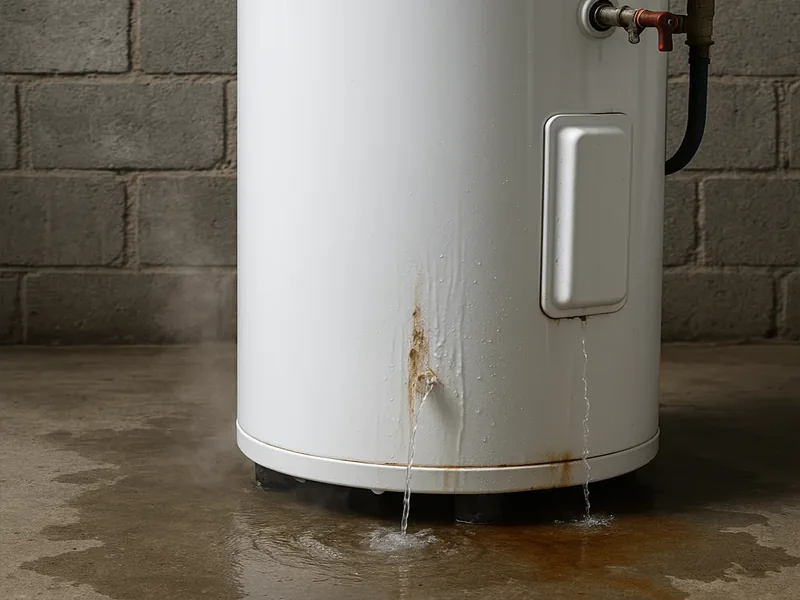
Where Tank Water Heaters Actually Leak From
A tank water heater has a short list of places it can leak, and each one tells a different story. The most common is the temperature and pressure relief valve — the T and P valve — whose discharge pipe runs down the side of the tank. When that pipe drips, the valve is either doing its job against excess pressure or temperature, or the valve itself has failed and needs replacement. Next is the drain valve at the tank's base, a small spigot that seeps when its washer wears out or when sediment keeps it from seating. Then come the inlet and outlet connections on top: the cold supply and hot outlet nipples, dielectric unions, and flex lines can weep from loose fittings, failed washers, or corrosion — all repairable. Less common but serious are leaks from the tank shell itself: rust streaks running down the jacket, dampness at a welded seam, or water appearing from under the tank with no fitting nearby. A shell leak means the steel has corroded through, and no sealant or tightening fixes that — the tank is done. In Somerset homes we also see leaks that are not the heater at all: a sweating cold-water pipe dripping onto the tank top, or a nearby plumbing leak traveling along the floor. Sorting these out is the whole job, and it starts with looking, not assuming.
Leak or Something Else? How We Diagnose It
A surprising share of our leak calls in Somerset turn out to be something other than a leaking tank, and the diagnosis matters because the fixes are completely different. Condensation is the great impersonator: in humid weather, a cold tank sweats like a cold drink, and that sweat runs down and pools at the base looking exactly like a leak. We check for it by drying the tank and watching where moisture reforms. Plumbing leaks above the heater are the second impersonator — a dripping joint in the ceiling or a sweating cold-water line sends water down onto the heater, and the puddle at the base gets blamed on the tank. We trace upward before we condemn anything. Then there is the T and P valve doing its actual job: on homes with a pressure-reducing valve or backflow preventer creating a closed system, heated water has nowhere to expand, pressure spikes, and the relief valve drips exactly as designed. That is not a valve failure; it is a missing expansion tank. Only after ruling these out do we examine the tank itself: fittings tightened and inspected, valves tested, and the shell checked for the rust streaks and seam dampness that mark a breach. This methodical order — rule out the innocent explanations first — is what keeps Somerset homeowners from replacing heaters that were never the problem. Call (833) 713-2101 and we will run the full sequence at your home.
Corrosion, Pressure, and Age: Why Heaters Leak
Every tank leak in Somerset comes down to one of three forces, usually working together. First, corrosion — the slow, inevitable enemy. Your tank's steel is defended by its glass lining and the anode rod, but linings have imperfections and anodes get consumed, typically within five to eight years. After that, the steel is on its own, corroding from the inside out until a weld or fitting gives way. Second, pressure and thermal stress. Water expands as it heats; in a closed plumbing system that expansion has nowhere to go, so pressure spikes with every heating cycle, flexing seams and joints thousands of times. Add high municipal pressure on top and the tank lives a hard life. Third, heat and sediment. Mineral sediment blanketing the tank floor insulates the steel from the water, creating localized overheating that weakens the metal and bakes scale into every surface. Gas heaters add burner heat to that equation; electric heaters add element hot spots. Put a fifteen-year-old tank with a long-dead anode, heavy sediment, and no expansion tank in a Somerset basement and a leak is not a surprise — it is chemistry and physics running their course. Understanding these forces is also how we advise you after a repair: fix the leak, then fix the conditions where you can.
Our Leak Repair Visit, Step by Step
A leak call to our crew follows a deliberate order, and Somerset homeowners tell us the transparency is what they remember. Step one happens on the phone: if water is actively spreading, we guide you to the cold-water shutoff above the heater and the power or gas controls, so the situation stabilizes before we arrive. Step two is the trace: our technician dries, inspects, and follows the water to its source — fittings, valves, connections, or shell — ruling out condensation and overhead plumbing leaks along the way. Step three is the fix for what is fixable. A failed T and P valve gets replaced, with pressure and temperature verified so we know why it failed. A weeping drain valve gets a new valve, plus a flush if sediment caused it. Supply-side seeps get new washers, dielectric unions, or connectors, torqued correctly and rechecked under full pressure. Step four is the assessment: anode, sediment, pressure, expansion control, and shell condition, reported to you plainly. Step five, only if the shell is breached, is the replacement conversation — sizing, fuel type, venting, and placement, with the old unit removed. No step gets skipped, and you approve everything before it happens. That is a leak call done right: (833) 713-2101.
Serving Somerset 02726: What We See in Local Homes
Somerset sits on the Taunton River with waterfront neighborhoods and the Somerset Reservoir nearby, a town of mid-century neighborhoods — ranches, capes, and split-levels from the 1950s through the 1970s — plus older homes near the village centers. Most houses have basements, town water serves the community, and many water heaters are now on their second or third generation.
Even replacement-era heaters in Somerset are aging into failure territory: gas valves that drop pilots, elements burned out in sediment, relief valves weeping. The river-valley humidity keeps basements damp, which accelerates corrosion on valve bodies and fittings — we see it on nearly every older installation here. Older tanks are everywhere in this housing stock, and once the anode rod is gone, shell leaks follow — we trace every drip to its source before recommending anything. Somerset 02726 gets prompt service from our Attleboro crew — call (833) 713-2101.
If You Need a New Heater: Sizing It Right
A breached tank forces a replacement decision, and getting the sizing right is the most important part of that decision for your Somerset home. Capacity is the headline number — 40 and 50 gallons cover most households — but the real question is your peak demand: morning showers overlapping, laundry running, dishwasher going. We size to that peak, not to the old tank's label, because the old one may have been wrong all along. Recovery rate is the quiet partner of capacity: it measures how fast the heater reheats, and a high-recovery 40-gallon can beat a slow 50-gallon in real use. Fuel and venting follow your home's existing setup — gas needs proper venting with verified draft, electric needs the right circuit — and we confirm both before recommending. We also correct the conditions that shortened the old tank's life: an expansion tank where the system is closed, a pressure check, a fresh anode from day one, and a drain pan with drainage when the heater sits over finished space. The installation includes full testing — temperature, pressure, leak checks, and venting verification — and we take the failed unit away. It is a complete job, not a drop-off. Start it with a call to (833) 713-2101.
What to Do Right Now: Emergency Steps
If your water heater is leaking at this moment in Somerset, do these things in order — and then call (833) 713-2101. First, stop the energy: for a gas heater, turn the control to pilot or off; for an electric heater, switch off its double breaker at the panel. This prevents the heater from firing while the water level drops. Second, stop the water: close the cold-water shutoff valve on the pipe entering the top of the heater. If you cannot find it or it will not turn, use your home's main water shutoff. Third, relieve pressure: open a hot-water tap somewhere in the house and leave it open — this breaks the vacuum and lets the tank drain in a controlled way rather than bursting from a fitting. Fourth, contain what is already out: towels, a mop, and anything that keeps water away from walls, stored belongings, and floor drains you want flowing freely. Do not try to disassemble fittings or plug the leak with sealants — improvised repairs on a pressurized tank fail, sometimes dramatically. If water is near electrical outlets or the breaker panel, stay clear and tell us when you call. Once the situation is stable, call (833) 713-2101: we will talk you through anything unclear and dispatch a technician. Fast action now is what separates a mop-up from real water damage.
Talk to a Water Heater Tech Right Now
Not sure where the water is coming from, or whether it is even the heater? Call (833) 713-2101 and describe what you see — where the water is, how fast it is spreading, what kind of heater you have. We will help you read the situation, walk you through shutoffs if needed, and schedule a same-day visit to your Somerset home for a proper diagnosis. Straight answers from people who trace leaks every day. (833) 713-2101. Ring (833) 713-2101.