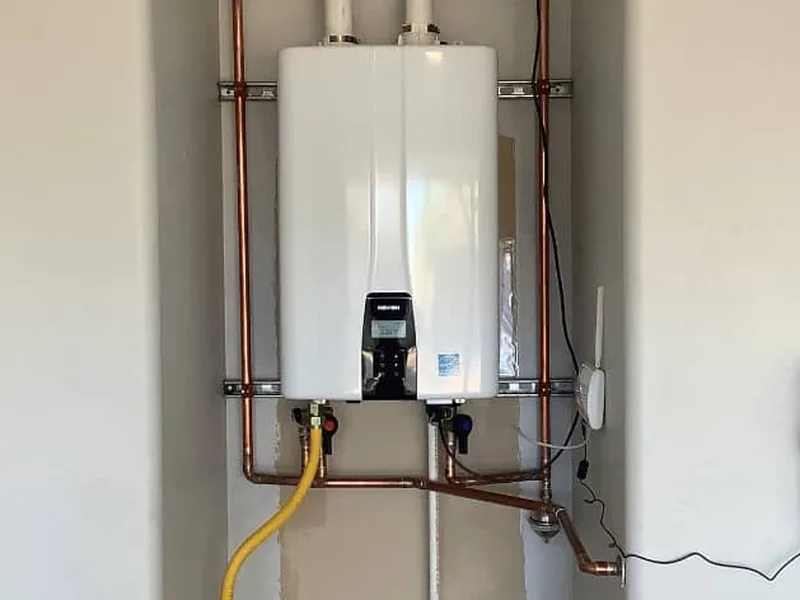
Why Tankless Leaks Look Different in Attleboro's Older Homes
Attleboro earned its "Jewelry City" nickname from generations of jewelry manufacturing, and the building stock still shows it: mill-era brick buildings converted to apartments and condos, early-1900s colonials and multifamilies near downtown, and streets of post-war Capes and ranches farther out. A large share of the tankless units in the 02703 were not part of original construction — they were retrofitted in when a tank failed or during a remodel. Retrofits are where tankless leaks are born.
The most common retrofit problem we see is the gas supply. A tankless unit draws far more gas at full fire than the tank heater it replaced — often 150,000 to 199,000 BTU against a tank's 40,000. Homes plumbed decades ago for a tank heater frequently have a half-inch gas line that cannot feed a tankless unit properly. That does not directly cause a water leak, but the resulting short-cycling and incomplete combustion stresses the heat exchanger, and stressed heat exchangers develop the pinhole leaks that drip down inside the cabinet. Venting is the second retrofit weak point. Tankless units need sealed, correctly sloped vent runs; in Attleboro's older homes we find vents snaked through old masonry chimneys or run with sags that trap acidic condensate, which then eats through joints and drips. The third is the condensate drain itself: condensing tankless models produce a steady trickle of acidic condensate that must drain by gravity to a proper receptor. In retrofits it is often run to the nearest floor drain with a sagging hose, and when that line clogs or the neutralizer cartridge saturates, water backs up into the unit and out the bottom. Knowing the house usually tells us where to look first.
Where Tankless Water Heater Leaks Actually Come From
A tankless unit has no storage tank to rust through, so its leaks come from a shorter but trickier list of sources. The heat exchanger is the heart of the unit — a copper or stainless coil that the burner fires directly. Pinhole leaks develop here from thermal stress, scale hotspots, or corrosion, and they typically show as a slow drip from inside the cabinet that worsens when the unit fires. Condensate system leaks are the most common call we get: the condensate trap, drain hose, or neutralizer cartridge clogs with sediment or the acidic condensate itself, and water backs up and overflows. Inlet and outlet water connections leak when unions loosen from thermal cycling or when the original installer under-tightened them. Internal O-rings and gaskets harden with heat and age, weeping at the water valve or flow sensor. Venting joints can drip condensate back into the unit if the vent was installed without proper slope. And in units mounted in unconditioned spaces, freeze damage splits the heat exchanger — the copper literally bursts when trapped water freezes and expands. Each source leaves different evidence, and reading that evidence correctly is the difference between a lasting repair and a callback.
Signs Your Tankless Unit Is Leaking — Not Just Condensing
Not every drop of water under a tankless unit is a leak, and misreading the signs wastes money. A condensing tankless unit legitimately produces condensate — slightly acidic water that drains from the condensate trap during and after firing. That is normal as long as it goes down the drain line. What is not normal: water pooling on the floor away from the drain line, drips from inside the cabinet, water stains on the wall behind the unit, a musty or metallic smell near the heater, the unit's error code display lighting up with leak or flow codes, or hot water that cuts out intermittently. Another tell is timing — condensate appears while the unit fires; a fitting or exchanger leak often continues dripping long after the hot water is off. In Attleboro's older basements with stone or early concrete foundations, a slow leak can wick into the foundation and show up as dampness feet away from the unit, so check the wall and floor around the heater, not just directly beneath it. If you see active dripping from the cabinet itself, shut the unit's water isolation valves if you can find them, and call (833) 713-2101 rather than letting it run.
How We Diagnose and Repair a Leaking Tankless Unit
Our diagnostic process starts with the unit cold and the power on, so we can watch it fire. First we dry the area and lay down paper or dry cloths to map exactly where water appears. Then we open the cabinet and inspect the heat exchanger with a bright light, looking for green or white mineral tracks on copper, rust staining on stainless, and active weeping at tube joints. We check the condensate trap and drain line for blockages, test the neutralizer cartridge, and verify the drain has continuous downhill slope. Inlet and outlet unions get checked for weep under pressure, and we inspect internal O-rings at the water control valve. We also read the unit's error history — many modern units log ignition failures and flow faults that point at the failing component. For freeze-split exchangers the damage is usually obvious: a cracked copper header with water spraying when pressurized.
Repairs follow the diagnosis. Condensate problems get a full cleanout: trap flushed, drain line cleared or re-routed with proper slope, neutralizer media replaced. Fitting leaks get new seals and proper torque, sometimes with replacement unions. O-rings and gaskets are replaced with manufacturer-spec parts. Heat exchanger pinholes in accessible spots can sometimes be repaired, but a widely pitted or split exchanger means exchanger replacement — still far less than a whole new unit. After any repair we run the unit through full-fire cycles, verify zero weeping, confirm condensate drains freely, and check combustion. Only then do we call it done.
Retrofit Realities: Gas Lines, Venting, and Drains in 02703 Homes
Because so many Attleboro tankless units are retrofits, the repair often reveals an installation problem underneath the leak. Gas line sizing is the big one: if the unit has been starved for gas since day one, the exchanger has lived a hard life of short-cycling, and simply fixing the pinhole without addressing the supply invites a repeat. We measure gas pressure under full fire and will tell you plainly if the line is undersized — correcting it is a separate job, but knowing matters. Venting is the second: we check the vent material (it must be the manufacturer's approved sealed vent, not repurposed B-vent), the slope back to the unit for condensing models, and every joint for condensate staining. A vent full of trapped acidic condensate will keep eating joints no matter how many times you wipe up the drip. Third is the condensate receptor: Attleboro's older basements often have a single old floor drain or a sump pit, and we make sure the condensate actually reaches one by gravity, through a neutralizer, without low spots. Fixing the leak without fixing the path that caused it is a temporary patch, and we do not do temporary patches.
Keeping Your Tankless Unit Leak-Free in Attleboro
Attleboro's municipal water comes from surface supplies and runs naturally soft, which is actually good news for tankless owners: soft water forms far less scale inside the heat exchanger than hard well water does. Scale is the number one exchanger killer, so Attleboro units have a natural advantage — but soft water is slightly more corrosive to metals, which makes the annual inspection of the exchanger and the anode-free design's weak points worth doing. Descaling (flushing the exchanger with a mild acid solution via the service valves) is still worthwhile every one to two years, especially if your home has any galvanized piping that sheds sediment. Keep the condensate neutralizer cartridge on a replacement schedule — saturated media lets acidic condensate attack the drain line and the trap. Keep the area around the unit clear so you can see drips early, and glance at the floor under the unit monthly. In homes near the Ten Mile River's low-lying streets, where basements run damp, a small dehumidifier near the mechanical area slows corrosion on the cabinet and fittings. And if your unit lives in an attached garage, make sure the freeze-protection mode stays powered through winter — unplugging the unit for a vacation in January is how exchangers split.
What Happens When You Call (833) 713-2101
When you call the Water Heater Leak Repair Crew about a leaking tankless unit in Attleboro, you will talk to someone who knows these systems, not a call center reading a script. We will ask where the unit is mounted, what brand it is if you know, where you see water, and whether it is actively dripping — that tells us what to bring and how urgent it is. Active leaks get priority scheduling. On arrival, our technician maps the leak, opens the unit, and diagnoses the source before quoting any repair, so you know what is wrong and what it takes to fix it. Most tankless leak repairs — condensate cleanouts, fitting reseals, gasket replacements — are completed in a single visit. Heat exchanger replacements take longer and we will be upfront about parts lead time. After the repair we fire the unit, verify it is dry, and walk you through what we found and how to spot trouble early next time. One call, one visit in most cases, and a dry floor underneath your tankless unit.