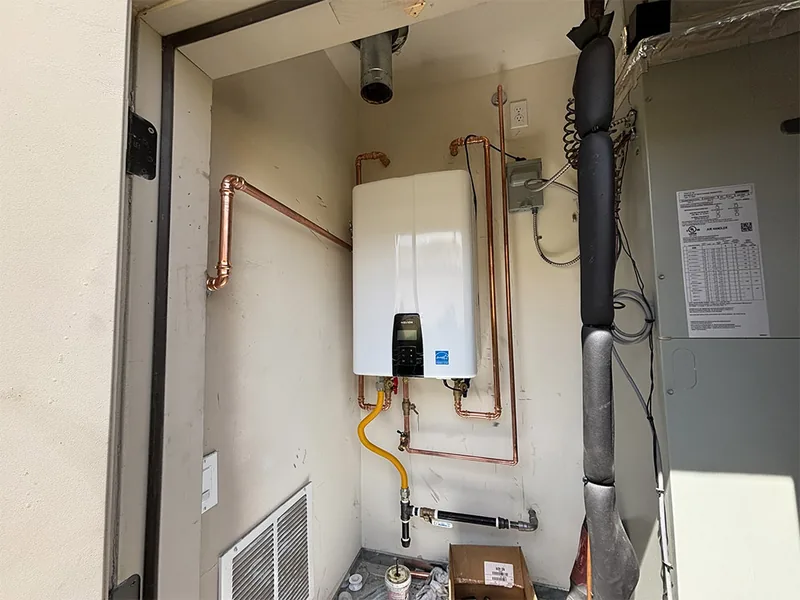
Bellingham's Two Water Worlds — and What Each Does to a Tankless Unit
Bellingham straddles two water realities, and your tankless unit's leak risk depends on which one feeds it. Most of the town's subdivisions take municipal water from the Bellingham DPW — treated, consistent, moderately soft surface-influenced water that is relatively kind to heat exchangers. Units on this water tend to leak from age-related causes: gaskets hardening after a decade of thermal cycling, condensate neutralizer cartridges saturating, fittings loosening. The outlying parts of town are a different story. Homes beyond the water mains run private wells, and southeastern Massachusetts well water commonly carries iron, manganese, and low pH. Iron feeds scale and sediment that bake onto the heat exchanger; acidic water attacks copper passages directly. A tankless unit on well water can develop exchanger pinholes years earlier than its municipal-water twin across town.
There is a second Bellingham split that matters: pressure behavior. Municipal customers sit on a steady street pressure, while well homes ride a pressure tank cycling between its cut-in and cut-out — that constant pulsing works inlet fittings and internal seals harder. When we arrive at a Bellingham home, one of our first questions is which water serves the house, because it changes where we look first and what we recommend afterward. A well-fed unit with a leaking exchanger gets a frank conversation about pre-filtration and descaling frequency; a municipal-fed unit with the same symptom gets a different maintenance plan.
The Usual Leak Points on a Tankless Unit
Every tankless water heater, regardless of brand, concentrates its leak risk in the same few places. The heat exchanger — copper or stainless tubing wrapped around the burner — develops pinhole leaks from scale hotspots, corrosion, or thermal fatigue; these show as drips from inside the cabinet, often with green-white mineral tracks on copper. The condensate system on condensing models is the single most common leak source we repair: the trap clogs, the drain hose sags and holds water, or the neutralizer cartridge saturates, and acidic condensate backs up and overflows the cabinet base. Inlet and outlet unions weep as their seals age and thermal cycling works them loose — look for crusty buildup on the pipe connections beneath the unit. Internal O-rings at the flow sensor and water control valve harden and seep. Vent joints drip condensate back into the unit when the vent run lacks proper slope. And freeze damage splits exchangers in unconditioned spaces. On a service call we check these in order of likelihood, and the evidence — mineral tracks, staining patterns, drip timing — almost always names the culprit before we turn a wrench.
Garage Installations and the Bellingham Winter Problem
A striking number of Bellingham tankless units hang on garage walls. Builders loved the arrangement: the unit stays out of the finished basement, venting runs short through the exterior wall, and the mechanical room stays clear. In July it is perfect. In January it is a freeze risk. Tankless units carry only a small volume of water, but it sits in thin copper passages that rupture easily when frozen. Factory freeze protection helps — the unit briefly fires its burner when internal sensors detect near-freezing temperatures — but it requires continuous electrical power. A tripped GFCI, a homeowner unplugging the unit before a trip, or an ice-storm outage during a cold snap defeats it, and the split exchanger announces itself with water spraying or pouring the next time the system pressurizes.
Garage units also suffer wider temperature swings that accelerate gasket aging, and their condensate drain lines often run along cold exterior walls where condensate can freeze mid-line and back up. If your Bellingham tankless lives in the garage, keep it powered all winter without exception, insulate any exposed water piping, and have the freeze-protection function tested each fall. If you return from a winter trip to water under the unit, shut the isolation valves and call (833) 713-2101 before running hot water — firing a freeze-split exchanger can turn a repair into a replacement.
Telling a Real Leak from Normal Condensate
Condensing tankless units legitimately make water. Burning natural gas efficiently produces acidic condensate that drips from the heat exchanger into a trap and out a small drain hose — during heavy hot-water use you might see a steady trickle, and that is normal provided it reaches the drain. The confusion starts when the drain path fails. A clogged trap, a sagging hose, or a saturated neutralizer turns normal condensate into an overflowing leak, and to a homeowner it looks identical to a broken unit. The distinction matters because the fixes differ.
Here is how to read the evidence: condensate appears while the unit is firing and stops within minutes after; a fitting or exchanger leak often keeps dripping with the unit idle. Condensate is clear and slightly acidic; exchanger weep may carry green or rusty tinting. Water at the small plastic drain hose points to the condensate path; water from inside the metal cabinet or at the big pipe unions points to the unit itself. Drying the area and running hot water for five minutes while watching the first fresh drip form is the most reliable home test. If the drip comes from inside the cabinet or continues with the unit off, call (833) 713-2101 — that is a genuine leak needing repair.
Our Repair Process, Step by Step
We diagnose before we quote, and we repair the cause rather than the symptom. The visit starts with the unit idle: we dry the area, lay absorbent cloths to map drip points, and inspect the cabinet exterior for staining. Then we open the unit and examine the heat exchanger under bright light for pinhole weeping, mineral tracks, and corrosion. The condensate trap comes out for cleaning, the drain line gets checked for slope and blockages, and the neutralizer cartridge is tested — saturated media gets replaced. Inlet and outlet unions are inspected under pressure for weep, and internal O-rings at the water valve and flow sensor are checked. We pull the unit's error history, which often corroborates what our eyes found.
Repairs are matched to findings: condensate path rebuilds with proper downhill slope and fresh neutralizer media; union reseals with new gaskets torqued to spec; O-ring and gasket replacement with manufacturer parts; exchanger pinhole repair where accessible or full exchanger replacement when pitting is widespread. For freeze-split exchangers we assess whether the damage is limited to the exchanger or reached the gas valve and electronics — water and gas controls do not mix, and we will tell you honestly when replacement of the unit is the safer call. Every repair ends with full-fire test cycles and a verified-dry inspection before we leave.
Keeping a Bellingham Tankless Unit Dry for the Long Run
Maintenance is where Bellingham's two water worlds diverge again. On municipal water, schedule a descale flush every 18 to 24 months and replace the condensate neutralizer cartridge on the manufacturer's interval — saturated media is the quiet cause of half the condensate overflows we repair. On well water, move descaling to annually and add sediment pre-filtration ahead of the unit; the iron and sediment in local wells bake onto exchangers far faster, and a fifty-dollar filter cartridge protects a thousand-dollar exchanger. Every fall, verify freeze protection on garage units and confirm the unit has uninterrupted power. Monthly, glance under the unit for fresh drips or mineral crust — catching a weeping union early is a gasket; ignoring it is a rotted-out cabinet base. Keep the vent termination outside clear of shrubs, snow, and insect nests, since a blocked vent changes combustion and increases condensate problems. And in the Silver Lake area's damper basements, a dehumidifier near the mechanical space slows cabinet and fitting corrosion. Small habits, dry floor.
What Happens When You Call (833) 713-2101
Calling the Water Heater Leak Repair Crew about a leaking tankless unit in Bellingham gets you a straight conversation with someone who works on these systems daily. We will ask where the unit is mounted, whether you are on town water or a well, where the water is appearing, and whether it is actively dripping — your answers tell us what to load on the truck and how urgently to schedule. Active leaks get priority. On site, we map the leak, open the unit, and identify the source before discussing any repair, so you hear the diagnosis first and the fix second. Most tankless leak repairs — condensate rebuilds, union reseals, gasket replacements — finish in one visit. If an exchanger replacement is needed, we will be direct about parts timing. Before leaving, we fire the unit through full cycles, confirm everything is dry, and show you what to watch for. One call to (833) 713-2101, and the mystery puddle gets a name and a fix.