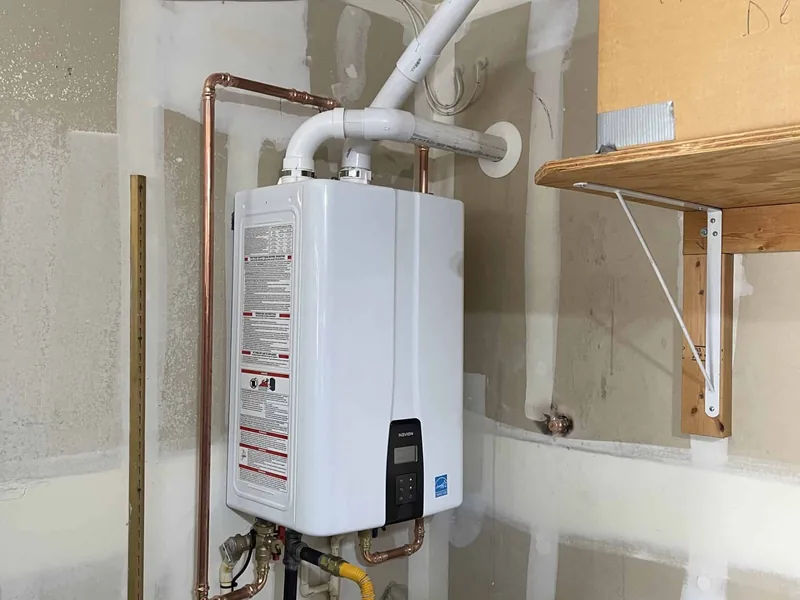
How Berkley's Well Water Attacks a Tankless Unit
A tankless water heater is essentially a high-performance heat exchanger with water racing through it, and well water is the toughest opponent it faces. In Berkley, where the majority of homes run private wells, the groundwater commonly carries three troublemakers. Iron and manganese precipitate out as sediment that bakes onto the heat exchanger's inner walls, creating insulating hotspots; the metal overheats locally, weakens, and develops pinhole leaks. Acidity — low-pH groundwater is widespread in southeastern Massachusetts — does not need heat to do damage; it steadily dissolves copper from the inside, thinning passages until they weep. And plain sediment, from sand to silt stirred up after heavy rains, settles in the condensate trap and drain line, choking the condensate path until it overflows.
Then there is the pressure behavior unique to well systems. A well pump fills a pressure tank that cycles roughly between 40 and 60 psi, so every fixture in the house — including the tankless unit's inlet — feels a constant pulse. Municipal water holds steady; well water breathes. That cycling flexes inlet unions and internal seals thousands of times a year, loosening fittings that would stay tight on town water. When we diagnose a Berkley tankless leak, we are not just finding the drip — we are reading what the well did to the unit, because the water chemistry determines whether a repair will last or fail again.
The Leak Points We Find Most on Well-Fed Units
On Berkley's well-fed tankless units, the failure pattern is consistent. Heat exchanger pinholes lead the list: scale hotspots and acidic thinning open tiny weeps that show as drips from inside the cabinet, often with greenish-white mineral tracks on the copper. Because the damage is chemical as well as thermal, pitting is frequently widespread rather than isolated — we inspect the whole exchanger, not just the obvious drip. Condensate system failures run second: sediment settles in the trap and drain hose, and the neutralizer cartridge exhausts faster when it must neutralize both combustion condensate and mineral-laden water. Inlet union weeping is more common here than on town water, thanks to pressure-tank cycling working the seals. Internal O-rings at the flow sensor harden and seep. And in Berkley's many detached garages, barns, and workshops where units were mounted for convenience, freeze-split exchangers appear after cold snaps knock out power to the well pump and the unit together — no power means no freeze protection and no water pressure, a brutal combination. Each of these leaves distinct evidence, and we check them in this order on every Berkley call.
Why the Condensate Drain Deserves Special Attention Here
The condensate drain is the most underestimated part of a tankless installation, and on well water it fails first. A condensing unit produces acidic condensate whenever it fires; that liquid must travel from the trap, through a neutralizer cartridge, down a hose with continuous slope, to a drain. In Berkley homes we find this path compromised in predictable ways: sediment from the well settles in the trap's low spots, gradually raising the water level until condensate spills over the trap's edge inside the cabinet. The neutralizer media — crushed marble or similar — dissolves as it neutralizes acid, and mineral-heavy water exhausts it faster; once saturated, raw acidic condensate attacks the plastic trap and hose, making them brittle. Drain hoses get routed to the nearest floor drain or laundry sink with sags that hold water, and in winter those sags freeze. The homeowner sees water under the unit and assumes the heater is broken; often the heater is fine and the drain path has failed. Our condensate service — trap removal and flushing, hose re-routing with true downhill slope, fresh neutralizer media, and verification of the receptor — resolves a large share of Berkley "leaking tankless" calls without touching the heat exchanger at all.
Our Diagnostic and Repair Process
A Berkley service call starts with questions about the well: recent pump work, pressure tank age, any filtration equipment, and whether the water has changed taste or color lately. Those answers shape the diagnosis. On site, we dry the area and map drip points, then open the cabinet and inspect the heat exchanger for the telltale combination of scale crust and acidic thinning — green-white deposits plus thinned, pinkish copper. We pull and flush the condensate trap, check drain slope with a level, and test the neutralizer media. Inlet and outlet unions get inspected under full pressure, and we watch the pressure gauge while fixtures run to see the well's cycling pattern. The unit's error history often shows ignition or flow faults consistent with our findings.
Repairs address both the leak and its water-driven cause. Condensate path rebuilds with proper slope and fresh media. Union reseals with new gaskets. O-ring replacement at the water valve and flow sensor. For exchanger pinholes we assess extent honestly: isolated accessible pinholes can sometimes be repaired, but widespread acidic pitting across the coil means exchanger replacement — and we will show you the damage so the recommendation makes sense. Critically, we also address the water: sediment pre-filter installation, neutralizer maintenance scheduling, and a descaling plan. Fixing the leak without treating the water is a short-term patch on a well system, and we explain exactly why before you decide.
Filtration and Maintenance: The Real Fix for Well-Fed Tankless Units
Here is the truth about tankless units on Berkley well water: the repair fixes today's leak, but water treatment prevents next year's. A sediment pre-filter on the cold inlet — a simple cartridge housing — catches the sand, silt, and iron particulate before it reaches the exchanger and the condensate trap. For acidic water, an acid-neutralizing filter upstream protects not just the tankless unit but every copper pipe and fixture in the house. With filtration in place, annual descaling flushes keep the exchanger's passages clear; without it, even annual flushing fights a losing battle against continuous mineral loading. We recommend Berkley well owners check the sediment filter cartridge quarterly at first — you will quickly learn your well's loading rate — and replace neutralizer media on schedule rather than waiting for the condensate to turn destructive. Keep the pressure tank properly charged too: a waterlogged tank short-cycles the pump and exaggerates the pressure pulsing that loosens fittings. These are modest, inexpensive habits, and they are the difference between a tankless unit that leaks every other year and one that runs dry for a decade.
Freeze Risk in Berkley's Outbuildings and Detached Garages
Berkley's large lots mean many tankless units live outside the heated envelope — in detached garages, barn workshops, and pool houses. These are the highest freeze-risk installations we see. The unit's electric freeze protection only functions with power, and rural Berkley feels ice-storm outages as keenly as anywhere; when the power drops during a January cold snap, the thin copper passages of an idle exchanger can freeze and split within hours. The cruel part is the delay: the split often does not reveal itself until power and water return, when the next hot-water call pressurizes the cracked coil and water pours from the cabinet. If your unit lives in an unconditioned outbuilding, verify freeze protection every fall, keep the building as tempered as practical, insulate all exposed piping, and after any winter outage, check under the unit before running hot water. If you find water, close the isolation valves and call (833) 713-2101 — firing a split exchanger risks the gas controls and electronics, and we need to assess the full extent before the unit runs again.
What Happens When You Call (833) 713-2101
When you call the Water Heater Leak Repair Crew from Berkley, tell us you are on a well — it changes what we bring. We will ask about the unit's location, the water you are seeing, whether filtration exists, and how the pressure tank has been behaving. Our truck carries descaling equipment, neutralizer media, sediment filter components, and the seals and gaskets that well water consumes, so most diagnoses and many repairs happen in a single visit. On arrival we find the leak's source, show you the evidence, and explain both the repair and the water-treatment steps that keep it from recurring. You will get a straight assessment: what is leaking, why the well water contributed, what the fix costs in effort, and what maintenance the unit needs going forward. One call to (833) 713-2101, and your well-fed tankless unit gets care designed for well water.