Mill-Era Homes Meet Modern Tankless: Where the Friction Starts
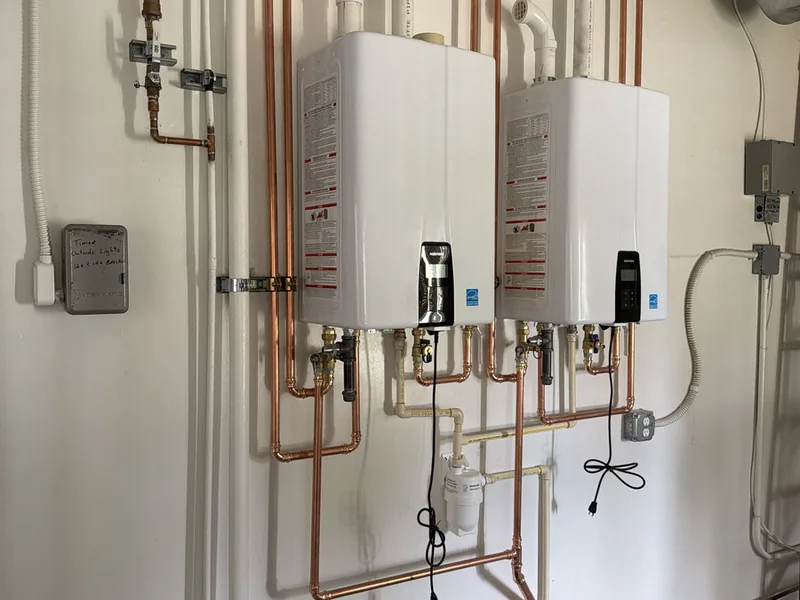
Blackstone grew up around its mills, and the housing near the town center still reflects it: dense worker housing, multifamily buildings, and converted mill spaces with fieldstone or early-concrete foundations, low basement ceilings, and plumbing systems that have been modified piecemeal for a hundred years. Dropping a modern tankless unit into that environment creates three predictable friction points. First, gas supply: the existing gas line was sized for a 40,000-BTU tank heater or less, while a tankless unit demands 150,000 to 199,000 BTU at full fire. Starved for gas, the unit short-cycles and the heat exchanger endures thermal stress it was never meant to see — the slow road to pinhole leaks. Second, venting: sealed, properly sloped vent runs are non-negotiable for tankless units, but old homes offer awkward paths. We find vents forced through abandoned chimney flues, run with sags that trap acidic condensate, or joined to incompatible materials — each a future drip point. Third, space: low basement headroom and cramped mechanical corners make proper condensate drainage with continuous downhill slope genuinely difficult, so installers compromise, and compromises leak. Understanding the house is half the diagnosis in Blackstone.
Where Tankless Leaks Actually Come From
A tankless unit's leak sources are few but specific. The heat exchanger — copper or stainless tubing around the burner — develops pinhole leaks from thermal stress, scale hotspots, or corrosion; expect drips from inside the cabinet, often with mineral tracks marking the path. The condensate system is the most frequent offender overall: the trap clogs, the drain hose sags, or the neutralizer cartridge saturates, and acidic condensate backs up and overflows inside the unit. Inlet and outlet unions weep as seals age and thermal cycling loosens them — the white or green crust on pipe connections under the unit is the signature. Internal O-rings at the flow sensor and water control valve harden with heat and seep. Vent joints drip condensate backward when slope is wrong. And freeze damage splits exchangers in unconditioned spaces like the detached garages common on Blackstone's larger lots. In this town's retrofits, we weight the condensate and venting causes more heavily, because the adapted installations fail there first.
Reading the Evidence: What the Drip Pattern Tells You
Before calling, you can learn a lot from watching the water. Dry the area thoroughly, then run hot water for five minutes and observe where the first fresh drip forms. Water at the small plastic drain hose or pooling directly beneath the cabinet's center suggests the condensate path — the trap, hose, or neutralizer. Drips or crust on the large pipe unions at the unit's bottom point to fitting weeps. Water emerging from behind the front cover, or staining on the wall behind the unit, implicates the heat exchanger or internal seals. Timing matters too: condensate appears during and shortly after firing; exchanger and fitting leaks often continue with the unit idle. Color helps: clear water near the drain hose is likely condensate; green-tinted drips suggest copper corrosion; rusty tones suggest steel components or old piping upstream. In Blackstone's older multifamily buildings, also check the floor below — a slow leak in an upstairs mechanical closet can stain the ceiling of the unit beneath before the owner upstairs notices anything. Note what you see and tell us when you call (833) 713-2101; it focuses the visit.
How We Diagnose and Repair a Leaking Tankless Unit
Our Blackstone visits start with the installation, not just the unit. We check gas pressure under full fire — undersized lines reveal themselves immediately — then inspect the vent run for material, slope, and joint staining. Only then do we open the cabinet: heat exchanger examination under bright light for pinholes and mineral tracks, condensate trap removal and flushing, drain-line slope verification, neutralizer media testing, union inspection under pressure, and O-ring checks at the water valve and flow sensor. The unit's error history gets reviewed for corroborating faults.
Repairs follow what we find, in order of root cause. A condensate overflow caused by a sagging drain hose gets the hose re-routed with proper continuous slope, not just a trap cleaning — otherwise it recurs. Fitting weeps get new gaskets torqued to specification. Exchanger pinholes get assessed for extent: isolated and accessible can sometimes be repaired; widespread pitting means exchanger replacement, and we show you the damage. Where the gas line is undersized or the vent run is fundamentally wrong, we explain the installation correction the leak is pointing to — fixing the drip without fixing the starved burner or the condensate-trap vent is a temporary patch. Every job ends with full-fire test cycles and a verified-dry unit before we leave.
Rentals, Multifamilies, and the Leak Nobody Reported
Blackstone's older multifamily stock adds a wrinkle: the person who sees the leak often is not the person who calls. In rental buildings, a slow tankless weep in a basement mechanical room can run for months — tenants do not inspect the landlord's equipment, and landlords do not visit monthly. By the time anyone calls (833) 713-2101, the cabinet base may be corroded, the wall behind the unit stained, and the floor damaged. Property owners in the 01504 should build a simple routine: a quarterly glance at each unit's mechanical area, checking for drips, crust on unions, and dampness on the wall behind the heater. It takes two minutes per building and catches the weeps that become water-damage claims. For tenants: if you notice water near the water heater, a musty smell in the basement, or the hot water behaving oddly, report it promptly — a small drip is a maintenance item, but months of seepage become a much bigger problem. We work with landlords across Blackstone on straightforward diagnosis and repair without drama.
Keeping a Tankless Unit Dry in a Blackstone Retrofit
Prevention in a retrofit means respecting the installation's weak points. Have the gas line sized correctly — this single correction extends exchanger life more than any other step in an older home. Keep the vent run inspected: joints should show no condensate staining, the termination outside should be clear of nests and debris, and any sag that developed over time should be re-supported. Descale the exchanger every 18 to 24 months (annually if any well water feeds the house), and replace condensate neutralizer media on schedule — acidic condensate eats traps and hoses from the inside. Verify the condensate drain still runs downhill all the way; houses settle, and a drain that sloped correctly five years ago may sag today. In Blackstone's damper river-proximate basements, keep the mechanical area ventilated and consider a dehumidifier — chronic dampness corrodes cabinets and fittings from the outside while the water chemistry works from the inside. And if the unit is in an unconditioned space, confirm freeze protection stays powered every fall.
What Happens When You Call (833) 713-2101
Call the Water Heater Leak Repair Crew from Blackstone and you will speak with someone who understands both the unit and the old house around it. We will ask the unit's location and brand if you know it, where the water appears, the age and type of the building, and whether the installation was a retrofit — that last answer shapes the whole visit. On arrival we assess the installation (gas, vent, drain) and the unit together, find the leak's source, and explain both the repair and any underlying installation issue it revealed. Most leak repairs — condensate rebuilds, reseals, gasket replacements — complete in one visit. Where an exchanger or installation correction is needed, you get a plain explanation and honest timing. We fire the unit, verify it dry, and show you what to watch. One call to (833) 713-2101 connects Blackstone's old houses with modern tankless care.