Two Water Sources, Two Leak Profiles in Dighton
Ask a Dighton homeowner where their water comes from and you will hear one of two answers, and the tankless unit's leak history usually matches. Homes on the Dighton Water District get treated municipal water — consistent chemistry, steady pressure, moderate mineral content. Their tankless units fail the way suburban units fail: after years of thermal cycling, gaskets harden and weep, condensate neutralizer cartridges saturate, inlet unions loosen. The leaks are age-driven and the repairs are straightforward. Private-well homes tell a harder story. Southeastern Massachusetts groundwater commonly carries iron, manganese, sediment, and low pH. Iron bakes onto the heat exchanger as insulating scale, creating hotspots that open pinhole leaks. Acidity thins copper passages from the inside. Sediment settles in the condensate trap until it overflows. And the well's pressure tank cycles endlessly between its cut-in and cut-out pressures, pulsing every seal in the unit.
The practical consequence: when we arrive at a Dighton home, the water source determines our inspection order and our recommendations. A well-fed unit with a cabinet drip gets the exchanger examined for chemical damage first and a conversation about filtration second. A district-fed unit with the same drip gets gaskets and unions first. Same symptom, different disease — and treating the wrong one wastes your money. Tell us your water source when you call (833) 713-2101; it is the single most useful fact for the visit.
Where Tankless Leaks Begin
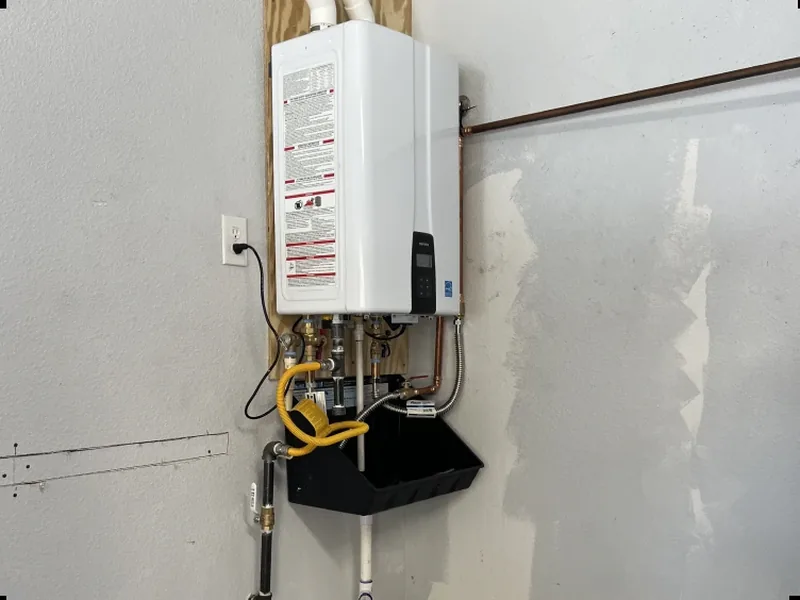
The anatomy of a tankless leak is the same across brands. The heat exchanger — copper or stainless tubing around the burner — develops pinhole leaks from scale hotspots, acidic thinning, or thermal fatigue; look for drips from inside the cabinet and mineral tracks on the metal. The condensate system fails most often overall: traps clog with sediment, drain hoses sag and hold water, neutralizer cartridges saturate, and acidic condensate backs up and overflows. Inlet and outlet unions weep as seals age — the crusty white or green buildup on the pipes beneath the unit marks the spot. Internal O-rings at the flow sensor and water control valve harden and seep with heat and age. Vent joints drip condensate backward when the run lacks proper slope. Freeze damage splits exchangers in unconditioned spaces. In Dighton we see the full catalog, but the well-fed units skew heavily toward exchanger and condensate failures while district-fed units skew toward seals and fittings. Knowing which pattern your home fits helps you read the early warnings.
Detached Garages, Workshops, and the Freeze Problem
Dighton's large rural lots mean tankless units frequently live outside the heated house — in detached garages, barn workshops, and outbuildings where they were convenient to vent and drain. Every one of those installations carries elevated freeze risk. A tankless exchanger holds little water, but it sits in thin copper passages that split readily when frozen, and the unit's electric freeze protection dies with the power. Rural Dighton knows ice-storm outages, and a January outage that idles a detached unit for a day can split the exchanger. The damage hides until water and power return, when the next hot-water call pressurizes the cracked coil.
Well systems compound the risk: when the power fails, the well pump stops too, so the unit sits with trapped water and no pressure — the worst freeze condition. After any winter outage, check under detached units before running hot water. Keep these units powered without exception through winter, insulate exposed piping, and have freeze protection verified each fall. If you find water under a detached unit after a cold snap, close the isolation valves and call (833) 713-2101 before firing it — a split exchanger can threaten the gas controls and electronics, and the full extent needs assessment first.
Damp River-Adjacent Basements and External Corrosion
Dighton's Taunton River frontage keeps some neighborhoods' basements damp for much of the year, and chronic dampness attacks a tankless unit from the outside while water chemistry works from the inside. Cabinet bottoms rust, mounting hardware corrodes, pipe fittings develop external crust, and the wall behind the unit stays moist enough to feed mold. A slow internal weep in a damp basement goes unnoticed longer — everything is already moist, so the extra water blends in until the damage is advanced. If your unit sits in a river-adjacent basement, the monthly glance underneath matters doubly: look for fresh drips distinct from ambient dampness, new rust streaks on the cabinet, and mineral crust forming on unions. A dehumidifier in the mechanical area is cheap insurance — it slows external corrosion and makes new leaks visible against a dry background. When we service Dighton river-neighborhood units, we inspect the cabinet and mounting for external corrosion alongside the internal leak sources, because both determine whether a repair or a replacement is the honest recommendation.
Our Diagnostic and Repair Process
Every Dighton visit starts with the water source and the unit's location — well or district, basement or detached — because those facts order our inspection. We dry the area and map drip points, then open the cabinet and examine the heat exchanger for the damage pattern matching the water: scale-crusted hotspots and acidic thinning on well-fed units, thermal-fatigue weeping on district-fed ones. The condensate trap comes out for flushing, drain slope gets verified with a level, neutralizer media is tested and replaced when saturated. Unions are checked under full pressure while we observe the well's pressure cycling if applicable. Error history is reviewed for corroboration.
Repairs match findings and address causes. Condensate path rebuilds with true downhill slope and fresh media. Union reseals with new gaskets. O-ring replacement at the water valve and flow sensor. Exchanger pinhole repair where isolated and accessible; exchanger replacement where pitting is widespread — and we show you the damage so the call makes sense. On well-fed units we pair the repair with water treatment: sediment pre-filtration, neutralizer scheduling, and an annual descaling plan. On any unit we verify gas pressure under full fire and vent slope, because installation weaknesses cause repeat leaks. The visit ends with full-fire test cycles and a verified-dry unit.
Maintenance That Fits Dighton's Conditions
The maintenance plan follows the water. Well-fed Dighton units: sediment pre-filter on the cold inlet with quarterly cartridge checks until you learn your well's loading, annual descaling flushes, neutralizer media on schedule, and pressure-tank air charge verified so cycling stays gentle. District-fed units: descaling every 18 to 24 months, neutralizer on the manufacturer's interval, and the same annual fall check of freeze protection for garage or detached installs. Every home: monthly glance under the unit for fresh drips or new crust, vent termination kept clear outside, and the condensate drain's downhill path confirmed after any plumbing work nearby. In damp river-adjacent basements, keep a dehumidifier running near the mechanical area. These habits are modest — a filter cartridge here, a glance there — and they are what separates the Dighton tankless units that leak every other year from the ones that run dry for a decade.
What Happens When You Call (833) 713-2101
Call the Water Heater Leak Repair Crew from Dighton and lead with your water source — well or district — and the unit's location. We will ask where the water is appearing, whether it is active, the unit's brand if you know it, and how the well equipment has been behaving if applicable. That shapes what we load: descaling gear, neutralizer media, filtration components, seals and gaskets. On site we diagnose before quoting, show you the evidence, and explain both the repair and the water-driven reason behind it. Most leak repairs finish in one visit; exchanger replacements get honest parts timing. We fire the unit through full cycles, verify it dry, and leave you with a maintenance plan matched to your water. One call to (833) 713-2101, and your Dighton tankless unit gets fixed for its actual conditions.