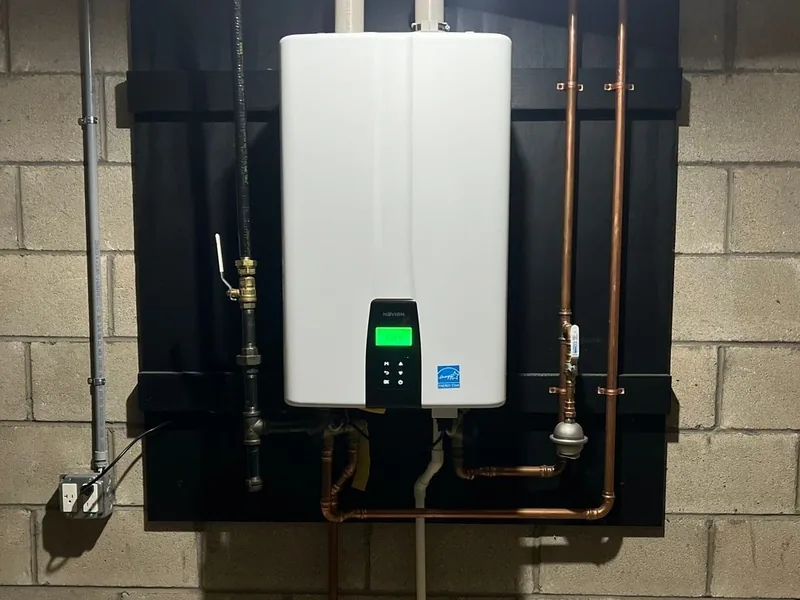
Historic Retrofits: Easton's Signature Tankless Challenge
The homes around Easton's historic center — 19th-century farmhouses, Victorians, and colonials, some with fieldstone foundations — were plumbed generations before tankless technology existed. Every tankless unit in these houses is a retrofit, and retrofits carry the town's most interesting leak causes. Gas lines sized for a 40,000-BTU tank heater cannot properly feed a 150,000-plus-BTU tankless unit; the resulting short-cycling stresses the heat exchanger toward pinhole failure. Venting a sealed-combustion unit through a house built for a chimney means long, creative vent runs, and every extra elbow and horizontal foot is a place for acidic condensate to collect and eat through joints. Stone foundations complicate the condensate drain: drilling a proper gravity drain path through two feet of fieldstone is nobody's idea of fun, so installers run the hose to the nearest receptor with whatever slope they can manage — and marginal slope fails as the house settles.
We do not criticize these installations; they were often the best option available. But when an Easton historic-home unit leaks, the diagnosis must include the installation, because the leak is frequently the installation's weakness made visible. A condensate overflow from a sagging drain hose gets the hose re-routed, not just the trap cleaned. An exchanger pinhole in a gas-starved unit prompts a frank conversation about the gas line. Fix the cause, not just the drip.
Newer Subdivisions: The Suburban Failure Pattern
Easton's 1990s-to-2010s subdivisions tell a simpler story. Builder-installed tankless units went in with correct gas lines, proper venting, and code-compliant condensate drains — and then went a decade or more without meaningful maintenance. The leaks we find here are age-driven: condensate neutralizer cartridges saturated long ago, letting acidic condensate attack the trap and hose; internal O-rings hardened by thousands of heating cycles, seeping at the flow sensor and water valve; inlet unions loosened by thermal cycling, weeping enough to crust the fittings. Heat exchanger pinholes appear too, usually from the slow accumulation of whatever mineral content the municipal water carries plus neglected descaling.
The good news is that these are the most straightforward repairs we do — the installation is sound, so the fix is the component. A condensate system rebuild, a union reseal, a gasket replacement, and the unit is dry. The lesson for subdivision owners is maintenance cadence: neutralizer media on schedule, descaling every 18 to 24 months, and a monthly glance under the unit. The builder gave you a good installation; a little attention keeps it that way. When you call (833) 713-2101 from a newer Easton neighborhood, we will ask the unit's age — it usually predicts the failure before we arrive.
Stone Foundations, Water Tables, and the Basement Environment
Easton's oldest homes often sit on fieldstone foundations, and several neighborhoods deal with high seasonal water tables. Both shape tankless leak behavior. Stone foundations are porous and uneven; a slow unit weep wicks into the stone and spreads as general dampness rather than a telltale puddle, hiding the leak's origin. Drilling condensate drains through stone is difficult, so drain routing in these homes deserves skeptical inspection — we have found hoses simply laid across the basement floor to a distant drain, relying on hope rather than slope. High water tables keep basements humid, accelerating external corrosion on cabinets, fittings, and mounting hardware, and making new leaks harder to spot against a background of ambient dampness.
Our approach in these basements: we trace moisture with the assumption that the visible dampness may be feet from the source, inspect the full condensate path rather than just the trap, and check the cabinet and mounting for external corrosion that affects the repair-versus-replace judgment. A dehumidifier near the mechanical area pays for itself in these homes — it slows corrosion and, just as importantly, makes a new leak visible against dry surroundings. If your Easton stone-foundation basement always feels damp, that is the environment; a new wet spot near the water heater is the signal.
Where Tankless Leaks Come From — The Complete List
Whatever the house, a tankless leak originates in one of a handful of places. The heat exchanger develops pinhole leaks from thermal stress, scale hotspots, or corrosion — drips from inside the cabinet, often with mineral tracks. The condensate system is the most common failure overall: clogged traps, sagging hoses, saturated neutralizer cartridges, frozen drain lines in winter. Inlet and outlet unions weep as seals age. Internal O-rings at the flow sensor and water control valve harden and seep. Vent joints drip condensate backward when slope is wrong. Freeze damage splits exchangers in unconditioned spaces. On an Easton service call we work this list in likelihood order, and the evidence — where the first fresh drip forms after drying, the water's color, whether it flows with the unit idle — identifies the source before tools come out. Homeowners can run the same test: dry the area, run hot water five minutes, watch where water first appears, and report it when calling (833) 713-2101.
Our Diagnostic and Repair Process
Diagnosis before quotation is our rule. We start with the house: retrofit or original install, stone or concrete foundation, basement or garage, municipal water throughout Easton. Then the unit: we dry the area, map drip points, open the cabinet, and inspect the heat exchanger under bright light for pinholes, mineral tracks, and corrosion. The condensate trap is removed and flushed, drain slope verified with a level, neutralizer media tested. Unions are checked under full pressure; O-rings at the water valve and flow sensor are inspected. Gas pressure under full fire is measured on retrofits — an undersized line shows immediately. The vent run gets checked for material, slope, and joint staining. Error history is reviewed.
Repairs follow root causes. Condensate path rebuilds with genuine downhill slope and fresh media — not just trap cleaning when the routing is the problem. Union reseals with new gaskets torqued to spec. O-ring and gasket replacement with manufacturer parts. Exchanger pinhole repair where isolated and accessible; exchanger replacement where pitting is widespread, with the damage shown to you. Installation corrections — gas line sizing, vent re-routing — are explained plainly when the leak points to them. Every repair concludes with full-fire test cycles and a verified-dry inspection. You will know what failed, why it failed, and what keeps it from failing again.
Maintenance for Easton's Two Housing Worlds
Historic-home owners: prioritize the installation. Verify the gas line is sized for the unit's full BTU demand — this one correction prevents the short-cycling that kills exchangers. Have the vent run inspected for slope and joint integrity every couple of years; old-house vent paths shift as structures settle. Confirm the condensate drain still runs downhill continuously; re-support any sagging sections. Descale annually to every 18 months depending on what the water carries, and keep neutralizer media fresh. Subdivision owners: the installation is likely fine, so prioritize the consumables — neutralizer on schedule, descaling every 18 to 24 months, trap cleaning, and the monthly under-unit glance for fresh drips or new crust. Everyone: keep the outdoor vent termination clear, verify freeze protection each fall for garage units, and run a dehumidifier in damp stone basements. Match the maintenance to the house, and the unit stays dry.
What Happens When You Call (833) 713-2101
Call the Water Heater Leak Repair Crew from Easton and describe the house as well as the leak — the home's age and the unit's location tell us where to look first. We will ask about the water's location and behavior, the unit's brand and age if known, and whether the installation was original or retrofit. Our trucks carry descaling equipment, neutralizer media, seals, gaskets, and the fittings that old-house drain corrections require. On site we diagnose fully before discussing repairs, show you the evidence, and explain both the fix and any installation weakness behind it. Most leak repairs complete in one visit; exchanger work gets honest parts timing. We fire the unit, verify it dry, and walk you through the maintenance your specific setup needs. One call to (833) 713-2101 brings Easton's historic and newer homes the same careful tankless care.