The Garage Habit: Foxborough's Most Common Tankless Placement
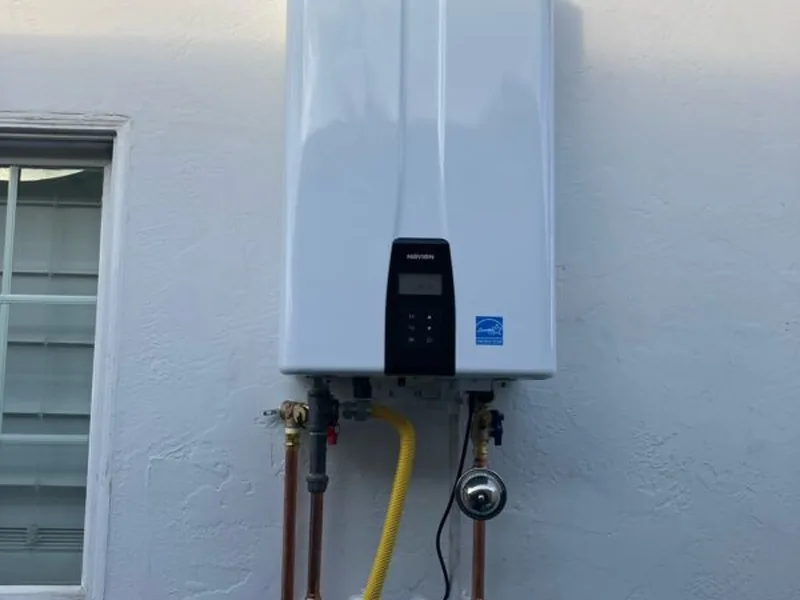
Walk through Foxborough's subdivisions and you will find tankless water heaters mounted on garage walls again and again. The logic was sound: the unit stays out of the living space, the vent run punches straight through the exterior wall, and the mechanical room keeps its floor space. But garage mounting concentrates three leak risks. First is freeze exposure. A tankless exchanger holds little water in thin copper passages, and the unit's electric freeze protection only works while powered. A tripped breaker, an unplugged unit before a vacation, or a winter outage during a cold snap can split the exchanger — the leak appears as a spray or pour the next time water flows. Second is temperature swing: garages cycle from summer heat to winter cold, and that constant expansion and contraction ages gaskets and O-rings faster than the steady climate of a basement. Third is the condensate drain: garage units often drain along cold exterior walls where the line can freeze mid-run in January, backing condensate up into the unit.
None of this means garage units are a mistake — most run for years without trouble. It means garage units deserve the fall checklist: verify freeze protection, confirm uninterrupted power, insulate exposed piping, and make sure the condensate line runs through as much conditioned space as possible. When a Foxborough garage unit leaks, we check the freeze and condensate angles first, because the placement points there.
Low-Lying Basements and the Leaks That Hide in Dampness
The other Foxborough pattern is the basement unit in the town's lower pockets, where wetlands and high seasonal water tables keep foundations damp. Here the problem is not the leak's cause but its camouflage: in a basement that always feels moist, a slow tankless weep blends into the background. The cabinet drips, the water wicks into the concrete, and nothing looks alarming until the cabinet base rusts through or the wall behind the unit stains. We have opened Foxborough basement units to find months of slow leakage that the homeowner never noticed because the basement "always smells a bit musty."
The defense is contrast. Keep the mechanical area as dry as practical — a dehumidifier near the water heater does double duty, slowing external corrosion and making any new water stand out against a dry floor. Monthly, look specifically under and behind the unit: fresh drips, new rust streaks on the cabinet, mineral crust forming on the unions. In damp basements, also check the wall behind the unit, since slow leaks wick sideways into foundation walls and show as staining feet from the heater. A leak you can see early is a gasket; a leak that hides for a year is a cabinet, a wall, and a much bigger repair. When we service Foxborough basement units, we inspect for external corrosion alongside the internal sources, because dampness attacks from both sides.
Where Tankless Leaks Come From
The leak sources are the same across brands, and worth knowing so you can read the signs. The heat exchanger — copper or stainless tubing around the burner — develops pinhole leaks from thermal stress, scale hotspots, or corrosion; expect drips from inside the cabinet, often with green-white mineral tracks on copper. The condensate system fails most often overall: the trap clogs, the drain hose sags, the neutralizer cartridge saturates, and acidic condensate backs up and overflows inside the unit. Inlet and outlet unions weep as seals age and thermal cycling loosens them — crusty buildup on the pipes beneath the unit is the mark. Internal O-rings at the flow sensor and water control valve harden and seep. Vent joints drip condensate backward when the vent lacks proper slope. Freeze damage splits exchangers in unconditioned garages. The home test that never fails: dry everything, run hot water for five minutes, and watch where the first fresh drip forms — at the small drain hose (condensate path), at the big pipe unions (fittings), or from inside the cabinet (exchanger or internal seals). Report what you see when you call (833) 713-2101.
Condensate: The Leak That Is Not the Unit's Fault
A large share of Foxborough "leaking tankless" calls turn out to be condensate management failures rather than broken heaters. Condensing units legitimately produce acidic water whenever they fire; the trap, neutralizer cartridge, and drain hose exist to handle it. When the trap clogs with sediment, the hose sags and holds water, the neutralizer saturates, or the line freezes in a cold garage run, condensate backs up and overflows — and to the homeowner it looks exactly like a leaking water heater. The unit is fine; the drain path failed.
Our condensate service addresses the whole path: trap removal and flushing, drain re-routing with genuine continuous downhill slope, neutralizer media replacement, and verification that the receptor can accept the flow. We also check the routing for freeze exposure — a drain that dips through an unconditioned crawl or along an exterior garage wall will fail again in January. Where gravity drainage is truly impossible, a condensate pump is the correct answer, not a longer sagging hose. Homeowners can prevent most of this: keep the neutralizer on its replacement schedule, and if your unit's drain hose runs through cold space, have it re-routed before winter. The cheapest tankless leak is the one the drain handles properly.
How We Diagnose and Repair
Our Foxborough visits follow a fixed discipline: diagnose fully, quote after. We start with placement and history — garage or basement, unit age and brand, where water appears and when. Then we dry the area and map drip points, open the cabinet, and inspect the heat exchanger under bright light for pinholes, mineral tracks, and corrosion. The condensate trap comes out for cleaning; drain slope is verified with a level; neutralizer media is tested. Unions are checked under full pressure; O-rings at the water valve and flow sensor are inspected. On garage units we verify the freeze-protection function and check for any past freeze damage. Error history is reviewed for corroborating codes.
Repairs match root causes: condensate path rebuilds with proper slope and fresh media; union reseals with new gaskets torqued to spec; O-ring and gasket replacement with manufacturer parts; exchanger pinhole repair where isolated and accessible, exchanger replacement where pitting is widespread — with the damage shown to you so the recommendation is transparent. Freeze-split exchangers get assessed for collateral damage to gas controls and electronics; water and gas components do not mix, and we will tell you plainly when replacement is the safer call. Every job ends with full-fire test cycles and a verified-dry unit.
The Foxborough Maintenance Calendar
Spread across the year, tankless maintenance in Foxborough is undramatic. Fall: verify freeze protection on garage units, confirm the unit has uninterrupted power, insulate exposed piping, and make sure the condensate drain does not run through freeze-exposed space. Winter: after any outage, check under the unit before running hot water; keep the outdoor vent termination clear of snow. Spring: inspect for any winter damage, clean the condensate trap, check neutralizer media. Every 18 to 24 months: descale the heat exchanger through the service valves — Foxborough's municipal water is kind to exchangers, but sediment and minor mineral content still accumulate. Monthly, year-round: glance under and behind the unit for fresh drips, new crust on unions, or rust streaks on the cabinet. In damp low-lying basements, run the dehumidifier steadily. None of these tasks is large; together they are why some Foxborough tankless units run fifteen dry years while their neglected neighbors leak at eight.
What Happens When You Call (833) 713-2101
When you call the Water Heater Leak Repair Crew from Foxborough, we will ask where the unit is mounted, what you are seeing and when, the unit's brand and age if you know them, and — for garage units — whether there has been a recent outage or cold snap. Your answers determine what we load and how we prioritize; active leaks go first. On arrival we diagnose completely before discussing any repair: the leak mapped, the cabinet opened, the source identified and shown to you. Most repairs — condensate rebuilds, reseals, gasket replacements — finish in one visit. Exchanger work gets honest parts timing. We fire the unit through full cycles, confirm zero weeping, and walk you through the maintenance your placement needs. One call to (833) 713-2101, and the puddle under your Foxborough tankless unit gets a name, a cause, and a fix.