Builder-Grade Units and the Maintenance They Never Got
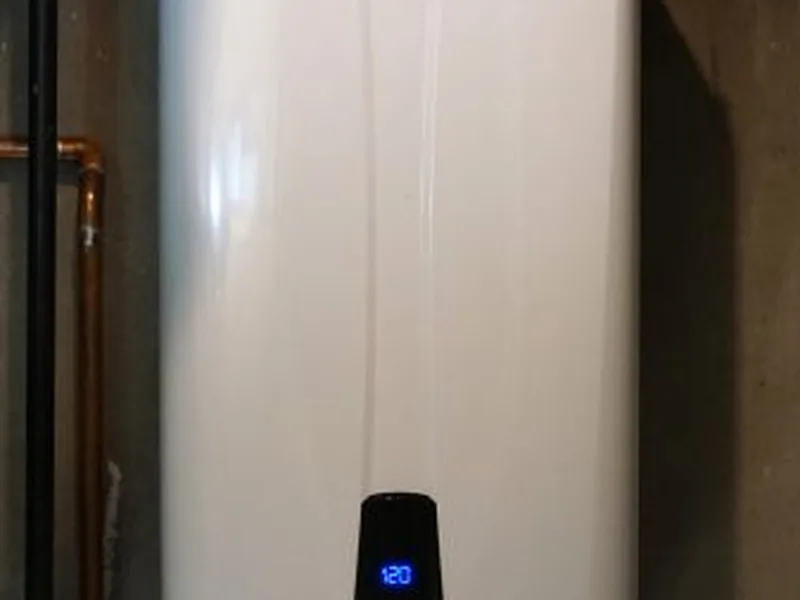
Franklin's growth-era subdivisions went up fast, and their mechanical systems were specified for cost as much as longevity. The tankless units in these homes are typically competent mid-range models — nothing wrong with them — installed correctly and then ignored for a decade. That neglect has a predictable leak timeline. Years three to five: the condensate neutralizer cartridge saturates, and acidic condensate begins attacking the trap and drain hose from the inside. Years five to eight: internal O-rings at the flow sensor and water valve harden from thousands of heating cycles and start seeping. Years seven to ten: inlet and outlet unions, worked by daily thermal expansion, loosen enough to weep — the white-green crust appears on the fittings. Year eight and beyond: the heat exchanger, never descaled, develops scale hotspots that open pinholes.
None of this is a defect; it is what happens to any tankless unit without maintenance. The encouraging part is that builder-grade does not mean repair-hostile — parts are standard, access is usually good in Franklin's unfinished basements, and the installations themselves are generally sound, so the fix is the component rather than the system. When a Franklin subdivision unit leaks, we are usually restoring a good installation to health, not rescuing a bad one. The repair is straightforward; the lesson is the maintenance schedule that follows.
Pressure Zones: Franklin's Rolling Terrain and Your Fittings
Franklin's hills do something most homeowners never consider: they divide the town into pressure zones. Water pressure at your tap depends on elevation relative to the supply, and across rolling terrain that varies meaningfully from neighborhood to neighborhood. Higher-pressure zones stress every seal in the plumbing system a little more — inlet unions on the tankless unit, internal O-rings, the pressure relief valve. In these zones, fitting weeps appear earlier and expansion-related issues are more common. Lower-pressure areas are gentler on seals but can mask the symptoms of a failing pressure regulator elsewhere.
This matters for tankless leaks in two ways. First, a weeping union in a high-pressure-zone home may be telling you as much about the street pressure as about the gasket — we check system pressure as part of our diagnosis, and if it runs high, a pressure-reducing valve protects the repair and the whole house. Second, thermal expansion hits harder where pressure is already elevated: water heated in a closed system has nowhere to go, and the tankless unit's fittings feel it. If your Franklin home is on one of the town's higher streets and your tankless fittings weep, mention the elevation when you call (833) 713-2101 — it helps us bring the right diagnostic approach and the right long-term fix.
The Unfinished Basement Mechanical Corner
Franklin's two-story colonials overwhelmingly put the tankless unit in an unfinished basement mechanical corner — and that placement is mostly good news. Access is open, the space stays temperate year-round, vent runs are short, and the condensate drain usually reaches a nearby receptor by gravity. Leaks here are easy to spot early (the concrete floor shows every drip) and easy to service. The failure pattern in these installs is the honest suburban one: consumables exhausted, seals aged, descaling skipped.
The watch points are modest: keep the area around the unit clear so drips stay visible — the mechanical corner that becomes a storage corner hides leaks behind boxes. Make sure the condensate drain's slope survived any basement finishing or plumbing work nearby; we have seen good drains compromised by a later-installed water softener or a shifted laundry sink. And in the few Franklin homes where the unit went into an attached garage instead, apply the full freeze-protection discipline. The basement mechanical corner is the best-case home for a tankless unit; a little attention keeps it that way.
Where Tankless Leaks Come From
Across all placements, the leak sources are consistent. The heat exchanger develops pinhole leaks from scale hotspots, corrosion, or thermal fatigue — drips from inside the cabinet with mineral tracks. The condensate system is the most common failure: clogged traps, sagging hoses, saturated neutralizers, frozen lines. Inlet and outlet unions weep as seals age. Internal O-rings at the flow sensor and water valve harden and seep. Vent joints drip condensate backward when slope is wrong. Freeze damage splits exchangers in unconditioned spaces. The diagnostic test you can run yourself: dry the area, run hot water for five minutes, and watch where the first fresh drip forms — small drain hose (condensate path), big pipe unions (fittings), inside the cabinet (exchanger or internal seals). Note the location and timing, then call (833) 713-2101 with the details; it sharpens the visit considerably.
Our Diagnostic and Repair Process
We diagnose before we quote — every time. The visit opens with the home's story: subdivision age, unit brand and age, water behavior, neighborhood elevation if relevant. Then the physical work: dry and map drip points, open the cabinet, inspect the heat exchanger under bright light for pinholes and mineral tracks, remove and flush the condensate trap, verify drain slope with a level, test neutralizer media, check unions under full pressure, inspect O-rings at the water valve and flow sensor, and measure system water pressure — in Franklin we always check this, given the terrain. Error history is reviewed for corroboration.
Repairs follow root causes. Condensate path rebuilds with true downhill slope and fresh media. Union reseals with new gaskets. O-ring replacement with manufacturer parts. Exchanger pinhole repair where isolated; exchanger replacement where pitting is widespread, with the damage shown to you. Where system pressure runs high, we discuss pressure regulation to protect the repair. Freeze damage gets assessed for collateral harm to controls. Every job closes with full-fire test cycles and a verified-dry unit — and a maintenance plan matched to your home's age, water, and pressure zone.
Maintenance That Matches a Franklin Home
For subdivision homes: put the consumables on a calendar. Neutralizer media per the manufacturer's interval (usually 1-2 years). Descaling every 18-24 months through the service valves — if your unit lacks service valves, have them added; they make every future service faster. Condensate trap cleaning annually. Monthly glance under the unit for fresh drips or new crust on unions. For homes in higher-pressure zones: have system pressure checked and consider a pressure-reducing valve if it runs high — it protects the tankless fittings and every other seal in the house. For the historic homes near the town center with retrofit units: add the installation audit — gas line sizing under full fire, vent slope and material, condensate routing — because retrofits carry the installation risks that subdivisions skip. Fall: verify freeze protection on any garage-mounted unit. Small, scheduled attention is the entire difference between Franklin tankless units that leak at year eight and those dry at year fifteen.
What Happens When You Call (833) 713-2101
Call the Water Heater Leak Repair Crew from Franklin and we will ask about the home's age and neighborhood, the unit's placement and brand, and what the water is doing — those answers tell us whether to expect the suburban consumables pattern, a pressure-zone fitting issue, or a retrofit installation problem. Active leaks get priority scheduling. On site we diagnose completely before discussing repairs: leak mapped, cabinet opened, source found and shown to you, system pressure checked. Most Franklin tankless leak repairs — condensate rebuilds, reseals, gasket replacements — finish in a single visit. Exchanger work gets honest parts timing. We fire the unit through full cycles, verify it dry, and leave you with a maintenance schedule fitted to your house. One call to (833) 713-2101 resolves the leak and sets up the years after.