Three Housing Worlds, One Set of Leak Sources
Mansfield contains three distinct tankless populations. The older colonials near the town center often carry retrofit units — installed when a tank failed, adapted to old gas lines and creative vent paths, with the installation weaknesses retrofits bring. The commuter subdivisions hold builder-installed units aging through the suburban consumables timeline: saturated neutralizers, hardened O-rings, loosened unions, never-descaled exchangers. The rental housing near the MBTA station and around town adds the human factor: units that nobody inspects between tenancies, where a slow weep can run for a year before anyone notices.
The leak sources are identical across all three — heat exchanger pinholes, condensate system failures, union weeps, gasket seeps, venting condensation, freeze damage — but the context changes the job. A retrofit colonial gets the installation audit (gas sizing, vent slope, condensate routing) because the leak may be the installation talking. A subdivision unit gets the consumables service because the installation is sound. A rental gets the full assessment plus a frank conversation about inspection routines, because the next leak will also hide until someone looks. When you call (833) 713-2101, telling us which Mansfield you live in — historic center, subdivision, or rental — focuses the visit before we arrive.
The Rental Factor: Leaks That Run Too Long
Rental properties produce Mansfield's worst tankless leak damage, not because the units differ but because the reporting loop is slow. A homeowner sees a puddle in their own basement the same day; a tenant may not enter the mechanical room for months, and a landlord may not visit between leases. By the time we get the call, a weeping union has been dripping for a season — the cabinet base is corroded, the wall behind is stained, the floor is damaged, and what would have been a gasket replacement is now a gasket plus cabinet and drywall work.
Mansfield landlords can break this cycle cheaply: a quarterly two-minute check of each property's water heater area — look for drips, crust on unions, dampness on the wall behind the unit, musty smells. Put it on the same schedule as smoke-detector battery checks. Tenants: report water near the water heater promptly, even if the hot water still works — early reporting turns a maintenance item into a quick visit instead of a damage claim. We work with Mansfield property owners regularly: straightforward diagnosis, plain-language findings you can act on, and repairs scheduled to minimize disruption. If you manage rentals in the 02048, call (833) 713-2101 and ask about setting up a routine inspection rhythm for your properties.
Where Tankless Leaks Come From
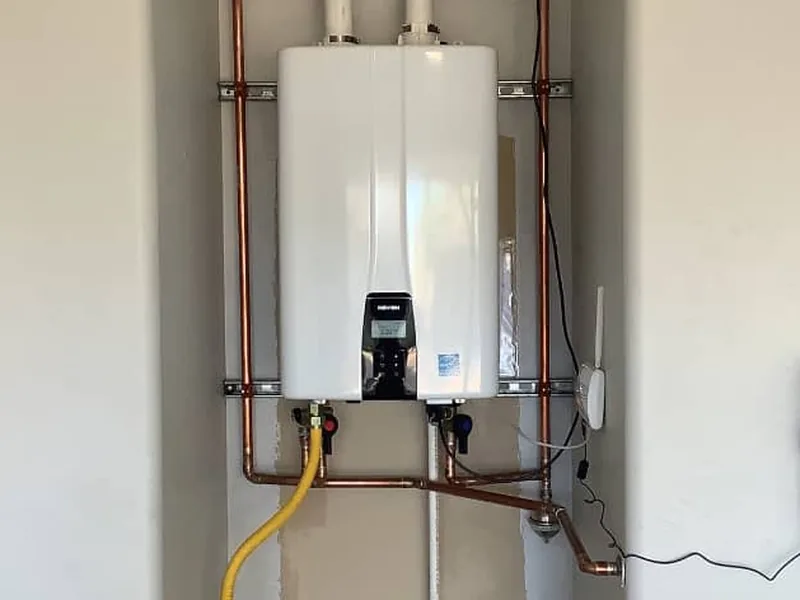
The anatomy is worth knowing whatever your housing situation. The heat exchanger — copper or stainless tubing around the burner — develops pinhole leaks from thermal stress, scale hotspots, or corrosion; look for drips from inside the cabinet and mineral tracks on the metal. The condensate system fails most often overall: clogged traps, sagging drain hoses, saturated neutralizer cartridges, frozen lines in winter. Inlet and outlet unions weep as seals age and thermal cycling works them loose — the white-green crust on the pipes beneath the unit marks the spot. Internal O-rings at the flow sensor and water control valve harden with heat and seep. Vent joints drip condensate backward when slope is wrong. Freeze damage splits exchangers in unconditioned garages and outbuildings. The home diagnostic: dry the area, run hot water for five minutes, watch where the first fresh drip forms — drain hose (condensate), pipe unions (fittings), inside the cabinet (exchanger or internal seals). Note it and call (833) 713-2101 with the details.
Retrofit Colonials: The Installation Audit
Mansfield's older colonials with retrofit tankless units deserve special diagnostic attention, because the leak is often a symptom of the installation. The three retrofit risks: gas line sizing — the original half-inch line sized for a 40,000-BTU tank cannot feed a 150,000-plus-BTU tankless properly, and the resulting short-cycling stresses the exchanger toward pinholes; venting — sealed, correctly sloped vent runs threaded through an old house often include sags or incompatible materials that trap acidic condensate and eat joints; and condensate drainage — adapted drain paths with marginal slope that fail as the house settles. When we service a retrofit colonial, we test gas pressure under full fire, inspect the full vent run for material and slope, and verify the condensate path with a level — not just the unit's components. Fixing a condensate overflow without correcting the sagging hose that caused it is a temporary patch. Homeowners sometimes flinch at hearing the installation needs correction beyond the leak repair; we explain it plainly because the alternative is paying for the same leak twice.
Our Diagnostic and Repair Process
Every Mansfield visit follows the same discipline: understand the house, then diagnose the unit. We ask about the home's age and type, the unit's placement and history, and the water's behavior — then we work. Dry the area and map drip points. Open the cabinet and inspect the heat exchanger under bright light for pinholes, mineral tracks, corrosion. Remove and flush the condensate trap; verify drain slope; test neutralizer media. Check unions under full pressure; inspect O-rings at the water valve and flow sensor. On retrofits, test gas pressure under full fire and inspect the vent run. Review error history for corroboration. Check system water pressure.
Repairs address root causes: condensate path rebuilds with genuine downhill slope and fresh media; union reseals with new gaskets torqued to spec; O-ring and gasket replacement with manufacturer parts; exchanger pinhole repair where isolated and accessible, exchanger replacement where pitting is widespread — damage shown to you, recommendation transparent. Freeze-split exchangers are assessed for collateral damage to gas controls and electronics. Installation corrections are explained when the leak points to them. Every job ends with full-fire test cycles, a verified-dry unit, and a walkthrough of what failed and what to watch. Diagnosis first, quotation second, dry floor always.
Maintenance for Mansfield's Three Housing Worlds
Owner-occupied colonials and subdivisions: the standard calendar. Neutralizer media on the manufacturer's interval. Descaling every 18-24 months through the service valves (have valves added if missing). Annual condensate trap cleaning. Monthly glance under and behind the unit for fresh drips, new crust, rust streaks. Fall freeze-protection verification for garage units. Vent termination kept clear. Retrofits add the installation watch: gas pressure, vent slope, and drain routing rechecked every couple of years as the old house settles. Rentals: everything above plus the quarterly landlord walkthrough — two minutes per property, checking for drips, crust, wall dampness, and musty smells. Put water-heater checks on the same schedule as detector batteries and filter changes. Across all three worlds, the pattern holds: the Mansfield tankless units that stay dry are the ones somebody looks at. Be that somebody, or hire us to be — call (833) 713-2101 to set up a routine.
What Happens When You Call (833) 713-2101
Call the Water Heater Leak Repair Crew from Mansfield and describe both the leak and the housing situation — owner-occupied, rental, subdivision, or historic colonial. We will ask where the unit sits, what the water is doing, the unit's brand and age if known, and for rentals, how long the issue may have been present. Active leaks get priority. On arrival we diagnose fully before discussing any repair: the source found, the evidence shown, the cause explained in plain language. Most tankless leak repairs — condensate rebuilds, reseals, gasket replacements — complete in one visit; exchanger work gets honest parts timing. We fire the unit, verify it dry, and leave you with maintenance guidance for your situation. Landlords and property managers: ask about inspection routines for your portfolio. One call to (833) 713-2101 serves every Mansfield housing world.