Acid, Iron, and Pressure: Mendon's Triple Threat to Tankless Units
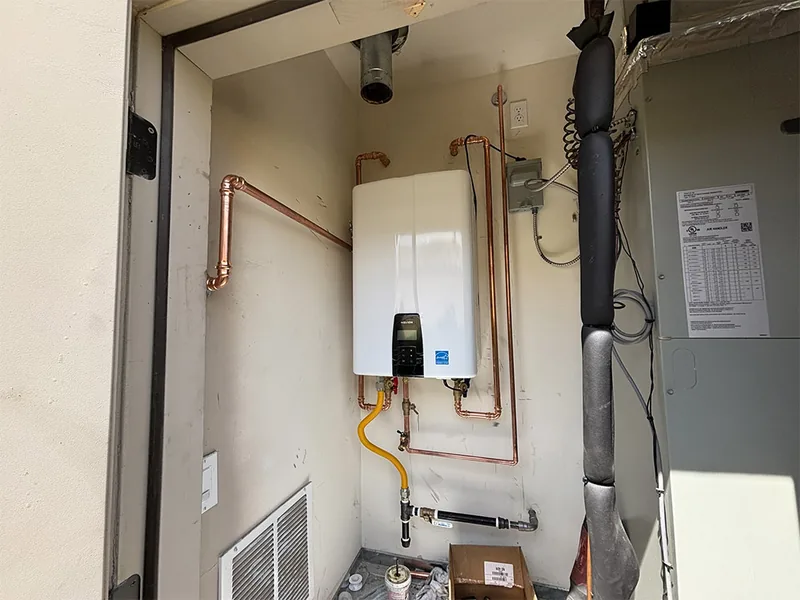
Three characteristics of Mendon's water define its tankless leak pattern, and they attack different parts of the unit. Acidity — low-pH groundwater common across this region — dissolves copper steadily from inside the heat exchanger's passages. It needs no heat and no time off; it works continuously, thinning tube walls until pinholes weep, often at bends and joints where the metal is already stressed. The signature is thinned, sometimes pinkish copper with weeping rather than heavy crust. Iron and manganese precipitate as sediment that bakes onto the exchanger's inner walls, forming insulating scale; the metal overheats in hotspots and fails there, leaving crusty, mineral-tracked pinholes. Sediment — sand and silt, worst after heavy rains — settles in the condensate trap and drain line, raising water levels until the trap overflows inside the cabinet.
Then the pressure behavior: well systems cycle between the pump's cut-in and cut-out pressures, so the tankless inlet feels a constant pulse that municipal-water units never experience. That flexing works inlet unions and internal seals loose over time. A Mendon tankless unit thus faces chemical attack inside, sediment attack below, and mechanical flexing at its connections — simultaneously, for its entire life. Our diagnosis reads all three, because the repair plan must answer all three.
Where the Leaks Start on Mendon Units
The failure order on Mendon well-fed units is consistent. Heat exchanger pinholes lead — from acidic thinning, scale hotspots, or both, showing as drips from inside the cabinet with greenish-white mineral tracks on copper. The damage is frequently widespread rather than isolated, so we inspect the entire coil, not just the obvious drip. Condensate system failures run second: sediment-choked traps, sagging hoses, neutralizer cartridges exhausted by the double duty of neutralizing combustion acid plus mineral-heavy water. Inlet union weeping is more common here than on town water, courtesy of pressure-tank cycling. Internal O-rings at the flow sensor and water control valve harden and seep. Freeze-split exchangers appear in the detached garages, barns, and workshops scattered across Mendon's large lots — outbuildings where units were mounted for convenience and where power outages kill freeze protection. Vent joints drip condensate backward when slope is wrong. Every Mendon call gets this list checked in order, and the evidence — tracks, staining, drip timing — names the culprit.
Hills, Pressure Tanks, and Fitting Fatigue
Mendon's rolling hills add a wrinkle even well owners overlook: elevation changes affect the whole water system's behavior. Homes at different elevations see different static pressures, and the pressure tank's cycle interacts with that baseline — a tank set for a valley home behaves differently on a hilltop. The practical effect on the tankless unit is the same amplified: more pronounced pressure pulsing at the inlet, more flexing of unions and seals, earlier weeping. A waterlogged pressure tank — one that has lost its air charge — makes everything worse, short-cycling the pump and hammering the plumbing with rapid pulses.
During our diagnosis we watch the system pressure while fixtures run, reading the well's cycling pattern the way a mechanic reads an engine's idle. A healthy cycle is slow and regular; a rapid-fire cycle points to a waterlogged tank that is punishing every seal in the house, not just the tankless unit's. Correcting the tank's air charge is inexpensive and it protects the leak repair — resealing a union while the system hammers it is a short-lived fix. When you call (833) 713-2101 from Mendon, mention how your well pump behaves; frequent short cycling is diagnostically valuable.
Filtration: The Repair's Essential Partner
On Mendon well water, fixing the leak without addressing the water is a temporary patch — we say this plainly because it determines whether our work lasts. The essential partner to any tankless repair here is filtration. A sediment pre-filter on the cold inlet catches sand, silt, and iron particulate before they reach the exchanger and condensate trap; cartridges are inexpensive and the housing is compact. For acidic wells, an acid-neutralizing filter upstream protects the unit's copper passages and every copper pipe in the house. With filtration handling the incoming load, annual descaling flushes keep the exchanger clear; without it, flushing fights a continuous battle.
We install sediment pre-filters during repair visits — the plumbing is already open and it is the highest-value addition for a well-fed unit. Neutralizer media for the condensate system gets scheduled, not deferred. And we set the maintenance rhythm: filter cartridge checks quarterly until your well's loading pattern is known, descaling annually, neutralizer on interval. Mendon homeowners who adopt this routine see their tankless units go from leaking every other year to running dry for a decade. The water is the environment; treat the environment and the equipment thrives.
Freeze Exposure Across Mendon's Outbuildings
Mendon's large lots and rural character put tankless units in some of the most freeze-exposed installations we service: detached garages, barn workshops, pool houses, even well houses. The physics are unforgiving — thin copper passages, small trapped water volume, and electric freeze protection that dies with the power. A January ice-storm outage idles the unit, the passages freeze and split, and the damage waits silently until water and power return and the next hot-water call pressurizes the cracked coil. Well homes suffer the double hit: the pump stops too, leaving stagnant trapped water in the worst possible freeze condition.
Prevention is a fall ritual: verify freeze protection function, confirm the unit will stay powered, insulate all exposed piping, and temper the outbuilding as much as practical. After any winter outage, inspect under the unit before running hot water — look for fresh water, listen for hissing, check the cabinet base. If you find evidence of freezing, close the isolation valves and call (833) 713-2101 without firing the unit: a split exchanger can threaten gas controls and electronics, and the full damage needs assessment before anything runs. Outbuilding units can serve reliably for years with this discipline; without it, one bad outage ends them.
Our Diagnostic and Repair Process
A Mendon visit begins with the well's story: pump age, pressure tank behavior, filtration equipment, recent water changes, and the unit's location — basement, garage, or outbuilding. Those answers order our inspection. We dry the area and map drips, open the cabinet, and examine the heat exchanger for Mendon's signature damage: acidic thinning plus scale hotspots, green-white tracks on copper, widespread versus isolated pitting. The condensate trap is pulled and flushed; drain slope verified; neutralizer media tested. Unions are checked under full pressure while we observe the well's cycling. O-rings at the water valve and flow sensor are inspected. On outbuilding units, freeze protection is tested and past freeze damage is ruled in or out. Error history is reviewed.
Repairs pair the component fix with the water fix. Condensate path rebuilds with true slope and fresh media. Union reseals with new gaskets. O-ring replacement. Exchanger pinhole repair where isolated and accessible; exchanger replacement where pitting is widespread — damage shown to you, recommendation transparent. Sediment pre-filter installation while the plumbing is open. Pressure-tank charge correction where cycling is abusive. Every job ends with full-fire test cycles and a verified-dry unit, plus a maintenance plan written for your well. Diagnosis first, quotation second, and the water always part of the answer.
What Happens When You Call (833) 713-2101
Call the Water Heater Leak Repair Crew from Mendon and lead with the well and the unit's location — those two facts shape everything. We will ask about the water you are seeing, pump and pressure-tank behavior, existing filtration, the unit's brand and age, and whether there has been a recent outage. Our trucks carry descaling equipment, neutralizer media, sediment filter components, seals, gaskets, and freeze-assessment tools, so most Mendon visits diagnose and often repair in one trip. On site we find the source, show you the evidence, explain the water's role honestly, and pair the repair with the filtration and maintenance that make it last. One call to (833) 713-2101 gives your well-fed tankless unit care designed for Mendon's water, hills, and winters.