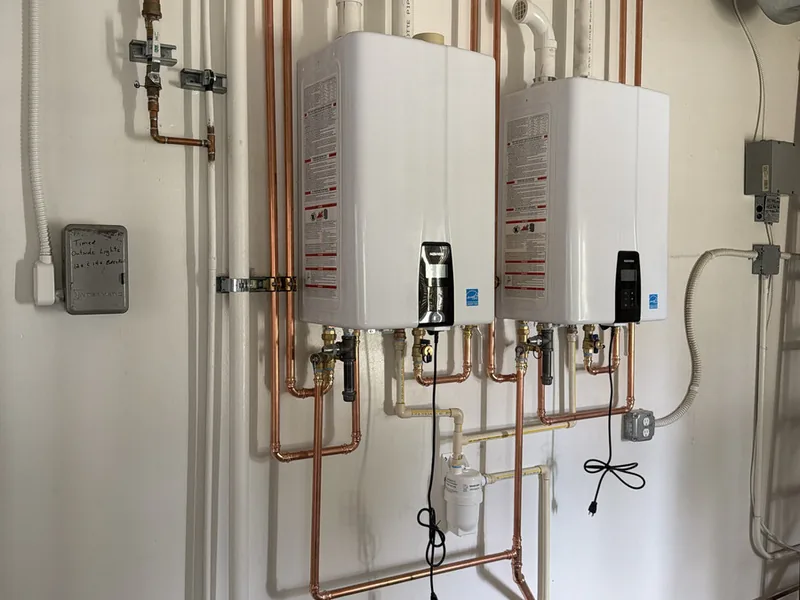
Jewelry-Town Buildings Meet On-Demand Heating
North Attleboro's identity as a historic jewelry manufacturing center shaped its buildings: dense downtown blocks, mill structures converted to apartments and condos, early-1900s colonials and multifamilies, and later the post-war Capes and ranches filling outward. Tankless units in the older buildings are overwhelmingly retrofits, and each retrofit negotiates with a structure designed for something else. The gas line was sized for a 40,000-BTU tank heater; the tankless wants 150,000 to 199,000 BTU at full fire. Starved burners short-cycle, and short-cycling fatigues heat exchangers toward pinhole leaks — the most expensive leak a tankless unit can develop. Venting must thread sealed, sloped runs through buildings made for chimneys; adapted runs sag, trap acidic condensate, and eat through joints. Condensate drainage must cross old basements — fieldstone, early concrete, low ceilings — to reach a receptor, and marginal slope fails as buildings settle.
The converted mill spaces add their own character: high ceilings but awkward mechanical placement, shared-wall considerations, and plumbing systems that have been reconfigured many times. When a North Attleboro unit leaks, we read the building first — retrofit or original, downtown old or suburban newer — because the building predicts the failure. The repair then addresses both the component and the installation weakness behind it.
Where Tankless Leaks Come From
The component sources are the same across brands. The heat exchanger develops pinhole leaks from thermal stress, scale hotspots, or corrosion — drips from inside the cabinet, mineral tracks on the metal. The condensate system fails most often overall: clogged traps, sagging hoses, saturated neutralizer cartridges, frozen lines. Inlet and outlet unions weep as seals age and thermal cycling loosens them — crusty buildup on the pipes beneath the unit. Internal O-rings at the flow sensor and water control valve harden and seep. Vent joints drip condensate backward when slope is wrong. Freeze damage splits exchangers in unconditioned garages. In North Attleboro's retrofits, condensate and venting failures lead because adapted installations fail there first; in the newer suburban homes, the pattern is the honest suburban one — consumables exhausted, seals aged, descaling skipped. The pre-call test works everywhere: dry the area, run hot water five minutes, watch where the first fresh drip forms, and report it to (833) 713-2101.
Downtown Old vs. Suburban New: Two Diagnostic Paths
A tankless leak in North Attleboro's downtown old stock and one in the outer suburbs get different diagnostic emphasis. Downtown and near-downtown: start with the installation. Gas pressure under full fire (undersized lines are the rule, not the exception, in retrofits), vent material and slope through the old structure, condensate routing across the old basement. The leak is frequently the installation's weakness made visible — a condensate overflow from a sagging adapted hose, an exchanger pinhole in a gas-starved unit. Suburban Capes and ranches: start with the components. Builder or replacement installs are generally sound, so the failure is usually consumables — saturated neutralizer, hardened O-rings, loosened unions, scaled exchanger. The repair is the part, not the system.
Both paths converge on the same discipline: diagnose fully before quoting, repair root causes rather than symptoms, verify dry with full-fire test cycles. But the order of inspection differs, and that order is what local experience buys you. Tell us which North Attleboro your home belongs to when you call (833) 713-2101 — downtown old, mill conversion, or suburban newer — and the visit starts focused.
Condensate: The Quiet Majority of Leak Calls
More North Attleboro "leaking tankless" calls resolve in the condensate path than anywhere else. The mechanism is simple: condensing units make acidic water whenever they fire, and the trap, neutralizer, and drain hose must carry it away. In retrofits, that path is often the most compromised part of the installation — hoses run to distant receptors with marginal slope, neutralizers were never installed, traps go uncleaned for years. The failure looks like a broken water heater: water under the unit, sometimes inside the cabinet where the trap overflowed. But the heater is fine; the drain failed.
Our condensate service rebuilds the whole path: trap removal and flushing, hose re-routing with genuine continuous downhill slope verified by level, neutralizer media replacement, receptor verification. Where gravity drainage is impossible in an old basement's geometry, a condensate pump is the correct answer. Homeowners can prevent most of this with the neutralizer schedule and an annual trap cleaning — small maintenance against the most common leak call we make. If your North Attleboro unit's leak is clear water near the small drain hose, the condensate path is suspect number one; call (833) 713-2101 and describe exactly where the water sits.
Our Diagnostic and Repair Process
Every visit follows the same order: house, then unit, then quotation. We establish retrofit versus original install, building age, foundation and basement conditions, unit placement. Gas pressure under full fire is tested on retrofits. The vent run is inspected for material, slope, and joint staining. Then the component inspection: heat exchanger under bright light for pinholes and mineral tracks; condensate trap pulled and flushed; drain slope leveled; neutralizer media tested; unions checked under full pressure; O-rings at the water valve and flow sensor inspected; error history reviewed.
Repairs are matched to root causes. Condensate path rebuilds with true slope and fresh media — not just trap cleaning when routing is the problem. Union reseals with new gaskets torqued to specification. O-ring and gasket replacement with manufacturer parts. Exchanger pinhole repair where isolated and accessible; exchanger replacement where pitting is widespread, damage shown to you. Installation corrections — gas line upsizing, vent re-routing — explained plainly when the leak points to them. Freeze damage assessed for collateral harm to controls. Every repair ends with full-fire test cycles and a verified-dry unit, plus a walkthrough of what failed and the maintenance that prevents recurrence. You will understand your unit better when we leave than when we arrived.
Maintenance for North Attleboro's Two Building Eras
Older downtown buildings and mill conversions: watch the installation. Gas pressure rechecked periodically on retrofits, vent slope and joints inspected as the old building settles, condensate routing verified — adapted drains are the first thing to fail. Descale every 18-24 months, neutralizer on schedule, trap cleaned annually, monthly glance under the unit for fresh drips or new crust. Suburban homes: the installation is likely sound, so run the consumables calendar — neutralizer, descaling, trap cleaning, monthly glance — and verify freeze protection each fall for garage units. Everywhere: keep the vent termination clear, keep the mechanical area clear of storage so drips stay visible, and in damp low-lying basements near the Ten Mile River watershed, run a dehumidifier to slow external corrosion and make new leaks visible. Match the maintenance to the building era, and North Attleboro's tankless units stay dry across both.
What Happens When You Call (833) 713-2101
Call the Water Heater Leak Repair Crew from North Attleboro and describe the building as well as the leak — downtown old, mill conversion, or suburban newer tells us where to look first. We will ask about the water's location and behavior, the unit's brand, age, and installation history, and whether the leak is active. Active leaks get priority scheduling. On arrival we assess the installation and the unit together, find the source, show you the evidence, and explain both the repair and any underlying installation weakness. Most leak repairs — condensate rebuilds, reseals, gasket replacements — complete in one visit; exchanger or installation work gets honest timing. We fire the unit through full cycles, verify it dry, and walk you through the maintenance your building era needs. One call to (833) 713-2101 connects North Attleboro's old buildings and new suburbs with the same careful tankless care.