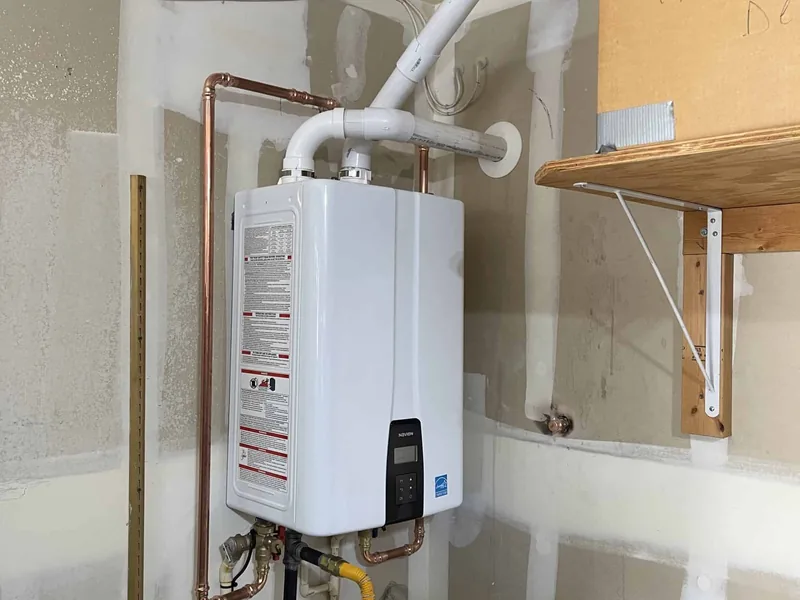
What Tankless Leak Repair Looks Like
The repair follows the diagnosis. Weeping fittings get new washers, O-rings, or reseated connections — the simplest fix and the most common. Cracked plastic housings on flow sensors or inlet filters are replaced with new assemblies. A scaled heat exchanger gets a full descaling flush first; if the metal proves sound, the flush plus repaired fittings resolves it, but if descaling reveals pitting or thinning, the exchanger itself is replaced — a bigger job, but still far less than a new unit. Condensate problems get cleared lines, fresh neutralizer media, and rerouted terminations. Relief valves that weep from age are replaced and the discharge piped to code.
Every repair ends the same way: the unit reassembled, filled, and run through a full heating cycle while we watch every joint we touched. Combustion is verified on gas units, temperature rise is measured against the rating plate, and the error history is cleared and monitored. We also descale as part of most leak repairs, because the scale that contributed to the leak is still in the exchanger. Somerset customers who call (833) 713-2101 get the unit back verified under load — not just "no longer dripping," but heating correctly and efficiently.
Repair or Replace: The Honest Conversation
Not every leaking tankless unit deserves repair, and we say so plainly. The decision turns on three factors: the unit's age, the failed component, and the condition of the heat exchanger. A failed fitting or sensor on a six-year-old unit with a clean exchanger is an obvious repair. A leaking heat exchanger on a fourteen-year-old unit that has never been descaled is a different conversation — the exchanger is the heart of the machine, and replacing it on a unit near the end of its service life buys time rather than value.
We also weigh efficiency. A fifteen-year-old tankless unit, even repaired, runs at yesterday's efficiency; the energy savings of a modern condensing replacement can be real over the unit's life. But we never push replacement to pad a ticket — if the unit has years left and the repair is sound, we repair it and tell you how to protect it. Somerset homeowners who call (833) 713-2101 get the reasoning in plain language: what the repair buys in expected years of service versus what replacement buys. The decision is yours; our job is making sure it is an informed one.
Gas vs Electric Tankless: Different Leak Profiles
Gas and electric tankless units leak in different places, and knowing which you have focuses the diagnosis. Gas units — the majority in Somerset — carry the full catalog: heat exchanger pinholes from scale and thermal stress, condensate system failures on condensing models, weeping water fittings near the gas valve, and venting-related moisture. Their leaks interact with combustion, so a leak near the burner demands extra care and a combustion check after repair.
Electric tankless units are simpler machines with fewer leak points but their own pattern: heating-element seals that harden and weep, inlet and outlet fittings stressed by thermal expansion cycling, and pressure-relief weeping where inlet pressure runs high. They do not produce condensate, which eliminates a whole category. When you call (833) 713-2101, telling us gas or electric — and the unit's location, garage or basement or exterior — lets us arrive with the right parts and the right diagnostic focus. Either way, the process is the same: find the exact source, fix it properly, verify under load.
Maintenance That Keeps Tankless Units From Leaking
Almost every tankless leak we repair in Somerset traces back to skipped maintenance, and the prevention list is short. Descale annually — a pump-circulated flush dissolves the scale before it becomes the insulation that cracks exchangers. Clean the inlet water filter regularly; the little screen catches the grit that chews through seals and scores sensor housings. On condensing units, check the condensate neutralizer media yearly and keep the drain line clear and freeze-protected. Inspect visible fittings for the white or green crust that betrays a slow weep, and wipe it away — if it returns, you have a leak forming.
Set the output temperature sensibly — most households are comfortable around 120 degrees — because higher settings accelerate scale formation and thermal stress. And keep the area around the unit clear and dry; a damp, cluttered mechanical space hides the first signs of trouble. None of this is complicated, and we walk Somerset homeowners through it after every repair. A maintained tankless unit is a twenty-year appliance; a neglected one is a leak waiting for a cold snap. Call (833) 713-2101 and we will put your unit on a maintenance rhythm that prevents the repeat visit.
Well Water and Tankless Units: A Demanding Pair
Several Somerset-area neighborhoods run on private wells, and well water is the hardest test a tankless unit faces. Iron, manganese, and sediment arrive in concentrations town water never sees. Sediment settles in low spots and grinds through seals; dissolved minerals scale the exchanger far faster than municipal water does; iron bacteria can foul sensors and leave the telltale orange staining inside the cabinet. A tankless unit on untreated well water without a pre-filter is living on borrowed time.
The defense is layered: a sediment pre-filter on the incoming line, changed on schedule; more frequent descaling — twice a year is not excessive on heavy well water; and periodic water testing so treatment matches what the well is actually delivering. When we repair tankless leaks on well-water homes around Somerset, we check the pre-filter situation as part of the job, because fixing the leak without addressing the water that caused it guarantees a sequel. If your well-water tankless unit is leaking, scaling rapidly, or throwing flow errors, call (833) 713-2101 — the repair and the water treatment need to be planned together.
What Happens When You Call {phone}
Call the Water Heater Leak Repair Crew from Somerset and tell us what you are seeing — the drip location, any error code, whether hot water is intermittent or gone, and whether the unit is gas or electric. Tankless leaks and error codes get priority scheduling because a small leak reaches electronics fast. On arrival we run the full diagnostic: history, visual mapping of mineral trails, under-load observation, and isolation pressure testing to name the failed component.
You will hear the diagnosis and the honest repair-versus-replace read before any work begins. Most fitting, sensor, and condensate repairs finish in one visit; exchanger replacements are scheduled with the part in hand. Every job ends with a full-load verification — temperature rise, combustion check on gas units, and a dry cabinet. One call to (833) 713-2101 brings Somerset's tankless leak to a proper, verified fix, plus the maintenance guidance that keeps it from coming back.
Where Tankless Leaks Actually Begin
A tank unit leaks from one big vessel; a tankless unit leaks from a dozen small ones. Start with the heat exchanger — the copper or stainless coil where flame meets water. Years of thermal cycling plus scale stress it, and pinholes develop that weep under pressure, often misting onto the burner below where the water flashes to steam and leaves white mineral traces. Next, the water connections: inlet and outlet fittings with washers and O-rings that harden and shrink with heat, seeping a few drops an hour. The flow sensor housing and inlet filter cap are plastic in many models — they crack from overtightening or age. On condensing units, the condensate trap and drain line can clog with scale debris, backing acidic condensate into the cabinet. And the pressure relief valve weeps when thermal expansion or high inlet pressure pushes past its setting.
Tracing which one is actually leaking is the whole job. Water runs downhill and wicks along brackets, so the puddle under the unit is rarely beneath the source. In Somerset homes we dry the cabinet, run the unit under load, and watch with a light and mirror — the active drip never lies. Call (833) 713-2101 and describe where you see water; we will find where it starts.