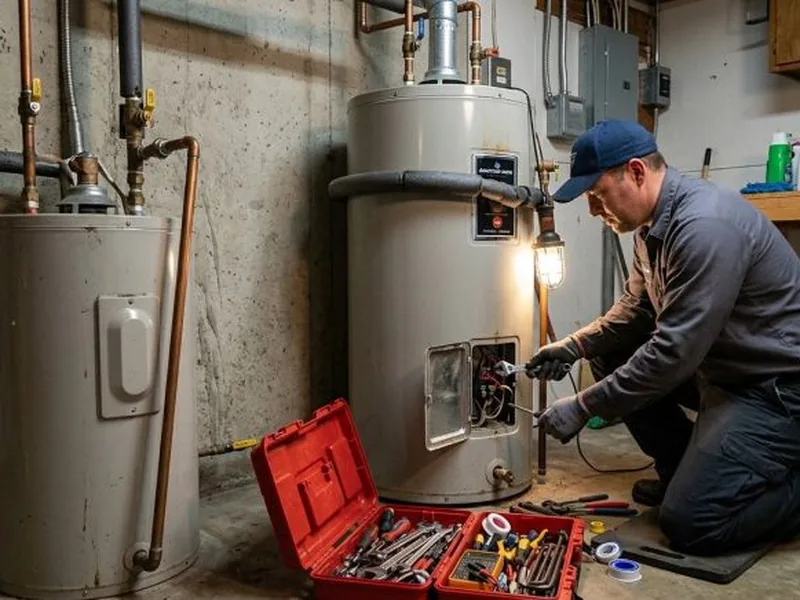
How a Water Heater Thermostat Actually Works
An electric storage water heater does not heat all its water at once. It has an upper thermostat and a lower thermostat, each paired with a heating element, operating in sequence. The upper thermostat has priority: when the water at the top of the tank drops below the setpoint, the upper thermostat sends power to the upper element. Once the top is satisfied, it switches power down to the lower thermostat, which heats the bulk of the tank through the lower element. The upper thermostat also carries the ECO — the energy cut-off, a high-limit safety switch that trips if water temperature climbs dangerously high, cutting power to both elements. A gas water heater works differently: a combination gas control valve mounted on the tank includes the thermostat, which opens and closes gas flow to the burner based on water temperature, with its own high-limit protection.
This architecture explains every symptom. No hot water at all usually means the upper thermostat failed or the ECO tripped — nothing heats. Hot water that runs out after a few minutes points to the lower thermostat or lower element — the top heats, the bulk never does. Water hot enough to scald suggests a thermostat stuck in the closed position, heating without limit until the ECO trips or the TPR valve weeps. Lukewarm water that never gets properly hot often means a miscalibrated or failing thermostat reading temperature wrong. Knowing which symptom you have tells us which thermostat to suspect before we open a panel.
Why Thermostats Fail in Attleboro's Older Homes
Thermostats are simple devices — a temperature sensor and a switch — but Attleboro's housing stock gives them plenty of ways to die. Sediment is the leading killer: the city's older neighborhoods still have homes with aging galvanized or copper piping that sheds sediment, and Attleboro's own water, while soft, carries enough particulate over the years to blanket the tank bottom. That sediment buries the lower element and insulates the lower thermostat from the water it is supposed to sense. The thermostat then misreads temperature, the element overheats beneath its sediment blanket, and both fail prematurely — the classic reason a ten-year-old tank starts delivering five-minute showers. Electrical wear is second: thermostats cycle thousands of times a year, and contacts pit and degrade, especially where voltage fluctuates in older panels. Moisture is third: in Attleboro's damper basements — particularly the low-lying streets near the Ten Mile River — condensation and minor seepage corrode thermostat terminals and wiring connections behind the access panels. And age finishes the job: most thermostats are designed for roughly the tank's own lifespan, so a fifteen-year-old tank with original thermostats is living on borrowed time.
Symptoms Decoded: Which Thermostat Is Failing
Match your symptom to the failure and you will understand the repair before we arrive. No hot water whatsoever, with the breaker untripped: suspect the upper thermostat or a tripped ECO. Pressing the ECO reset button (behind the upper access panel) may restore heat temporarily, but if it trips again, the thermostat is faulty or the water is genuinely overheating — either way it needs professional attention, because a repeatedly tripping high-limit is a safety signal. Hot water for a few minutes, then cold: the lower thermostat or lower element has failed; the upper section heats but the tank's main volume never does. Water hot enough to scald at every tap: a thermostat stuck closed, heating beyond the setpoint — check the temperature immediately and call (833) 713-2101, since scalding water is a burn hazard, especially for children and older adults. Water never quite hot enough: a thermostat reading high, cutting off early, or an element partially failed. Breaker tripping when the heater runs: a shorted thermostat or element. In Attleboro's multifamily buildings, take scalding complaints seriously and fast — one stuck thermostat can endanger several households.
The Multifamily Factor: Triple-Deckers and Shared Tanks
Attleboro's downtown triple-deckers and multifamily conversions put a special responsibility on water heater thermostats. A single tank often serves multiple units, which means a failed lower thermostat does not just shorten one family's shower — it leaves three households with lukewarm water and three sets of complaints. Worse, a stuck thermostat producing scalding water becomes a multi-household burn hazard, and landlords carry the liability. We urge Attleboro property owners to treat hot-water complaints as priority maintenance: verify water temperature at the tap (it should be around 120 degrees), and if tenants report scalding or sudden loss of hot water, schedule service immediately rather than waiting for a convenient day.
There is also an access reality: in older multifamilies, the water heater often sits in a cramped basement corner behind stored belongings, or in a locked utility area tenants cannot reach. Make sure the heater remains accessible — a thermostat diagnosis takes minutes with clear access and much longer without it. If you manage Attleboro rentals, consider an annual water-heater check alongside your other property maintenance: verify temperature, look for leaks, and confirm the ECO has not tripped. It is inexpensive prevention against the emergency call at 10 p.m. when the building has no hot water. Call (833) 713-2101 to set up a routine for your properties.
Our Thermostat Diagnosis and Replacement Process
We diagnose before replacing, because thermostats share symptoms with elements and wiring. The visit starts with the symptom history and a tap-temperature check. Then power off at the breaker — verified with a meter, not assumed — because 240 volts demands respect. We remove the access panels and insulation, exposing the upper and lower thermostats, and inspect for the visual tells: scorched terminals, corroded connections, moisture behind the panels, swollen or discolored components. Each thermostat is tested with a multimeter for continuity and proper switching; elements are tested too, since a failed element mimics a failed thermostat and replacing the wrong part wastes your money. We check the ECO's state and the tank's overall condition — a thermostat replacement on a tank that is itself failing is poor advice, and we will tell you.
Replacement, when indicated, is methodical: wires labeled or photographed before disconnection, the old thermostat unclipped, the new matched unit installed (we generally replace thermostats as a pair on older tanks, since the survivor is usually close behind), connections torqued to spec, panels and insulation restored. Both thermostats are set to 120 degrees. The tank is confirmed full before power is restored — energizing elements in a partially drained tank destroys them in seconds. Then we verify: proper heating sequence, correct shutoff at setpoint, stable tap temperature. Most thermostat replacements in Attleboro complete in a single visit.
Sediment, Temperature Setting, and Making the Repair Last
A new thermostat in a sediment-choked tank is a short-lived repair, so we address the environment. If sediment buried the old lower thermostat, we recommend flushing the tank — draining several gallons from the drain valve to carry sediment out — and discuss whether the anode rod's condition suggests the tank itself is near end of life. The temperature setting matters too: 120 degrees is the standard recommendation, hot enough for household needs while limiting scald risk and slowing sediment bake-on and tank corrosion. Higher settings shorten thermostat and element life and raise energy use for no real benefit.
For Attleboro's older homes, we also look at the electrical supply: loose connections in an aging panel cause voltage fluctuations that pit thermostat contacts, so we inspect and tighten what we can reach. In damp basements, we note moisture behind the panels and suggest the dehumidification or drainage attention that protects the new components. And we leave you with the symptom decoder: if hot water behavior changes — shorter supply, hotter than set, ECO trips — call early. A thermostat caught at the first symptom is a simple swap; one left until it takes the element with it costs more. Call (833) 713-2101 at the first sign of trouble.
What Happens When You Call (833) 713-2101
Call the Water Heater Leak Repair Crew from Attleboro and describe the hot-water symptom — no hot water, runs out fast, scalding, lukewarm, tripped breaker. We will ask whether the heater is electric or gas, its approximate age, and where it is installed; your answers tell us what to expect and what to bring. Loss of hot water and scalding complaints get priority scheduling. On arrival we diagnose fully — symptom history, temperature check, panel inspection, electrical testing — and identify whether the thermostat, element, or something else is at fault before discussing any replacement. Most thermostat jobs finish in one visit, with both thermostats set to 120 degrees and verified. We will also give you an honest read on the tank's overall condition, so you are not replacing parts on a heater that needs replacement itself. One call to (833) 713-2101 restores hot water done right.