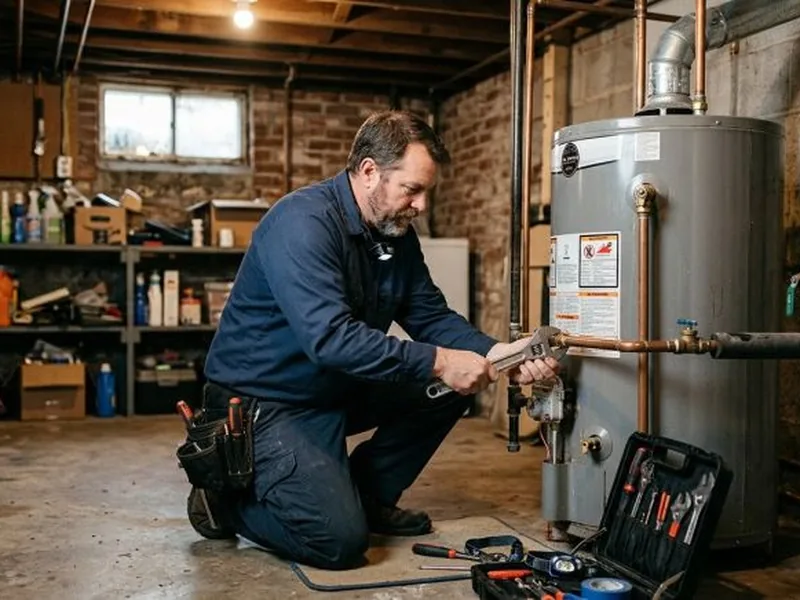
The Two-Thermostat System in Your Electric Tank
Most electric water heaters in Bellingham homes use a two-thermostat design that is elegant in its simplicity. The upper thermostat, paired with the upper heating element, has priority: when the water at the tank's top cools below the setpoint, it powers the upper element. Once satisfied, it hands power down to the lower thermostat, which drives the lower element to heat the tank's main volume. The upper thermostat also hosts the ECO — the energy cut-off high-limit switch that kills power to both elements if water temperature climbs to dangerous levels. Gas heaters consolidate this into a combination gas control valve with its own thermostat and high-limit.
Every common symptom maps to this architecture. Total loss of hot water: the upper thermostat failed or the ECO tripped. A few minutes of hot water then cold: the lower thermostat or lower element failed — the top heats, the bulk does not. Scalding water at every tap: a thermostat stuck closed, heating past the setpoint until the ECO or TPR valve intervenes. Persistently lukewarm water: a thermostat misreading temperature and cutting off early. A tripping breaker: a shorted thermostat or element. When you describe your symptom to us at (833) 713-2101, you are already halfway to the diagnosis.
Builder-Grade Tanks and the Subdivision Failure Timeline
Bellingham's 1980s-to-2000s subdivisions went up with builder-grade electric water heaters — decent tanks, installed correctly, then largely ignored. Thermostat failures in these homes follow a timeline. In the early years, everything works; sediment accumulates silently at the tank bottom. By year eight to twelve, the sediment blanket is thick enough to insulate the lower thermostat from the water, causing misreads and overheating cycles that cook the lower element and thermostat together. Electrical contacts, cycled thousands of times, pit and degrade. Moisture from the occasional damp basement corrodes terminals. Somewhere in year ten to fifteen, the symptom appears: short showers, a tripped ECO, scalding spikes.
The encouraging news for subdivision owners: the tanks themselves are often still sound when the thermostats fail, making thermostat replacement the right call rather than a new heater. We verify tank condition during every diagnosis — checking for leaks, rust, and age — so the recommendation is honest. A twelve-year-old tank with solid steel and a failed lower thermostat gets new thermostats; a fifteen-year-old tank with a rusting base gets a frank conversation about replacement. When you call (833) 713-2101, the tank's age helps us plan, but the on-site assessment decides.
Well-Water Homes: Sediment Punishes Lower Thermostats
Bellingham's rural-edge homes on private wells give thermostats a harder life. Well water here commonly carries iron, manganese, and sediment that settle relentlessly to the tank bottom, burying the lower element and thermostat far faster than town water does. A sediment-buried lower thermostat cannot sense water temperature accurately — it reads the superheated pocket around the element instead — so it cycles erratically, overheats, and fails early. We see well-water tanks needing lower thermostat attention years before their town-water counterparts.
The defense is maintenance, not resignation. Annual tank flushing — draining several gallons through the drain valve — carries sediment out before it becomes a blanket. A sediment pre-filter on the water line reduces the incoming load. And when we replace thermostats on a well-water tank, we flush as part of the job and set a maintenance rhythm: the new thermostats will last dramatically longer in a flushed tank than in a sediment tomb. If your Bellingham well-water heater is delivering shorter and shorter showers, the lower thermostat is likely crying for help under inches of sediment. Call (833) 713-2101 before it takes the element with it.
Scalding Water: The Symptom to Take Seriously
Of all thermostat failures, the stuck-closed thermostat producing scalding water demands the fastest response. Water at 140 degrees scalds in seconds; at 150, in under two seconds. Children and older adults are most vulnerable, and in a household with both, a stuck thermostat is a genuine safety hazard. The ECO high-limit should trip as backup, and the TPR valve should weep if pressure climbs — but safety devices are backups, not plans.
If your Bellingham taps deliver scalding water, check the temperature with a thermometer and call (833) 713-2101 promptly. Until we arrive, avoid drawing hot water unattended and supervise children's tap use. Do not keep resetting a tripped ECO to buy time — each reset while the fault continues risks overheating the tank. When we arrive, we will identify whether the thermostat is stuck, miscalibrated, or whether the gas control valve (on gas units) is at fault, replace the failed component, set everything to 120 degrees, and verify stable temperature at the taps. Scalding water is the one thermostat symptom where waiting is never the right call.
Our Diagnosis and Replacement Process
We test before we replace, because elements and wiring mimic thermostat failures. The visit begins with your symptom story and a tap-temperature measurement. Power goes off at the breaker and is verified dead with a meter. Access panels and insulation come off, exposing both thermostats; we inspect for scorched terminals, corrosion, moisture, and swollen components. Each thermostat gets multimeter testing for continuity and correct switching behavior; elements are tested too, since a dead element produces the same short-shower symptom as a dead lower thermostat. The ECO's condition is noted, and the tank gets an overall assessment — leaks, rust, age — because thermostat replacement on a dying tank is money misspent.
Replacement is careful work: wires photographed or labeled, old units unclipped, matched new thermostats installed (we usually do the pair on older tanks — the survivor is rarely far behind), connections secured, insulation and panels restored. Both set to 120 degrees. The tank is confirmed completely full before power returns — dry-firing an element destroys it in seconds. Then verification: correct heating sequence, clean shutoff at setpoint, stable tap temperature over a full cycle. On gas units, the combination gas control valve is replaced with proper gas-connection procedure and leak testing. Most Bellingham thermostat jobs finish in one visit.
Making the New Thermostats Last
The replacement is the midpoint, not the end. To protect the new thermostats: flush the tank annually (more often on well water) to prevent the sediment burial that killed the old lower unit; keep the temperature at 120 degrees — higher settings accelerate wear, bake sediment harder, and raise scald risk; keep the mechanical area dry, since moisture behind access panels corrodes terminals; and have the electrical connections checked, as loose wiring in the panel pits thermostat contacts through arcing and voltage fluctuation. For subdivision homes, put tank flushing on the same calendar as the furnace filter. For well-water homes, add the sediment pre-filter and consider the water's mineral load in the maintenance interval.
We also teach the early-warning signs so the next failure gets caught at the symptom stage: showers shortening, water hotter than the setting, the ECO tripping even once. A thermostat replaced at the first symptom is a quick, clean job; one left until it destroys the element costs more and risks the tank. When Bellingham homeowners call (833) 713-2101 at the first sign, we keep it simple and inexpensive.
What Happens When You Call (833) 713-2101
Call the Water Heater Leak Repair Crew from Bellingham and describe the symptom — no hot water, short supply, scalding, lukewarm, tripped breaker — plus whether the heater is electric or gas and roughly how old. Mention town water or well; it changes our maintenance advice. Hot-water loss and scalding get priority scheduling. On site we diagnose completely: symptom history, temperature check, panel inspection, electrical testing of thermostats and elements, tank condition assessment. You will hear the diagnosis before any replacement is discussed, and an honest read on whether the tank itself warrants the investment. Most jobs complete in one visit with thermostats set to 120 degrees and verified. One call to (833) 713-2101 brings Bellingham's thermostats — and hot water — back to proper working order.